

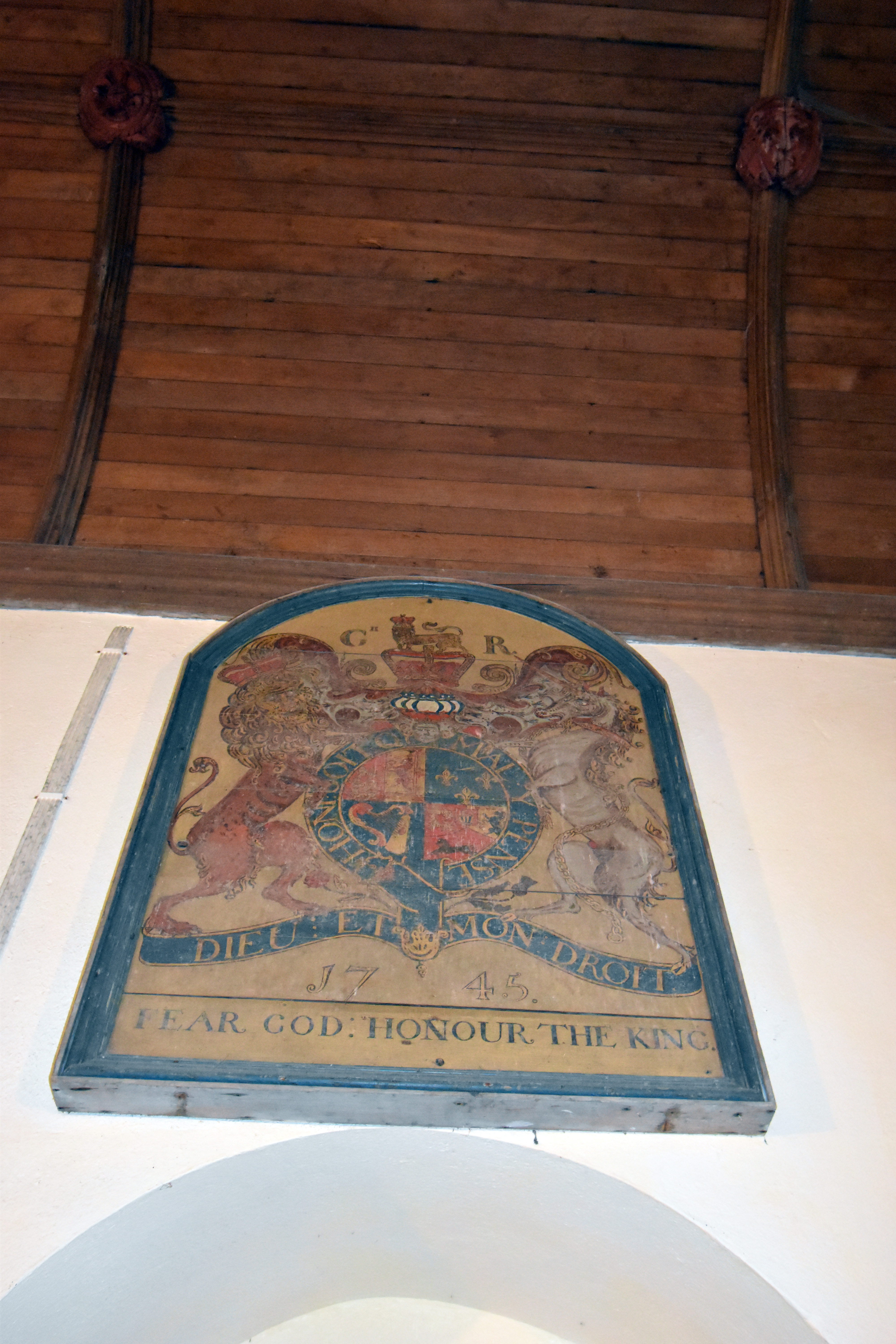
Above the south door of St Peter’s hangs the Royal Coat of Arms dated 1745, a reminder of a moment when loyalty to the Hanoverian monarchy was far from a formality. The date places it squarely in the year of the Jacobite Rising, when Charles Edward Stuart – Bonnie Prince Charlie – led his attempt to reclaim the throne for the exiled Stuart line. Across the country, parish churches were expected to make clear where their allegiance lay, and the display of the royal arms of George II was a public declaration of support for the reigning Hanoverian king. In remote rural parishes such as Buckland‑in‑the‑Moor, this was not simply decoration but a visible statement of political and religious loyalty at a time when the outcome of the rebellion was still uncertain.
The board itself is painted over an earlier set of arms from the Restoration period, a reminder that these symbols were periodically renewed to reflect the shifting political landscape. By 1745, the Hanoverian succession was still relatively young, and the government was keen to reinforce its legitimacy. Churches played their part by displaying the royal arms prominently, often above the main entrance where every parishioner would see them on entering and leaving the building.
Above the Royal Coat of Arms you can see several of the carved roof bosses that decorate the underside of the tower arch. These bosses are thought to date from the late medieval period and form part of the church’s original Perpendicular work. Three of them have long been said to represent Henry VIII, Anne Boleyn and Thomas Cranmer, a tradition that would place them in the early 1530s. Whether this identification is accurate is uncertain, but the faces do have a Tudor character, and the surrounding bosses include Tudor roses that support a date somewhere around the turn of the sixteenth century. It is more likely that they were carved slightly earlier, perhaps in the reign of Henry VII, when the tower was built or rebuilt, but the exact chronology has been lost to time.

