

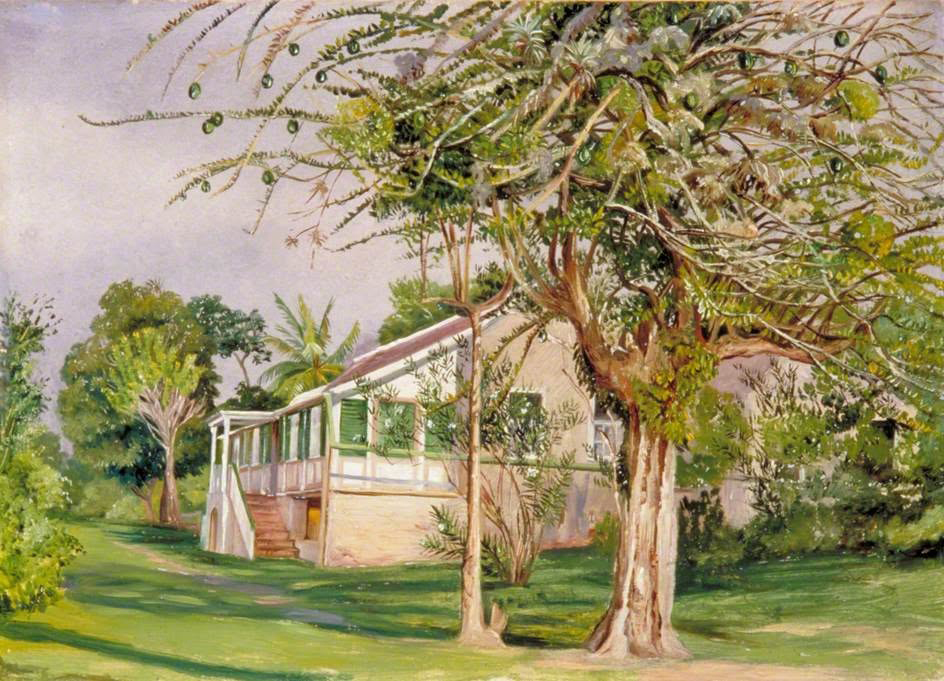
Bermuda Mount appears today as little more than a name on an old map of Jamaica, but in the nineteenth century it was one of the upland retreats favoured by British officers seeking relief from the heat and humidity of the coastal plain. Elevated ground, moving air and distance from the mosquito‑ridden lowlands made such places attractive to Europeans posted to the island. It was here, in 1877, that Captain Hugh Allen Markey of the Royal Artillery died at the age of thirty‑seven while serving as Brigade Major to the forces in Jamaica. His memorial in Heavitree preserves the bare facts of his career, but the location of his death hints at the wider story of imperial service in a climate that was often unforgiving.
Jamaica had long been one of Britain’s most strategically important possessions in the Caribbean. Its defence rested on a network of forts, coastal batteries and inland redoubts, all of which required trained artillerymen to maintain and operate the guns. Officers of the Royal Artillery were responsible not only for the technical aspects of gunnery but also for the organisation of the small garrison scattered across the island. As Brigade Major, Markey would have been involved in coordinating drills, inspections, communications and the movement of detachments between posts. It was a role that demanded both administrative skill and physical endurance, and it was carried out in an environment where yellow fever, malaria and dysentery were constant threats.
Bermuda Mount itself was one of several hill stations used by British personnel in the nineteenth century. These upland sites were chosen for their healthier air and their relative isolation from the diseases that ravaged the lowlands. Officers often lived or recuperated in such places while remaining within reach of their duties. That Markey died there strongly suggests illness rather than accident or violence, a fate shared by many soldiers serving in the West Indies. The British Army’s own statistics for the period show that disease killed far more men than any enemy action, and Jamaica was regarded as one of the most hazardous postings in the empire.
What gives Bermuda Mount an additional layer of interest is its appearance in the work of Marianne North, the celebrated Victorian botanical artist whose paintings now fill a dedicated gallery at Kew Gardens. North travelled widely in the 1870s, visiting Jamaica in 1871–72 and producing a series of landscapes and botanical studies. Her painting of Bermuda Mount, now in the Marianne North Gallery at Kew, shows a lush hillside scene rendered in her distinctive, vivid style. It captures the mixture of beauty and isolation that characterised many of the island’s upland settlements.
North’s life was as remarkable as her art. Born in 1830 into a prosperous and politically connected family, she trained initially as a singer before turning to painting after her voice failed. Following the death of her father in 1869 she devoted herself to travelling and documenting the flora of distant countries. Her journeys took her across the Middle East, North America, the Caribbean, Brazil, India, Japan, Borneo, Australia, New Zealand, the Seychelles and Chile. The scientific accuracy of her work, produced before photography became practical for field use, gives it lasting value. Her gift to Kew of hundreds of paintings, along with the gallery to house them, remains one of the great artistic legacies of the Victorian age.
It is possible that North and Markey were in Jamaica at roughly the same time, although there is no evidence that they met. What can be said with certainty is that both encountered Bermuda Mount during the 1870s, one as a military posting and the other as a subject for landscape painting. The location was attractive for its elevation and climate, but Jamaica as a whole remained hazardous for Europeans in the era before effective treatments for tropical diseases.

