

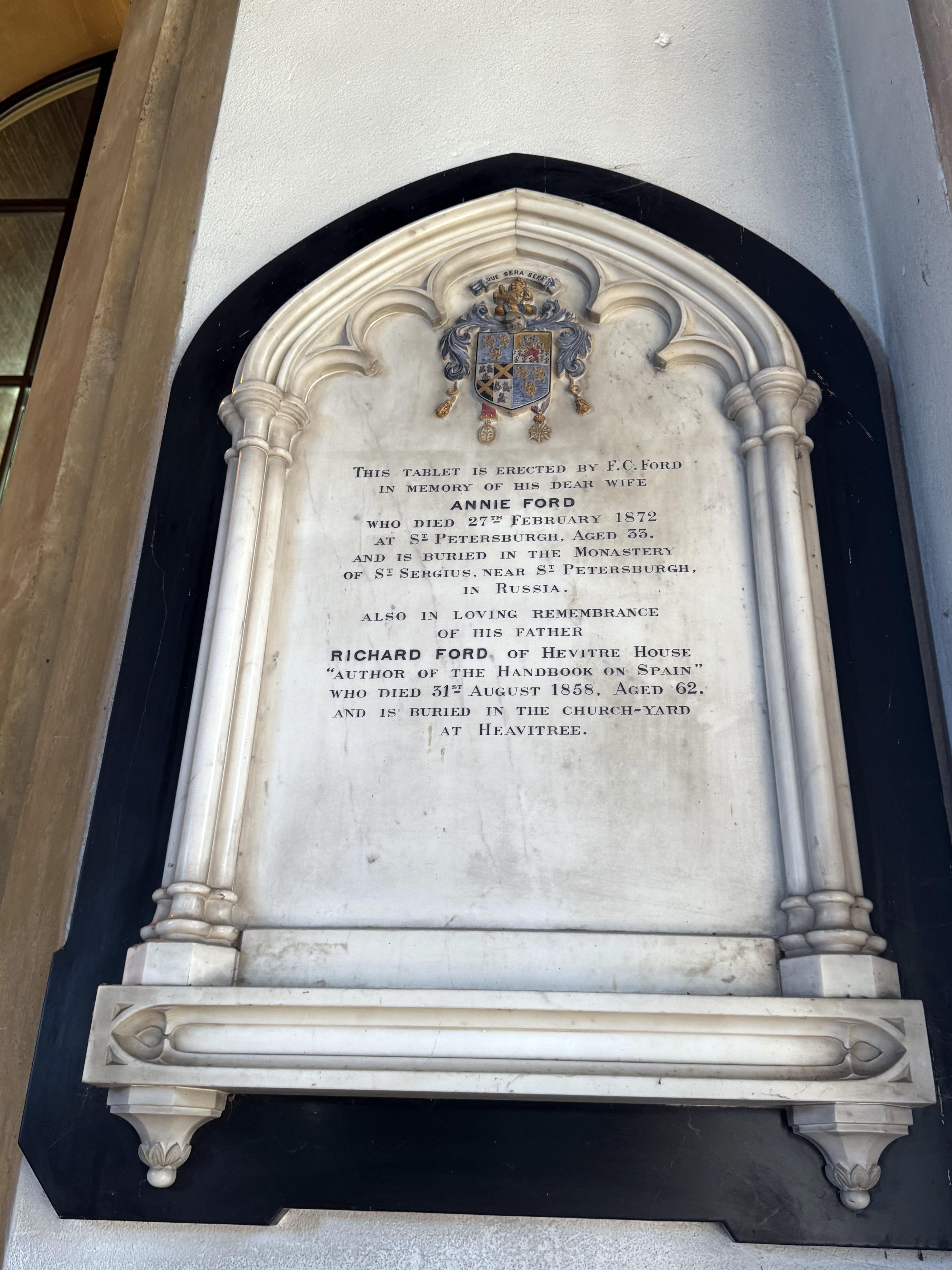
Annie Ford, born Annie de Garofalo in Naples, was the daughter of the Marqués de Garofalo, a member of the lower Neapolitan aristocracy whose family held minor court appointments under the Bourbon monarchy before Italian unification. The Garofalo household belonged to the broad stratum of titled families whose influence rested on historic privileges, administrative duties and proximity to the royal court rather than on large territorial estates. Annie grew up within the social circles frequented by foreign diplomats, merchants and military officers, and it was in this environment that she encountered the young British diplomat Francis Clare Ford. Their marriage in 1857 linked a Neapolitan noble house with the expanding diplomatic world of mid‑Victorian Britain.
Sir Francis Clare Ford was born in 1828 and educated at Eton before entering the Foreign Office in 1849. His early postings took him to Buenos Aires and Rio de Janeiro, where British commercial and political interests were expanding rapidly. He later served in Madrid and Constantinople, gaining experience in the diplomatic complexities of southern Europe and the Ottoman Empire. By the late 1860s he had been appointed to the British mission in St Petersburg during the reign of Alexander II, a period marked by reform, political tension and periodic outbreaks of disease. Annie accompanied him to Russia, and it was there, in 1872, that she contracted cholera and died. Her death occurred during one of the most demanding phases of Ford’s career, and she was buried in St Petersburg while Ford continued his diplomatic service abroad.
Annie’s father, the Marqués de Garofalo, belonged to the minor nobility of Naples. Although not one of the great magnates of the kingdom, the Garofalo family held court connections and administrative responsibilities typical of the Neapolitan aristocracy. The marquessate itself was characteristic of the region, where numerous titles were attached to estates or historic privileges rather than to large territorial holdings. His position ensured that Annie moved in circles where foreign diplomats were common, making her marriage to Francis Clare Ford both socially appropriate and strategically advantageous for both families during the political upheavals of the mid‑nineteenth century.
Annie and Francis had one son, John Gorman Ford, who entered the diplomatic service and continued the family’s association with foreign postings and international affairs. His career reflected the pattern of Victorian and Edwardian diplomatic families in which sons frequently inherited both the connections and expectations of their fathers. Annie’s death in St Petersburg left Ford a widower, and he later resumed his career with senior postings as Minister to Venezuela (1877–1884), Greece (1884–1888) and Spain (1888–1892). He was knighted in 1886, retired in 1893 and died in 1899.
Annie Ford’s life therefore forms part of a wider diplomatic narrative: a Neapolitan noblewoman whose marriage carried her across continents, whose movements followed the shifting priorities of British foreign policy, and whose death in St Petersburg illustrates the hazards faced by diplomatic families in an age when disease travelled as readily as the empires they served.
The marble memorial tablet in St Michael and All Angels Church, Heavitree, records that Annie Ford died on 27 February 1872 at St Petersburg, aged 33, and was buried in the Monastery of St Sergius near the city. The tablet was erected by her husband, Sir Francis Clare Ford, and also commemorates her father, Richard Ford of Heavitree House, author of The Handbook for Spain , who died on 31 August 1858 aged 62 and was buried in the churchyard at Heavitree. The memorial bears the Ford family coat of arms and forms part of the nineteenth‑century group of tablets within the church.

