

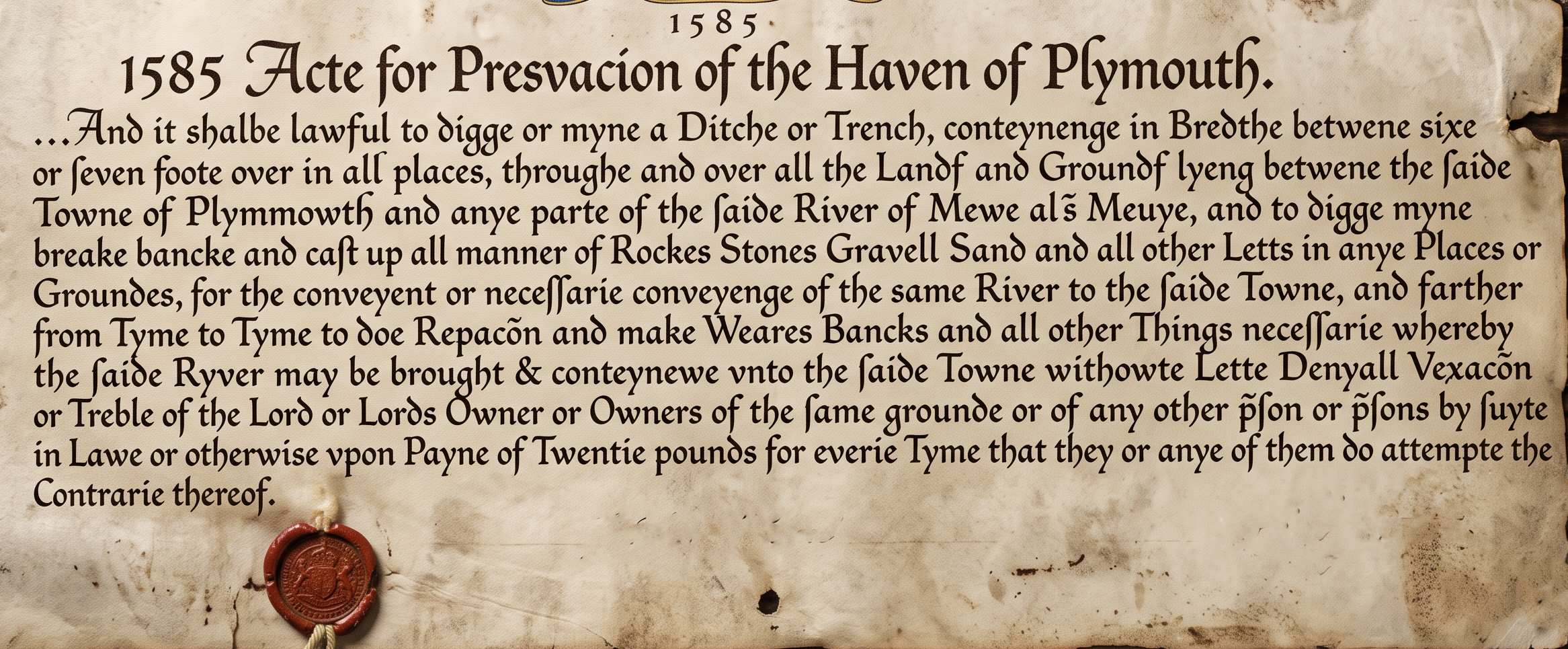
The Acte for Presvacion of the Haven of Plymouth, passed in the parliamentary session of 1584–85, is the legislative foundation for the construction of Drake’s Leat. It was introduced to address long‑standing problems affecting Sutton Harbour and the town’s water supply. Tin‑streaming on Dartmoor washed large quantities of sand and silt downstream, choking the harbour and threatening its usefulness for naval and merchant shipping. Plymouth also lacked a dependable source of fresh water for firefighting and for the growing demands of its population and industries. The Act provided the legal authority to bring water from the River Meavy to the town and to undertake the works necessary to maintain the harbour.
The Act’s most important clause authorised the digging of a continuous watercourse from the Meavy to Plymouth. The original wording survives and sets out the powers granted to the Mayor and Commonalty of Plymouth. It is reproduced here exactly as written:
“to digge or myne a Ditche or Trench, conteynenge in Bredthe betwene sixe or seven foote over in all places, throughe and over all the Landf and Groundf lyeng betwene the saide Towne of Plymmowth and anye parte of the saide River of Mewe als Meuye, and to digge myne breake bancke and cast up all manner of Rockes Stones Gravell Sand and all other Letts in anye Places or Groundes, for the conveyent or necessarie conveyenge of the same River to the saide Towne, and farther from Tyme to Tyme to doe Repacon and make Weares Bancks and all other Things necessarie whereby the saide Ryver may be brought & conteynewe vnto the saide Towne withowte Lette Denyall Vexacon or Treble of the Lord or Lords Owner or Owners of the same grounde or of any other pson or psons by suyte in Lawe or otherwise vpon Payne of Twentie pounds for everie Tyme that they or anye of them do attempte the Contrarie thereof”
The Act’s provisions at first reading were practical and aimed at improving Plymouth’s infrastructure and maritime security. The first provision was to provide an adequate supply of water for naval and merchant shipping using the harbour. Fresh water was essential for victualling ships, supporting crews and maintaining Plymouth’s role as a strategic port. The second provision was to improve poor quality land over which the leat passed by irrigation. Water diverted across the manors and commons between Meavy and Plymouth could revive pasture and increase agricultural productivity. The third provision was to provide water for firefighting. Plymouth’s timber‑built houses were vulnerable to fire, and a reliable supply of water was a civic necessity. The fourth provision was to scour Sutton Harbour. The continual flow of water from the leat was intended to flush out the sand and silt washed down from Dartmoor, preserving the harbour’s depth and usefulness.
These provisions show that the Act was conceived as a broad public measure rather than a private scheme. It addressed shipping, agriculture, public safety and harbour maintenance. Only later, through Drake’s parliamentary intervention, was milling added as a fifth provision. The Act therefore represents the Tudor government’s recognition of Plymouth’s strategic importance and its need for improved water management. Without this legislation the leat could not have been built, and Plymouth’s development in the late sixteenth and early seventeenth centuries would have been markedly different.
Note the above image is not the original but an artistic representation of it.

