

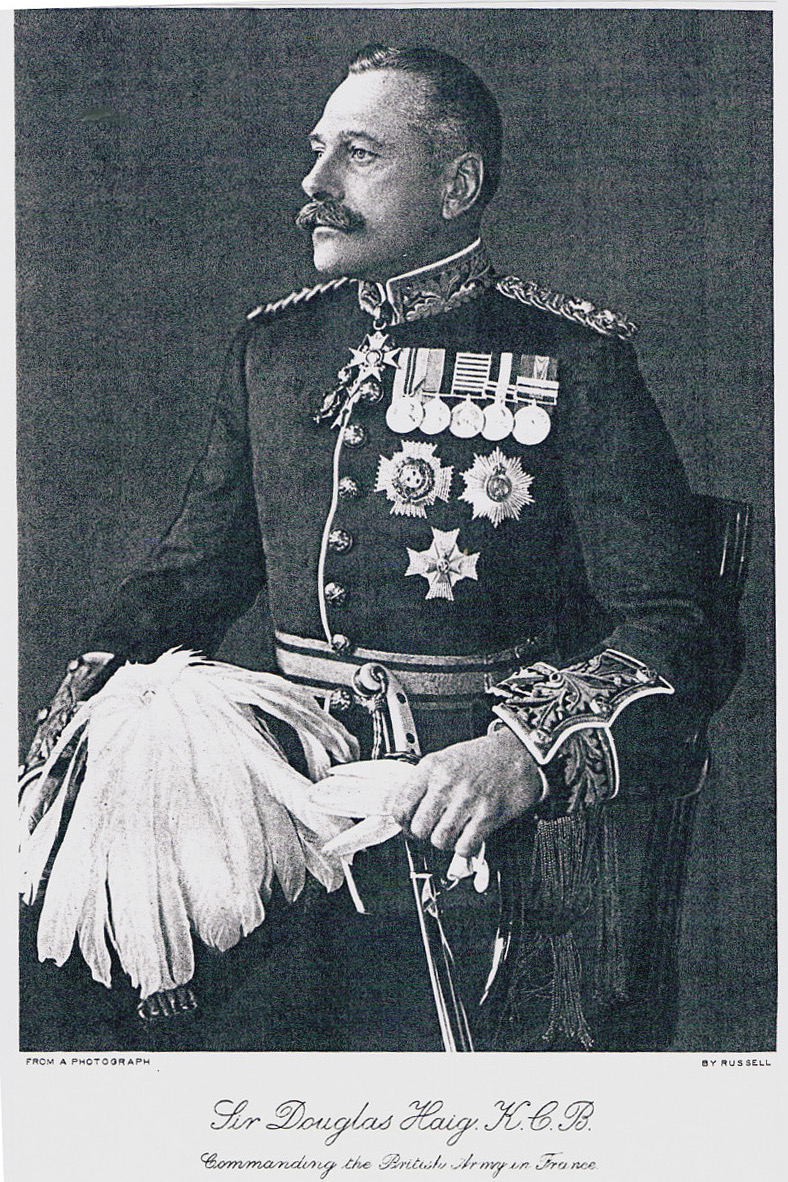
Douglas Haig was born in Charlotte Square, Edinburgh on 19 June 1861, the son of John Haig, whisky distiller. His mother was Rachel Mackerras Veitch who gave birth to eleven children. The family lived at Haig House, Windygates, Fife. Douglas was educated at Clifton College and went up to Oxford (Brasenose) in 1880, where he excelled at polo. He went to Sandhurst in January 1884 and was commissioned as a lieutenant into the 7th Hussars on 7 February 1885.
1885 Lieutenant, 7 Feb
1888 Adjutant, 7th Hussars, 25 Jul – 24 Jul 1892
1891 Captain, 23 Jan
1898 Seconded to the Egyptian Army, 28 Jan – 29 Sep
1898 Brevet Major, 16 Nov
1899 Deputy Assistant Adjutant General, South Africa, 9 Oct
1899 Major, 26 Jul
1900 Assistant Adjutant General, South Africa, 20 Feb – 16 Jul
1900 Brevet Lieutenant-Colonel, 19 Nov
1901 Lieutenant-Colonel, 17th Lancers, 18 Jul
1902 Brevet Colonel, 22 Aug
1903 Colonel, 30 Oct
1904 Major-General, 1 May
1909 Chief of General Staff, India, 22 Oct – 20 Feb 1912
1910 Lieutenant-General, 31 Oct
1912 General Officer Commanding Aldershot Command, 1 Mar
1912 Colonel of 17th Lancers, 14 May
1914 Commanded 1st Army Corps in the BEF, 15 Aug
1914 General, Dec
1915 Commander-in-Chief, BEF
1917 Field Marshal, Commander-in-Chief, Jan
1919 Colonel of the Royal Horse Guards (The Blues), 23 Jul
1919 Created Earl Haig, 19 Oct
1928 Colonel of the King’s Own Scottish Borderers, 24 Sep
Haig was posted to India, serving as a cavalry officer. He was in the Mahdist War in the Sudan in 1898, posted to the Egyptian Army, and served under Major-General French in the Boer War. He reached the rank of major-general in May 1904 at the age of forty-two. He was in Britain in 1905, responsible for military training, and was instrumental in the creation of the Territorial Army in 1908. In 1909 he was appointed Chief of the Imperial General Staff, providing military training throughout the British Empire.
In the First World War he went out to France with the BEF in August 1914 and by the time of the Somme offensive in 1916 he was in command of five armies totalling 1.5 million men. He famously ordered the First and Second Armies to fight to the last man in April 1918. After the war he came under criticism for sacrificing soldiers’ lives without compassion. However, he devoted his time to the welfare of ex-servicemen, and was a founder and president of the British Legion, as well as the British Legion Scotland, established in 1921. He also established the Earl Haig Fund, the origin of the sale of poppies for Remembrance Day.
Douglas Haig was a major-general when he married the Hon Dorothy Maud Vivian on 11 July 1905. She was the daughter of Hussey Crespigny Vivian, 3rd Baron Vivian of Glynn and Truro. The wedding was in the private chapel of Buckingham Palace. They had four children, three daughters and a son, and the family home was at Bemersyde, Roxburghshire, where he died of heart failure on 29 January 1928. He was given a grand state funeral after his body lay in state in St Columba’s Church, a service in Westminster Abbey, and a train journey to Edinburgh where his coffin lay in state once more at St Giles’ Cathedral for three days before burial at Dryburgh Abbey. An equestrian statue of Earl Haig stands in Whitehall.

