

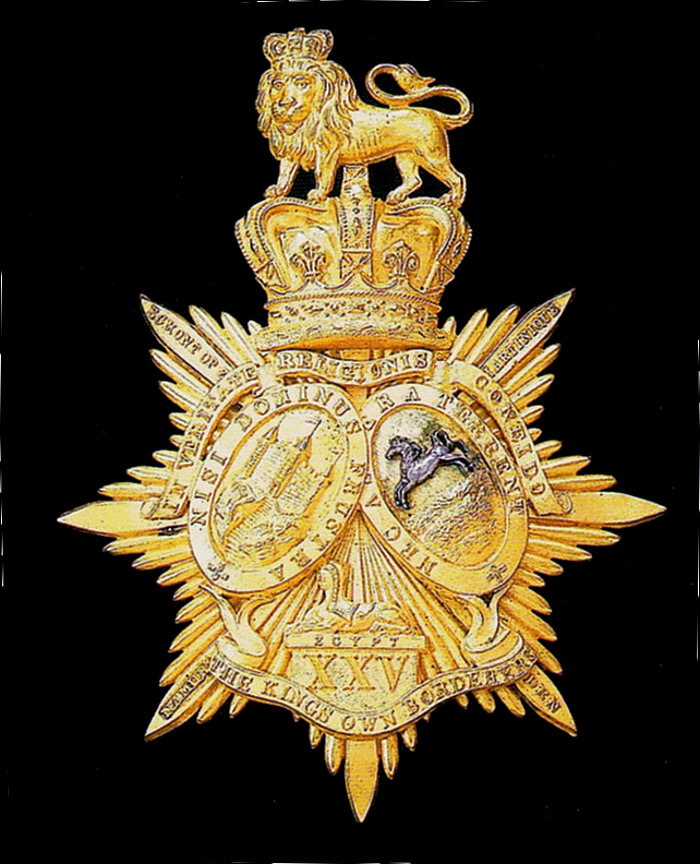
The introduction of a new pattern shako for the infantry in 1844 brought with it a redesigned gilt star plate for the front. The basis was the universal star which, for most regiments, carried a Victorian crown at the top. For the 25th King’s Own Borderers, however, the Royal Crest occupied this position. King George III had conferred Royal status on the regiment in 1805, permitting them to incorporate the Royal Crest into their badges and Colours.
The two central ovals display the castle of Edinburgh on the left, with the motto Nisi Dominus Frustra. This emblem was authorised for the regiment in March 1832, the motto also being that of the City of Edinburgh. The right-hand oval contains the silver prancing White Horse of Hanover with the motto Nec Aspera Terrent. Above the ovals, on a three‑part scroll, is the regimental motto In Veritate Religionis Confido, dating from 1805.
Five battle honours appear on the plate. Four are placed on the longer rays of the star: ‘Egmont Op Zee’ and ‘Martinique’ on the upper rays, and ‘Namur’ and ‘Minden’ on the lower rays. Although Namur was not officially a battle honour at the time, it was retrospectively awarded to fourteen regiments, including the 25th (KOSB), in 1910. The fifth honour is the Sphinx with ‘Egypt’, positioned near the base of the plate just above the Roman numeral XXV and the title ‘The King’s Own Borderers’.
