

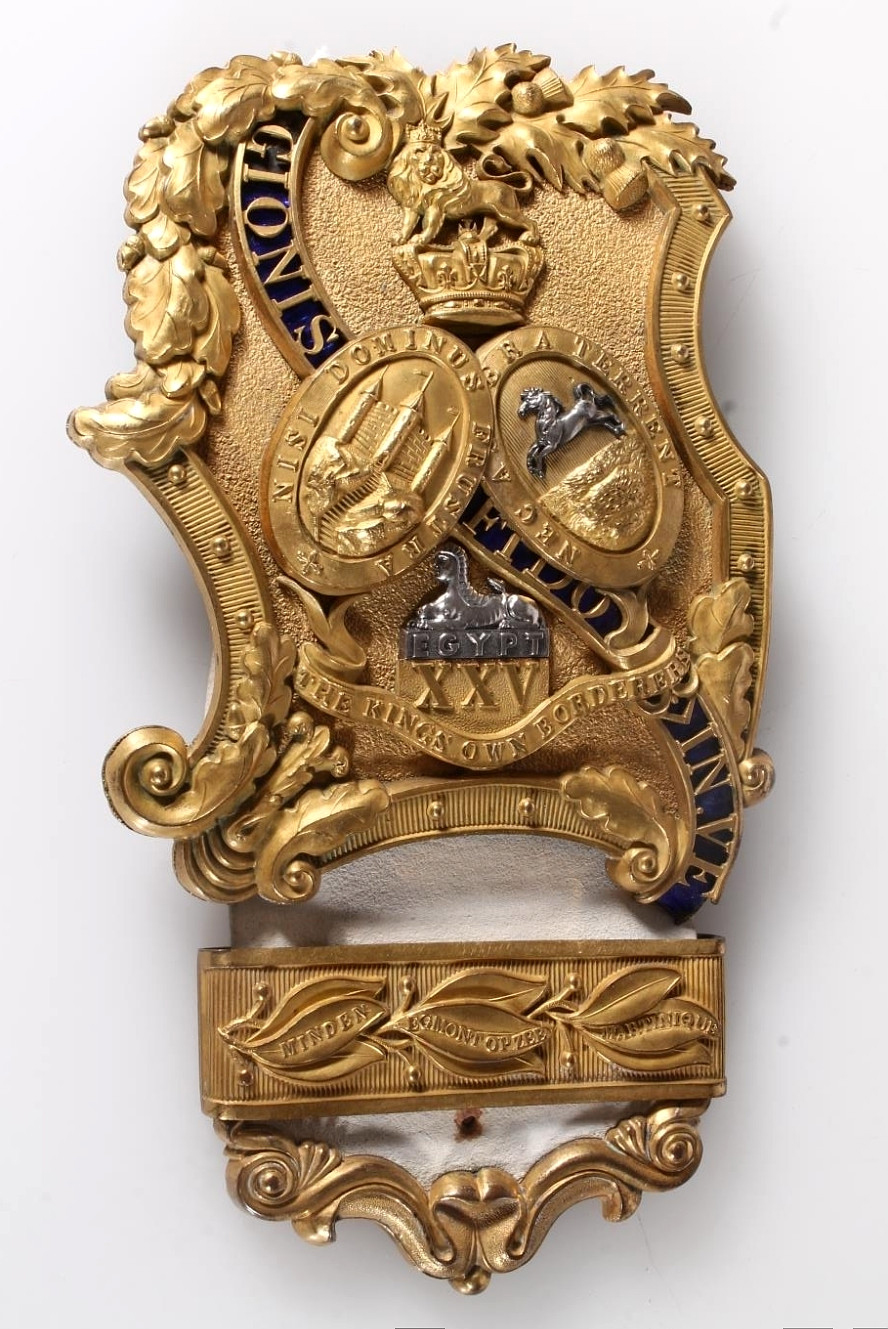
This asymmetrical rococo-style design was also used for the belt plates of the Royal Fusiliers and the 59th Regiment, and was adopted by several regiments of the East India Company, including the 12th Bombay Native Infantry. Officers of the 25th King’s Own Borderers wore this elaborate arrangement of symbols and mottos, together with a slide and tip. The slide is decorated with laurel and incorporates three battle honours: MINDEN, EGMONT OP ZEE and MARTINIQUE. Namur does not appear on this plate, although it was present on the shako plate.
The Castle of Edinburgh appears within an oval surrounded by the motto Nisi Dominus Frustra. The castle is shown on a craggy rock approached by a long flight of steps, an image familiar to anyone who has climbed to the castle on foot. This emblem was added to the regiment’s badge in March 1832, recalling its raising in Edinburgh in 1689.
The other oval pays homage to the House of Hanover, bearing the silver White Horse and the motto Nec Aspera Terrent. Above the ovals is the Royal Crest, granted by King George III in 1805. Below them is a silver Sphinx with Egypt on the tablet. The upper part of the plate features a sweep of oak leaves and acorns on the left, and thistles across the top.
The regimental motto appears on a blue enamelled band that winds from top left to bottom right. Curiously, it is partially obscured by the ovals and oak leaves, so that it reads GIONIS FIDO INVE, but it is intended to be In Veritate Religionis Confido. Beneath the Roman numeral XXV is the title ‘The King’s Own Borderers’. This title was used from 1805 until 1887, when ‘Scottish’ was added.
