

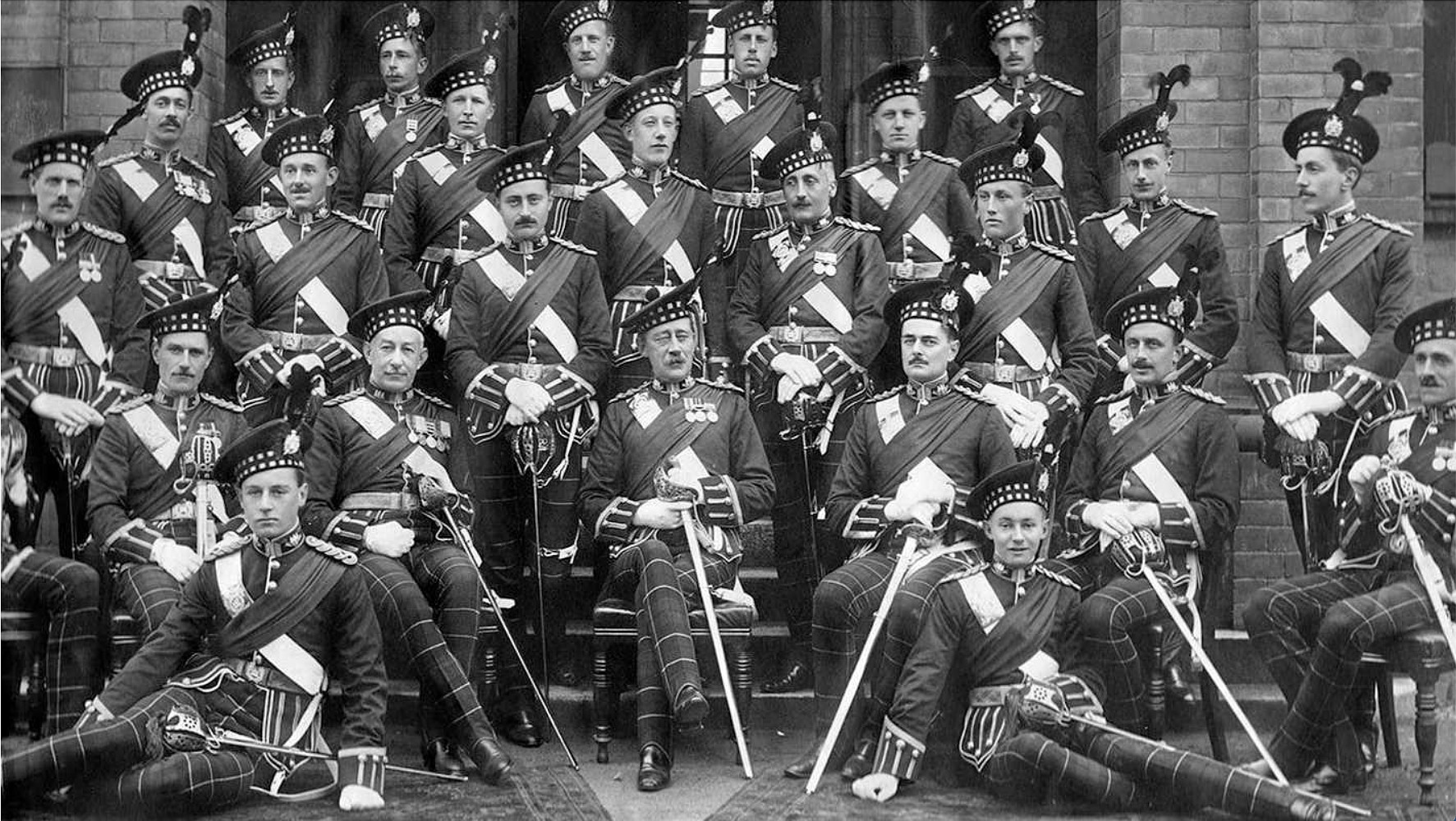
The officers in this group belong to the 2nd Battalion, photographed in Dublin in 1914. The dress uniform consists of a scarlet doublet with blue facings and gold lace, Leslie tartan trousers (or trews) and the Kilmarnock bonnet cocked. Unlike the NCOs and rank-and-file, they do not have chin-straps on the bonnet.
They have Highland-style crimson silk sashes on their left shoulder and white leather shoulder-belts on the right shoulder. Infantry officers in English regiments, from 1902, wore their sash around the waist and slung their swords from a hidden waist-belt. The swords of these officers, slung from the shoulder-belt, are Scottish broadswords (claymores). However, the three officers seated in the centre of the photo have straight infantry swords which were carried by mounted infantry officers.
The central figure is the commanding officer of the 2nd Battalion, Lieutenant-Colonel Cecil Macdonald Stephenson who had served in the South African War in the 1st Battalion, and in Burma in 1889. The second-in-command is 48-year-old Major Alfred Edward Haig, seated to the left of the CO. He was in command of soldiers who were provoked into firing on a stone-throwing mob in Dublin in 1913. The figure to the right of the CO is Captain Rupert Cholmeley Yea Dering, adjutant since 26 Aug 1912. He was killed in the fighting on Hill 60 in April 1915.
Another recognisable officer is Major Chandos Leigh DSO in the top left of the picture with a row of medals, including the DSO cross. He earned the decoration for his services in the Boer War, in 1901, after which he had been on secondment to the Egyptian Army for 10 years. He was with the battalion in the retreat from Mons and was mortally wounded in action on the Mons-Conde Canal. He died on 29 August 1914.

