

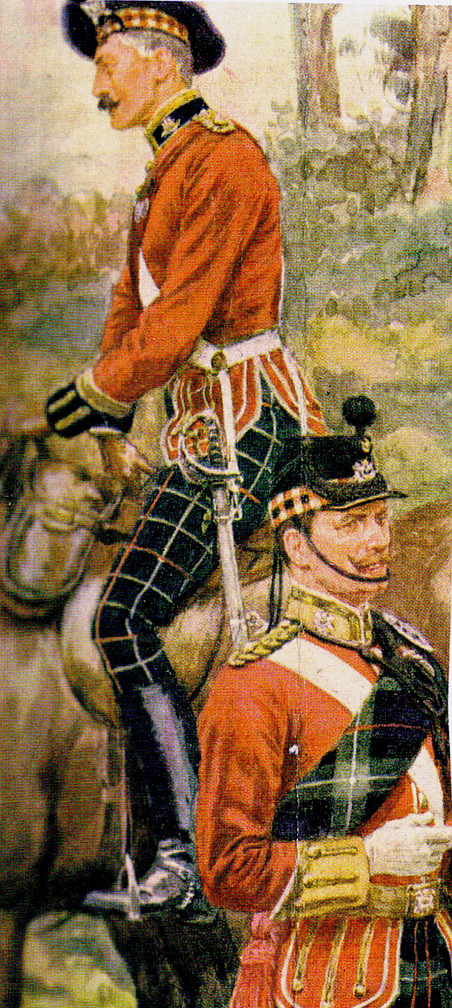
This detail from a painting of officers from different Scottish regiments shows a field officer of the KOSB in mounted order. The only officers of the regiment permitted to be mounted were the CO, the second-in-command and the adjutant. The rider’s grey hair suggests that this is the Commanding Officer. There is the suggestion of a medal but it is not clear.
The doublet is scarlet with dark blue facings and gold lace on the collar and cuffs. The cuffs have gold braid button-hole loops and gilt buttons and this is also to be seen on the Inverness skirts. After 1902 the Dress Regulations stipulated that field officers should not have gold lace edging on the Inverness skirts, or the extra line of gold lace on the cuffs. Some lieutenant-colonels were permitted to retain their pre-1902 doublets but the lieutenant-colonel in this illustration follows the 1902 Regulations.
The sword is the normal infantry sword rather than the broadsword worn by dismounted officers. The slings are attached to a shoulder-belt. This was a recent (1903) change to the method of carrying the sword in the KOSB, where previously the sword was slung from a waist-belt. The other distinction of Scottish officers was the wearing of the crimson sash on the shoulder which differed from other infantry regiments whose officers were authorised in 1902 to wear the sash around the waist.
The Leslie tartan breeches are worn with black knee boots and spurs, and the Kilmarnock bonnet appears quite large in this illustration. The figure in the foreground is an officer of the Highland Light Infantry.

