

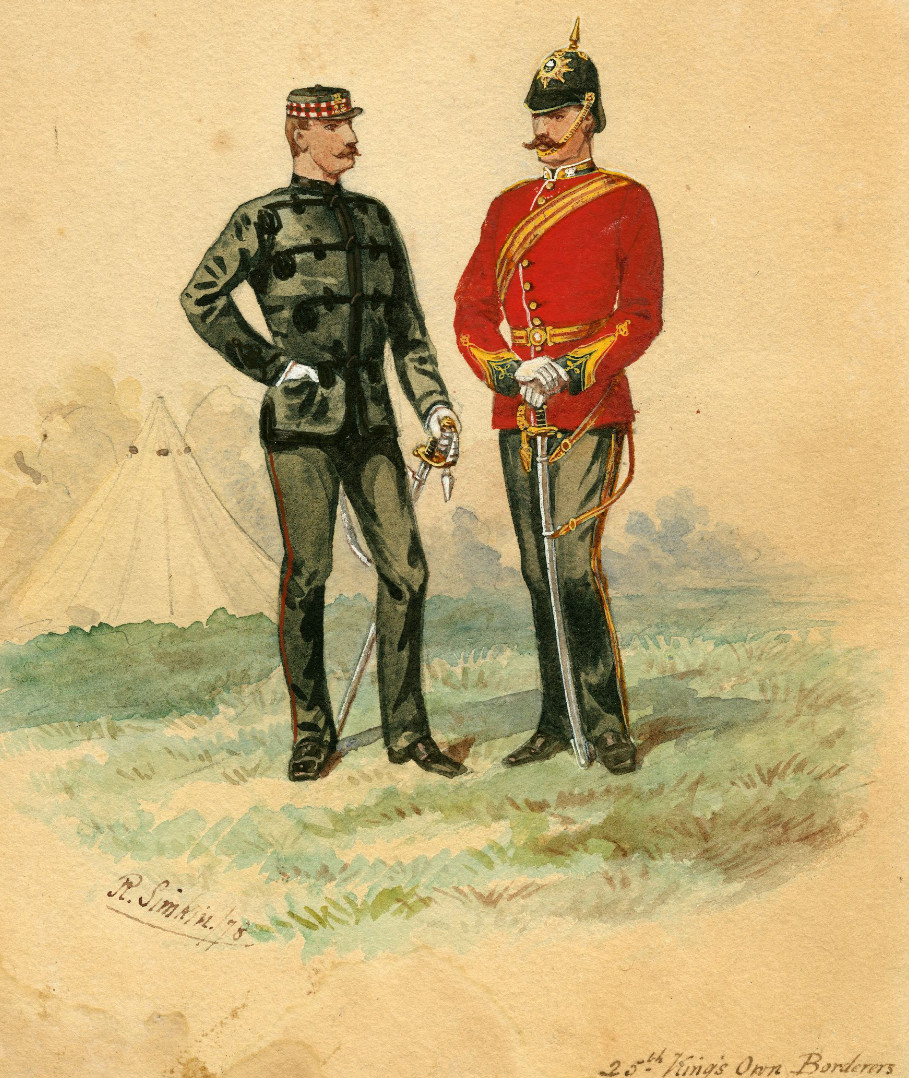
The 2nd Battalion was stationed at Aldershot in 1878, where Richard Simkin would have had the opportunity to observe the 25th King’s Own Borderers and record their uniforms. The painting of the regiment Resting on the March in 1878 was made retrospectively, but this study is contemporary, signed and dated, an early example of the artist’s work.
The lieutenant on the right is in dress uniform, scarlet tunic with blue cloth collar and cuffs. The cuffs for subalterns had half-inch gold lace around the pointed edge with gold Russia braid tracing both sides, forming a crow’s foot and eye on the blue cuff and an Austrian knot above. Distinctions of rank can be seen at Officer’s Uniform c1870. The collar is edged in white piping with half-inch gold lace inside the piping. A line of gold braid followed the base of the collar. A crown badge in silver embroidery on each side of the collar indicated the rank of lieutenant. On each shoulder there was a loop of square gold cord extending from the shoulder to the neck where it was fastened with a small regimental pattern gilt button. The front edge of the tunic was edged in white piping and fastened with eight gilt buttons (the artist has miscounted). The back skirts of the tunic had two buttons at the waist and straight vents edged in white.
The striped sash on his left shoulder was gold and crimson silk, 2.5 inches wide, ending on the right hip with a runner and tassels in gold and crimson. This was worn on state occasions and at balls and formal evenings. The waist belt is crimson Morocco leather covered with gold lace, also reserved for state occasions and balls. The sword has a gilt hilt and steel scabbard. The sword knot was gold and crimson cord with a gold acorn. The dress trousers were blue cloth with gold lace down the side that had a crimson central silk stripe. The regiment did not wear tartan trews until after 1881.
In 1878 the shako was replaced by the infantry pattern blue cloth helmet with gilt chin-chain and gilt spike on top. This was worn for home service, as hot climates required a white helmet. In 1903 the King’s Own Scottish Borderers replaced the helmet with the distinctive Kilmarnock bonnet.
While the lieutenant has a uniform that is devoid of Scottish influence, the officer in undress uniform has a forage cap that is diced in white, red and green. The badge on the front is an embroidered Royal Crest with a gilt 25 below. The straight peak was discontinued in 1881, replaced by a drooping peak.
The patrol jacket is blue cloth, edged with flat inch-wide black mohair. Across the chest are four lines of quarter-inch flat plait cording, black, and ending in drop loops. There is a figure of 8 in the middle on each side, and black netted olivets to fasten the cords, although there were hooks and eyes down the front. On each cuff there are Austrian knots formed also from flat plait cord. His trousers are blue cloth with a quarter-inch scarlet stripe down the side. His sword is attached to white slings which are linked to a webbing belt worn beneath the jacket.
The painting is from the Brown University Digital Repository:
https://repository.library.brown.edu/studio/


