

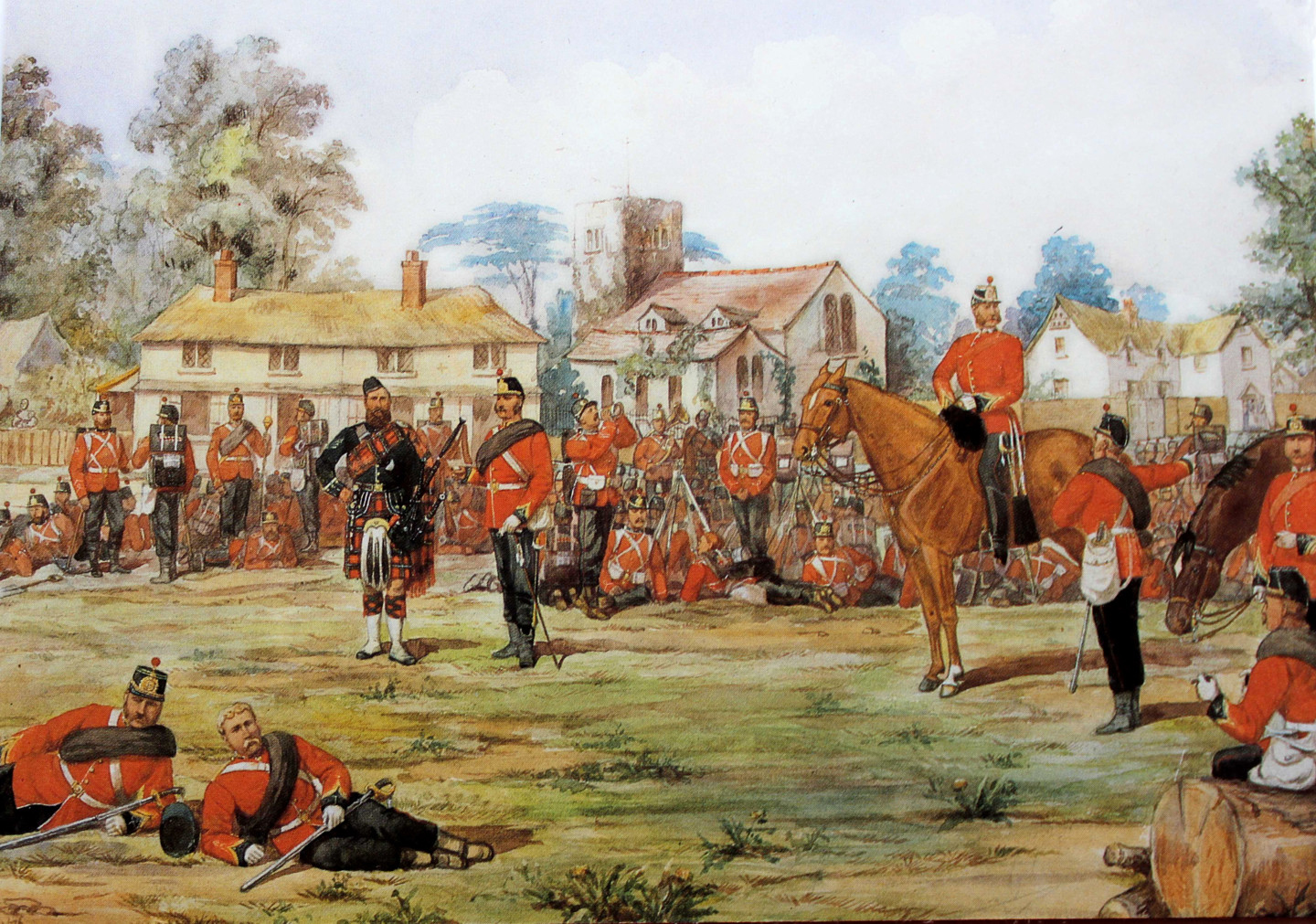
The artist Richard Simkin (1851–1926) began his career as a painter of military uniform in about 1875. The date of this picture is not known, but the style suggests that it was painted around 1898. The King’s Own Scottish Borderers were wearing Lowland Scottish uniform by that date, so Simkin was basing this scene on his research of the regiment’s uniform twenty years earlier. There is no indication as to what date the scene is supposed to represent, but the two battalions of the KOSB moved between England, Ireland and India during this period. In 1878 the 1st Battalion was in Fyzabad, Bengal, having embarked for India in October 1875 and not returning to England until 1891. The 2nd Battalion served in Ceylon and India from 1863 to 1876, and in 1878 was stationed at Aldershot. Simkin lived in Aldershot until around 1890, so would have seen the Borderers during their time there.
The battalion is shown halting at Cobham, Surrey, although none of the buildings, church included, match present‑day Cobham. The uniforms date between 1869 and 1878, the years in which this pattern of shako was worn by all ranks. The officers’ tunics have pointed cuffs, a style introduced in 1868. The officers are in dress tunics, but the men wear undress frocks which lack blue cuffs. The frock fastened with five buttons and had skirts rounded at the front. The epaulettes were red, edged white, and the collar blue. Each cuff had a white piping loop. The shakos have red ball tufts which, for a short period, were the distinction of ‘Royal’ regiments.
Prominent figures include the pipe‑major wearing Highland dress in the Royal Stewart tartan. An officer in marching order stands beside him. The mounted officer has a crown rank badge on his collar, identifying him as a lieutenant‑colonel. The 1878 Army List shows that the commanding officer of the 2nd Battalion was George Skene Hallowes, promoted to that rank on 15 July 1876. Second in command was Brevet Lieutenant‑Colonel Aylmer Spicer Cameron VC, awarded that rank on 1 October 1877.
On the left of the picture are two pioneers. The one facing the viewer has a beard and a sleeve badge which would be crossed axes. The other pioneer, with his back to us, carries a heavy load; his valise has a glengarry cap strapped to the outside, with a diced band. They do not wear the white ammunition pouches on the front of the waist‑belt seen on the other men. The drum‑major holds his mace, and beside him stands a sergeant with stripes on his left sleeve — probably an error by the artist, as another NCO near the horse’s head, with a single chevron, has no rank stripe on his left sleeve.
In the background, in front of the church, are a bandsman with a sousaphone or helicon, and another piper with his back to us. The officers in the foreground have blankets rolled and worn over the shoulder. The white shoulder straps are for the canvas haversack; there should also be a slim leather strap for the water‑bottle.
The photos are taken by kind permission from Badges and Insignia of The King’s Own Scottish Borderers by Hiram Dunn.

