

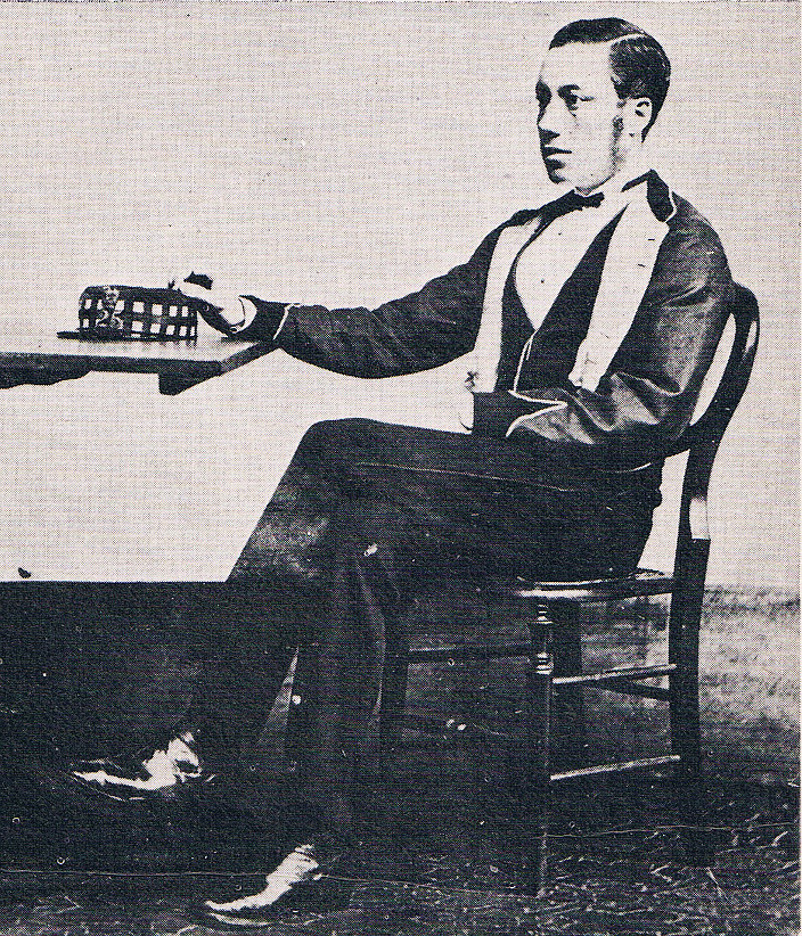
This photograph shows an officer of the 25th King’s Own Borderers in mess dress in 1865. At this date the mess jacket was simply the regulation shell jacket adapted for evening wear in the officers’ mess. Dress Regulations of 1864 describe the shell jacket as scarlet, edged white, with a rounded collar and pointed cuffs. It fastened with ten small gilt buttons of regimental pattern, with two buttons on each cuff. Rank distinctions were not worn by subalterns and captains; majors had an embroidered star on the collar, lieutenant-colonels a crown, and colonels a crown and star. When worn in the mess the collar was turned down to show the inside.
Shell jackets were worn in barracks when the men were dressed in white drill jackets. The 1864 Regulations permitted officers to wear the jacket open in the mess, with a waistcoat (blue for the 25th), shirt and tie. Winter trousers were Oxford mixture; in summer the Regulations specified “Oxford mixture Tartan serge”, both with a scarlet welt.
On the table is the officer’s undress forage cap with a diced band of red, white and green. In 1864 only four regiments were authorised to wear diced cap-bands: the 25th, 26th, 73rd and 75th. Most regiments were required to have only the regimental number embroidered on the front, but fifteen regiments were permitted to display their embroidered badge as well as the number. The cap here shows the Royal Crest badge above the figure 25. It is unclear whether the number is gilt metal or embroidery.
The photograph was published in the Bulletin of the Military Historical Society in May 1978. It was submitted by D. P. Geall, who stated that it was taken in Kandy, Ceylon, by the photographer J. Lawton. The officer is not identified, but he belonged to the 2nd Battalion, 25th King’s Own Borderers, which was stationed in Ceylon from 1863 to 1867 (the 1st Battalion being in Canada). According to the 1865 Army List the regimental depot was at Athlone. The commanding officer of the 2nd Battalion at this time was Lieutenant-Colonel Henry Torrens Walker.

