

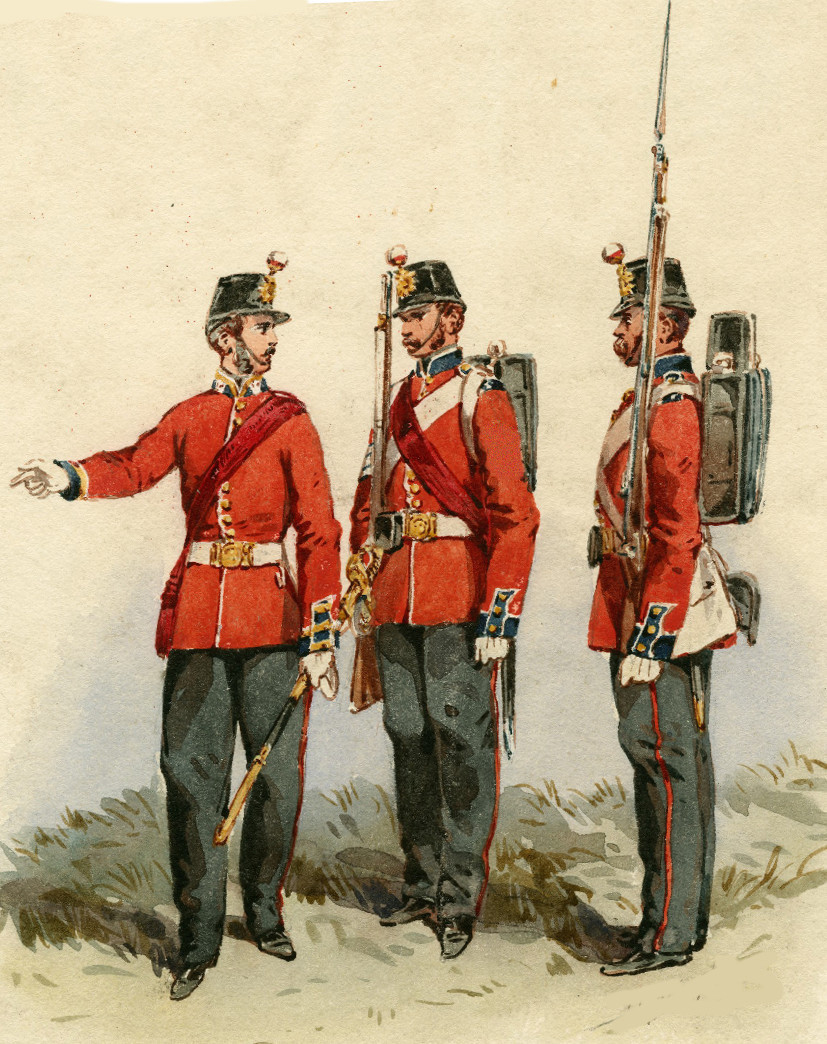
The 25th had been in India and Ceylon in the 1850s and were stationed in Gibraltar in 1860 and Malta a little later. The uniforms of the British infantry had changed radically in 1855 when the tunic replaced the tailed coatee. At first it was double-breasted but was quickly replaced by the 1857 pattern shown here. The dark blue facings can be seen on the collar, cuffs and shoulder straps.
The officer on the left has no shoulder straps, just a twisted silk crimson cord on his left shoulder to keep the crimson sash in place. He has embroidered crown badges on his gold-laced collar to denote the rank of lieutenant. Ensigns had a star rank badge (the rank of ensign was replaced by sub-lieutenant in 1871, changed to second lieutenant in 1876). The cuffs are round and have a slash flap of the same colour. There are three gilt buttons on the slash flap, and gold-laced button-hole loops. There is white edging to the flap and the cuff, and the cuff additionally had gold lace inside the white edge.
The new pattern shako introduced in 1855 was plain black felt and had a peak at the back as well as the front. The white over red ball tuft on the top was an indication that the officer and men are from a battalion company, but around this time the flank companies were abolished so the white and green ball tufts disappeared. The officer wears a white leather waist-belt to support his sword. The belt was fastened by a clasp that had a Victorian crown and 25 in the centre.
The man in the centre of the group is a sergeant, with three white chevrons on his right arm. More senior staff sergeants and sergeant-majors had gold lace stripes. He also has a crimson sash, but on the right shoulder. The slash flaps on his cuffs are blue with three brass buttons, but the artist, Orlando Norie, has omitted the white lace button-hole loops. He has a valise on his back but does not have covered mess tins on top like the private. The bayonet he has attached to his waist-belt is a 22 inch sword bayonet, noticeably longer than the 17 inch socket bayonet carried by the private.
The private is in marching order, with a valise on his back that has a folded greatcoat strapped to the outside. Mess-tins are covered and strapped to the top. He has a white canvas haversack on his left hip, slung on his right shoulder. A wide leather belt on his left shoulder supports the black ammunition pouch on his rear right hip. The small rear peak of his shako is more noticeable than on the other two figures.
All three men have Oxford mixture trousers, authorised for the winter months in the 1861 Dress Regulations. During the summer months, 1st May to 14th October, they wore dark blue trousers. In both cases the outside seam had a quarter inch scarlet welt. The 1855 DR stipulated white linen trousers for service in the Mediterranean, but this is not mentioned in the 1861 DR.

