

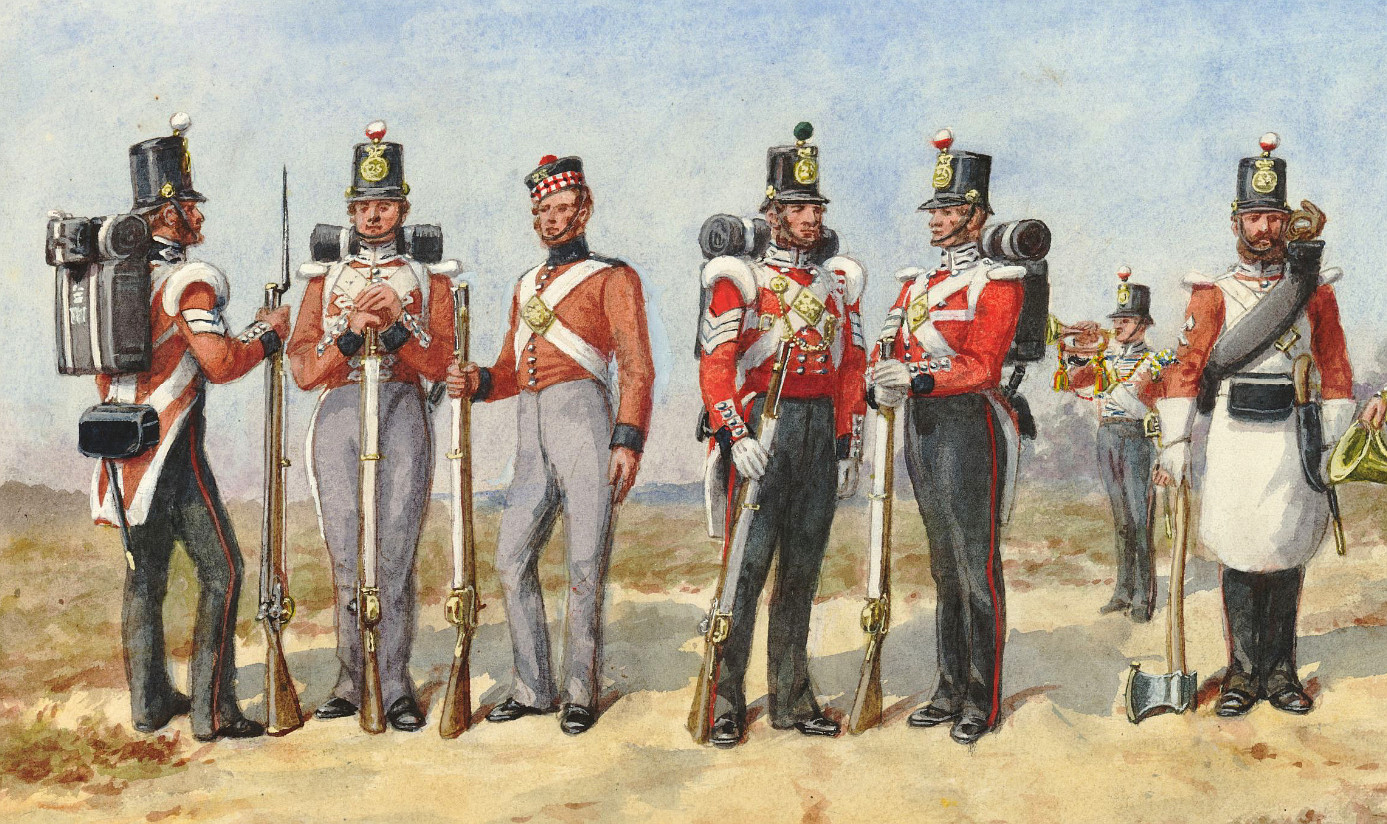
This painting is not contemporary; it was painted by Richard Simkin in 1882 and comes from the Brown University Digital Repository. But Simkin was a diligent student of the development of military uniform and these figures of the 25th King’s Own Borderers are a good representation of the range of types in the regiment before the uniform changes of 1855.
The most senior ranks here are the sergeants; one, a light company NCO and the other from a battalion company. The scarlet colour of their coatees can be compared with the duller red of the privates and corporal, being better quality. The corporal on the left is in review order and is identified as an NCO of the grenadier company by the white ball tuft in his shako and the flank company shoulder wings. The private next to him is also in review order, and is a battalion company man, having a white over red ball tuft and less prominent shoulder fringes. His tailed coatee has white lace button-hole loops across the chest. These are shown as bastion-shaped which the regiment had worn since 1768. Patterned lace had been discontinued in 1836, replaced by plain white. Cowell’s uniform details of 1831 gives most regiments ‘lace loops regular’ or ‘pairs’ but the 25th and 26th are described as having ‘plain embroidered loops, regular’.
The third figure is of interest because he has a cap that identifies him as belonging to a Scottish regiment. It is an undress forage cap, known as a Kilmarnock, but not like the large cap worn in dress uniform after 1903. The dicing was red white and green, with a brass 25 just above it. The man is a private, wearing an undress shell jacket which has a plain blue collar and cuffs, and no lace. The trousers worn by both privates are pale grey. The 1846 Dress Regulations for officers describe the trousers, which would have been comparable with other ranks, and say this:
‘Trousers — from the 15th of October to the 30th of April, Oxford mixture cloth, with a scarlet welt down the outer seam: from the 1st of May to the 14th of October, Grey Tweed, in the United Kingdom, and on the North American or other Stations in cold climates; White Linen, in the East or West Indies, the Mediterranean, or other Stations in hot climates.’
The Light Company sergeant has a green ball tuft on his shako and flank company shoulder wings. His scarlet coatee is double-breasted and has no lace across the chest. The belt on his right shoulder has a brass boss and chain attached to a whistle. He has a valise and rolled greatcoat on his back. Rank stripes are worn on both sleeves, as was customary for flank company NCOs.
The Battalion company sergeant has small white fringes on his shoulder and a white over red ball tuft. His stripes were worn on the right arm only. Both sergeants are in review order.
The pioneer on the left wears a white apron, only worn in review order. He carries an axe and there is a saw handle showing behind his head. A large cleaver is in a holster at his waist. He has the traditional pioneer’s beard and a crossed axes badge on his right sleeve.
