

In 1805 the regiment was honoured by King George III, and re-titled 25th The King’s Own Borderers. As they were then a Royal regiment they exchanged their deep yellow facings for dark blue. The uniform underwent a radical change at the beginning of the 19th century so that coats became fully closed, and the back of the coat was formed into short tails. The rank-and-file had single-breasted jackets while the officers' jackets from c1803 were double-breasted.
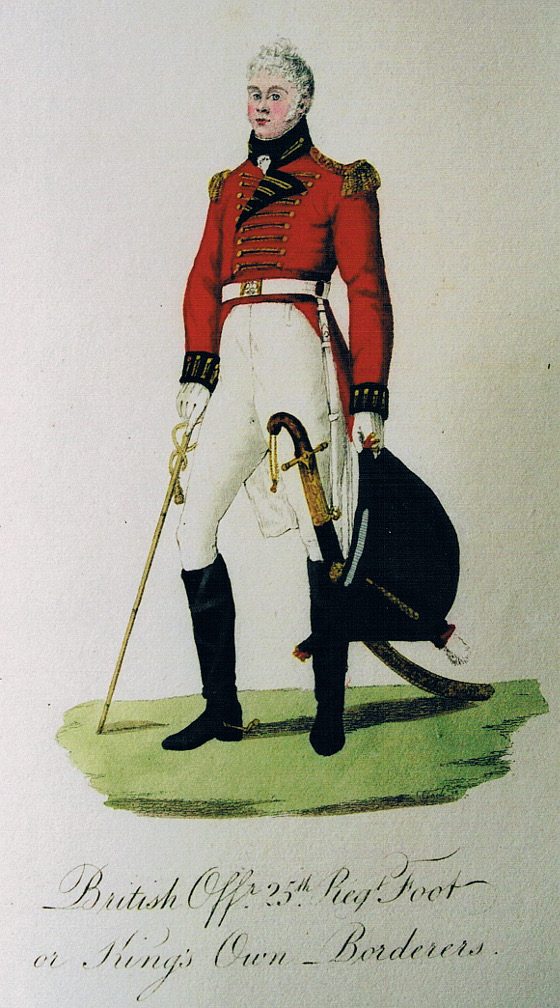
The officer illustrated here is wearing a dress coat, reserved for wear on state occasions and formal evening social gatherings. The coat-tails are long and lined with white. The front of the coat is double-breasted, with the top lapel folded back. This reveals gold lace on the inside of the lapel, mirroring the lace on the outside. We would need to see an actual example of a dress coat of the 25th Regiment from this period to ascertain whether the gold lace covered the inside of the blue lapel all the way to the waist. In this print the gold lace on the scarlet side of the lapels has a black line through the middle.
The blue cuffs have four visible gold lace button-hole loops and gilt buttons. The blue collar has only one loop and button on each side. The gold epaulettes are much fuller and more defined than in the late 18th century. In 1810 epaulettes became an indication of rank, so that company officers (subalterns and captains) wore only one epaulette on the right shoulder. Field officers wore one on each shoulder. Majors had a star badge; lieutenant-colonels had a crown, and colonels had a star and crown.
The officer is either a major or lieutenant-colonel. His rank allows him to support his sword from a waist-belt instead of a wide shoulder-belt like the lower officer ranks. The sword is the mameluke style, carried only in dress uniform. He holds a black bi-corn hat which was worn for-and-aft. It had a gold fringe at each corner and a gold loop on the side, with a white over red plume.
The print was produced by Goddard & Booth. It is no.16 in a series first published in 1822. But the date of the image is not made clear. The most likely dating is c1812.

