

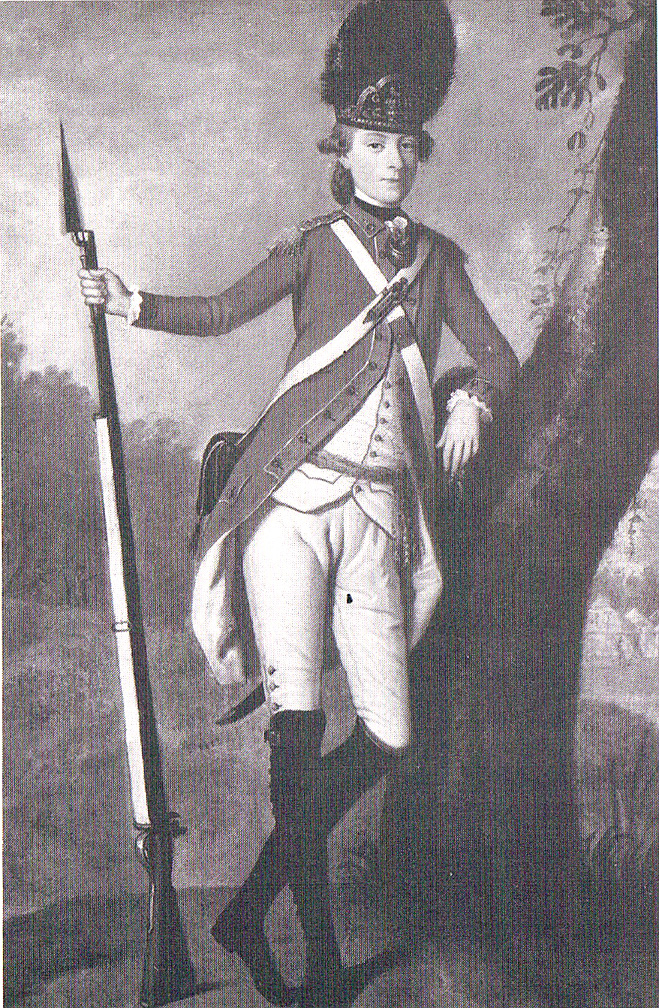
The development of the infantry coat can be seen in this painting to take the evolution of coat tails a stage further. The Minorca paintings of the early 1770s show the coat either worn with full skirts or pinned to form turn-backs on each hip. But in this painting, the white-lined turn-backs are further back on the hips so that they are almost fully-developed coat tails. The orange facings are shown on the collar, lapels and cuffs. Previously, the coat was worn open but is fastened near the top with hooks and eyes. Gilt buttons and gold lace button-holes decorate the collar, lapels and cuffs, also the pocket flaps on the skirts. As seen in the portrait of Ensign Stewart, there is white piping on the edges.
He is a flank officer so has a gold epaulette on each shoulder. The white waistcoat has plain gilt buttons and a red edge, also seen in the Stewart painting. A slim crimson silk sash is tied around his waist, the ends hanging on the left side. He has a white leather belt on each shoulder. The pouch-belt has a brass match-case, and a black pouch can be seen on his right hip. The sword-belt has a gilt belt-plate, and supports a curved sword on his left. The gorget is small and worn high on the neck.
The black fur grenadier cap conforms to the pattern laid down in the Regulations of 1768. The front plate has white metal devices on a background of black japanning. This is different from the plain black fur caps of c1770 seen in the Minorca paintings.

