

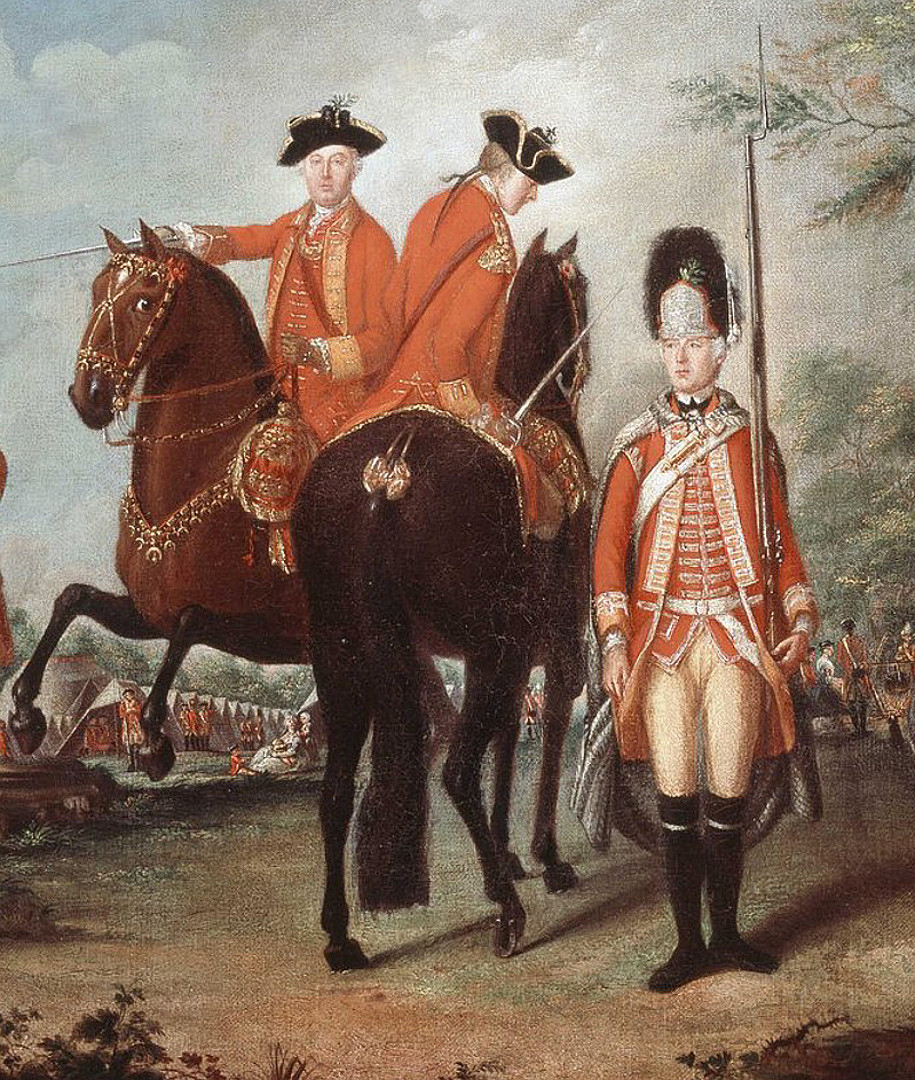
The most striking figure in the painting is the grenadier, who poses in the foreground with his blanket pulled back to reveal a very ornate uniform. Every infantry regiment had a grenadier company on the establishment, elite troops who were usually the first to attack the enemy. The Colonel of the 25th Regiment was Lord Lennox, a wealthy aristocrat who lavished money on his regiment and served with them in Minorca, where this was painted.
The fur cap was adopted in 1766 at His Lordship’s request and had an elaborate regimental-pattern silver plate on the front, edged in red, bearing a crown over a thistle and the Scottish motto Nemo me impune lacessit. The regiment was still Scottish, unofficially known as the Edinburgh Regiment, despite being obliged to have the territorial designation ‘Sussex’ from 1782. Only the rank and file had the plate on the front; a grenadier officer in the same painting wears a plain black bearskin. This man also has white tassels hanging on the left side. At the back of the cap, out of sight, is a yellow bag with a tassel at the point.
His coat and waistcoat are lavishly covered with regimental-pattern lace. This lace is white with blue, yellow and red stripes. At this stage the lace loops are square-ended. Within two years the regiment adopted bastion-shaped loops of a similar striped pattern. The grenadiers were distinguished by having lace along the edges of the lapels and following the edges of the coat-tails from the bottom of the lapels. The waistcoat is also edged with lace, including the pockets. The cuffs have a very unusual arrangement of lace, following the top edge of the yellow cuff and another around the middle of the cuff, with vertical loops and buttons intersecting these. A glimpse of the shoulder wings shows a lace edge and loops.
He has a broad white shoulder-belt with a brass match-case and chain fixed to the front with brass clips. A narrower white waist-belt has a brass buckle at the front and slings for his sword and bayonet, worn under the coat. He holds a flintlock musket with a socket bayonet attached. The blanket fastened at his neck indicates that he is on guard duty in the cold months. Close examination shows the edge of an undergarment beneath the waistcoat, for extra warmth.
The two mounted officers in this detail of the first painting in a series of six are a field officer, mounted on a brown horse with elaborate bridle and horse furniture, and the adjutant. It was customary for the commanding officer and second-in-command to be mounted, usually a lieutenant-colonel and a major, while only the adjutant, among the junior officers, was permitted to be on horseback on parade. In the Journal of the Society for Army Historical Research, vol. XIX no. 73 (Spring 1940), Percy Sumner wrote an article on the six paintings of the 25th Regiment in Minorca, where they were stationed from 1769 to 1775. He maintained that the two officers are a major and the adjutant.
However, an article written by W. Y. Carman in Campaigns magazine c. 1975 states that the senior officer is the Colonel of the regiment, Lord Lennox. One of the other paintings shows the commanding officer, Lieutenant-Colonel Robert Watson, who commanded the 25th from April 1763 to November 1773. So it could be him.
The coats worn by the officers are scarlet with deep yellow facings and gold-lace button loops on the lapels, collar and cuffs. The red waistcoat also has a profusion of gold lace down the front. There are also pocket flaps on each coat-tail, adorned with gold loops, and the back of the adjutant’s coat shows a small triangle of gold lace and two loops either side of the coat-tails. They wear black tricorn hats with gold lace edging and a black cockade fixed with a gilt button and gold loop. A sprig of foliage can be seen inserted behind the cockade. The adjutant’s hair forms a long pigtail. This is unusual for the period, as the long pigtail was not authorised until 1777, and hair was supposed to be powdered until it was abolished in 1795.
The adjutant’s gold epaulette is well shown here: a gold strap with a central stripe, or two lines of lace with a silk central colour. The gold lace forms a knot on the point of the shoulder, from which the gold bullion tassels hang down. The field officer appears not to have an epaulette, but it must be out of sight behind his right shoulder. In the early nineteenth century it was customary for field officers to have an epaulette on each shoulder, but in this period the epaulette did not signify rank; it was mostly necessary to ensure that the crimson silk sash stayed in place on the right shoulder. Only grenadier officers had two epaulettes.

