

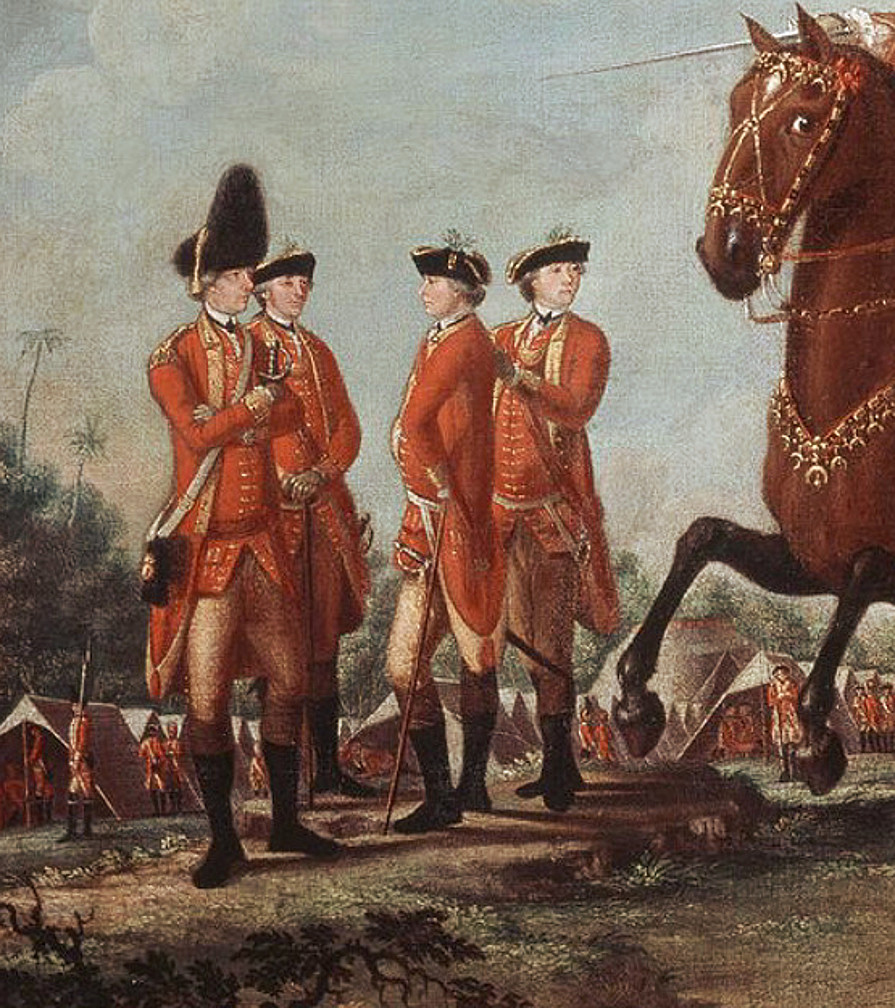
The four officers of the 25th Regiment are all on duty, as shown by their crimson silk sashes and the gilt gorgets worn at their throats. The distinctive bearskin cap worn by the officer on the left identifies him as a Grenadier Company captain or lieutenant. Prior to this period – that is, before the late 1760s – the grenadier cap was a pointed cloth mitre, elaborately embroidered on the front. The Colonel of the 25th, Lord Lennox, applied in 1763 for permission to clothe his grenadier company officers and men in a fur cap, but this was not granted until 1766.
The cap is plain black bearskin with a yellow bag at the back, hanging down on the right side and ending in a tassel. This pre‑dated the fur grenadier cap authorised for the line infantry regiments in July 1768, which did not come into effect until the following year, if not later. The 1768 Warrant of 19 December made changes to the rest of the uniform. The coats worn by all four officers – scarlet with deep yellow facings – comply with the order in that they have turn‑down collars and simple round cuffs with four gold‑laced buttonholes and gilt buttons on each cuff. Similar buttonholes and buttons are evenly spaced on each lapel, with one on each side of the collar. The pocket flaps on the back skirt of the coat also have gold lace, with buttons placed just below the flap. These can be seen on the waistcoats, as well as all the way down the front edges.
The red waistcoats had been retained from the previous clothing instructions, because the 1768 Warrant called for plain white waistcoats for all line infantry companies, without lace. They were also expected to wear white breeches, but here they wear buff breeches and black boots with brown tops.
Another change was the wearing of the crimson silk sash. From 1768 it was to be removed from the shoulder and worn around the waist. The Grenadier officer has his around the waist, but the other officers, from battalion companies, have theirs on the right shoulder. Two other paintings in this series of six show battalion company officers wearing the new white waistcoats but still wearing their sashes on the shoulder.
The Grenadier has a black grenade pouch on a white shoulder belt, with a gilt or brass bomb badge visible on the pouch flap. He holds a sword, but there is no sign of the scabbard; presumably it is suspended from a belt concealed by the waistcoat. He has a gold‑fringed epaulette on his shoulder and would have another on the left, marking his status as one of the elite grenadiers. Battalion company officers of all ranks had only one epaulette on the right shoulder. These did not indicate rank at this stage.
The black tricorn hats are gold‑laced and have a black cockade with a gilt button and gold lace. Every soldier and officer in this painting – of which this is a detail – has a sprig of foliage in their hat. The reason is not known, but it was a custom picked up during the Seven Years’ War of 1756–63. There are six paintings in the series, of which this is the first and oldest. They were painted in Minorca, where the 25th Regiment was posted from 1769 to 1775. The artist is thought to have been the Italian painter Guiseppe Ignacio Maria Chiesa. The originals are in the National Army Museum, Chelsea.

