

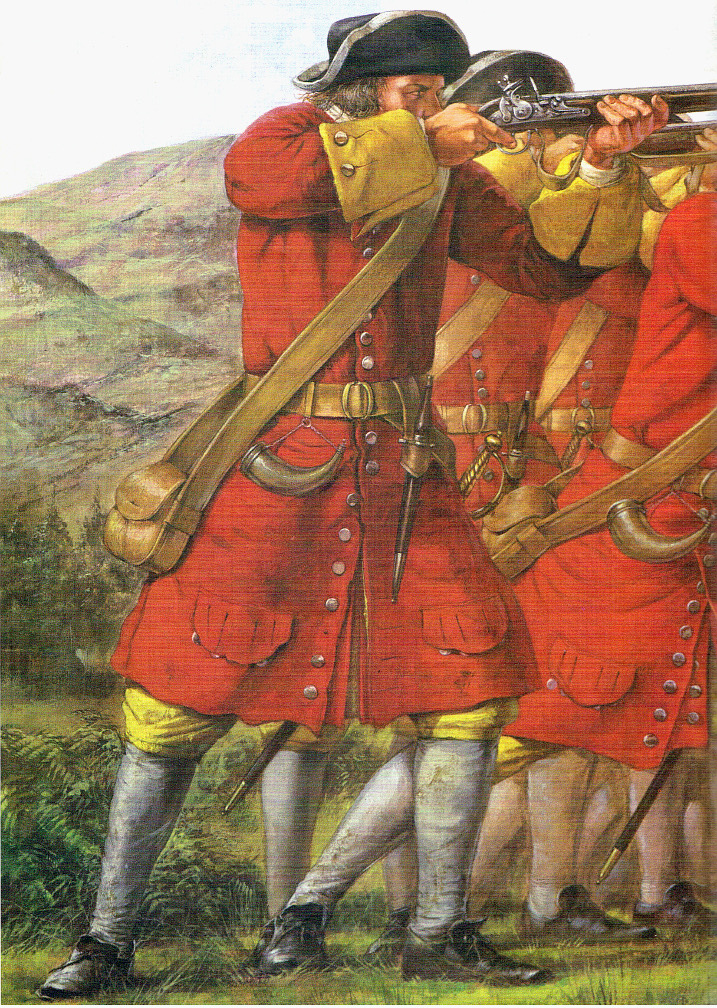
The red uniforms of the British Army were inspired by the Parliamentary New Model Army of the 1640s, but in the late 17th century uniform colours still varied widely according to the preferences of each regiment’s colonel. Some regiments wore blue, others grey, and there is no reliable evidence for the earliest uniform of Leven’s Edinburgh Regiment. This illustration, painted by Richard Hook and published in Military Illustrated in January 1995, depicts one of the two regiments that stood firm against the Jacobite Highlanders at Killiecrankie on 27 July 1689. These were Hastings’ Regiment (later the 13th Foot) and Leven’s Edinburgh Regiment (later the King’s Own Scottish Borderers). Hastings’ Regiment is known to have worn yellow facings and breeches from the outset, but it is unclear when Leven’s adopted the deep yellow facings that they retained until 1805.
The coat—variously described as a gown, cassock, or surtout—featured a profusion of buttons down the front, although it was only fastened to the waist. There was no lace on the coat at this time, although grenadier companies were beginning to introduce laced buttonholes. Infantrymen carried swords or hangers suspended from a waist‑belt, which also held a plug bayonet in a frog and a powder horn.
Infantry regiments of this period consisted of musketeers and pikemen, with grenadiers added from the 1670s. Each type of soldier was dressed and equipped differently. Around 1690, musketeers were transitioning from the older matchlock musket to the more reliable firelock or flintlock, as shown in this illustration.

