

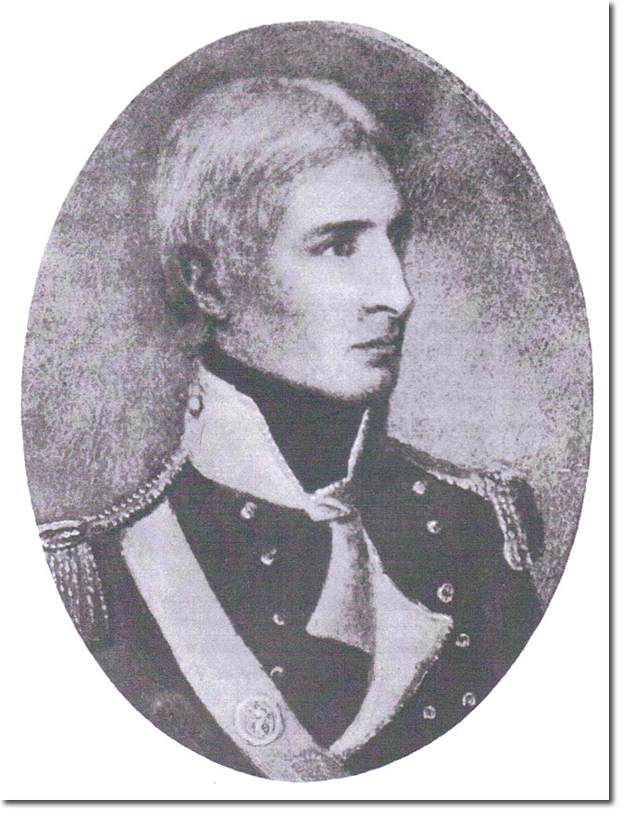
John Cameron was born on 3 Jan 1773, the second son of John Cameron of Culchenna, Inverness. He was educated at Eton and entered the 43rd Regiment as an ensign on 25 Sep 1787. His first active service was in the West Indies under Sir Charles Grey. He was at Martinique, St Lucia and Guadeloupe. He distinguished himself in the storming of the fortress of Fleur d’Epée. The 43rd was left in the West Indies, suffering so much from sickness that Captain John Cameron was the only officer fit enough to command the regiment. At Guadeloupe on 30 Sep 1794 he led the regiment fending off attacks by the French until he was severely wounded and taken prisoner. He spent two years on a prison hulk at Pointe-à-Pitre, but was released on exchange in 1797. He remained in the West Indies for another 3 years.
There was service in the Channel Islands in 1803 where he was married to Amelia Brock. He purchased the command of the 7th West India Regiment on 28 May 1807 but then transferred to the 9th (East Norfolk) Regiment on 5 Sep 1807. In 1808 he was lieutenant-colonel in command of the 2nd Bn 9th at Vimiera. He was then given command of the 1st Battalion for the rest of the Peninsula war. At Corunna he distinguished himself. His service in the Peninsula was interrupted by the expedition to the Scheldt.
The 9th Foot returned to Portugal in 1810 but Cameron became ill. When the battle of Busaco was about to start on 27 Sep 1810 he got out of bed and led the regiment with great bravery and had his horse shot from under him. He led the battalion again at Salamanca and Vittoria. He fought at the convent of St Bartholomew in July 1813, St Sebastian in Sep 1813, crossing the Bidassoa in Oct 1813, the Nivelle in Nov 1813 and the Nive in Dec 1813. The last battle was particularly gruelling for the battalion; when a French regiment threatened the rear of their line they about-faced and charged successfully with the bayonet.
For his service in the Peninsula war , Cameron was made Knight Commander of the Order of the Bath (KCB). The citation said ‘…we can honestly assert there was not a better soldier in any army’ He was also awarded the Army Gold Cross and the field officer’s small gold medal. The Portuguese awarded him with the Order of the Tower and Sword (the eight-pointed gold medal with blue ribbon). He was given a brevet of colonel on 4 June 1814 and went with the 9th to Canada. However the Hundred Days of Napoleon caused the quick return of the battalion and they arrived in France in August 1815, too late for the battle of Waterloo. On being promoted to command a brigade, Cameron relinquished command of the battalion on 19 July 1821.
Major-General Sir John Cameron KCB was given command of Western District and appointed Lieutenant-Governor of Plymouth on 25 Sep 1823, until 30 Sep 1834. He was appointed Colonel of the 93rd Regiment on 23 July 1832, transferring to the 9th Regiment on 31 May 1833. He was promoted to lieutenant-general on 10 Jan 1837.
Sir John Cameron was married to Amelia Bock of Belmont, Guernsey. She was a cousin of Major-General Sir Isaac Brock and niece of Admiral James Saumarez. They had three daughters and two sons, one of which reached the rank of General, Sir Duncan Alexander Cameron, and the other a lieutenant-general in the RE. Their daughter Anne married a vicar but died in childbirth at the age of 47 having given birth to 15 children. Sir John Cameron died on 23 Nov 1844.
As well as the medals shown below he also had a silver medal commemorating the renaming of Plymouth Dock to Devonport by King George IV in 1823.

