

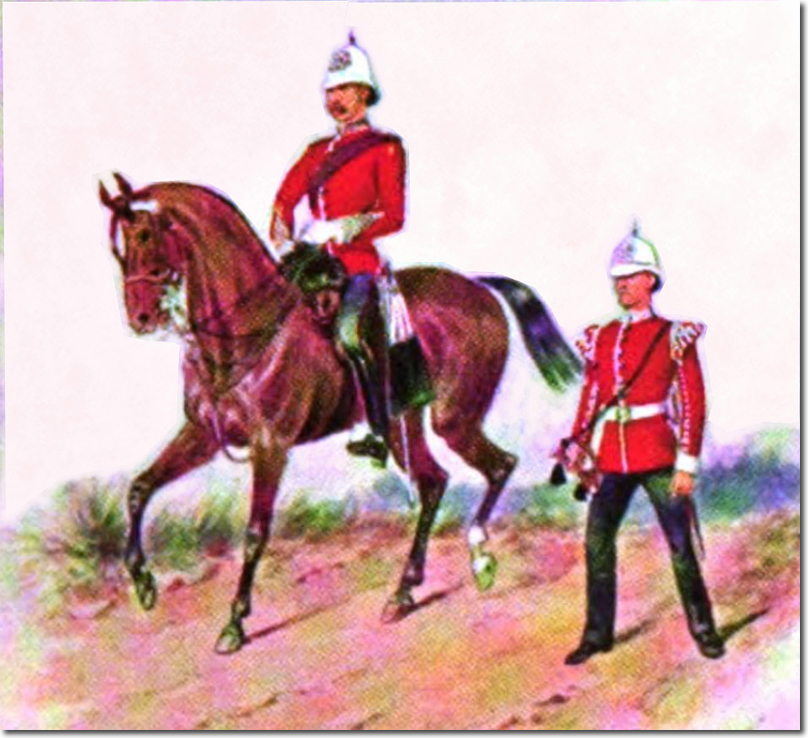
The young soldier on foot is a drummer who in this case is carrying out his other role as a bugler. He wears the special pattern drummers’ dress tunic which has distinctive lace which can be seen on his sleeves, both on the front, and the back seam. This lace also forms stripes on his shoulder wings and along the top of his collar. The same lace also covered the seams of the back of the tunic. This lace had a repeating pattern of a red imperial crown at regular intervals and was known as ‘crown and inch’. The shoulder wings of drummers differed from those of the band musicians in that the edge of the wings had a red and white fringe.
He has a bugle strung over his shoulder with a black or dark green string, with corresponding tassels on the bugle. An actual bugle string exists in the Norwich Museum Collection which is described as black. It may well have been a distinction of the Norfolk Regiment to have black strings and tassels, but the normal colour for Infantry non-royal regiments was green.
The other notable thing about this illustration by Simkin, which was reproduced in Loraine Petre’s History of the Norfolk Regiment, is the fact that the mounted officer and his bugler are wearing white helmets. The normal headgear for the British Infantry on home service was a blue helmet, worn from 1878 to 1914. The white helmet was introduced as an experiment for some regiments to wear for home service in 1889, but the experiment was abandoned in 1891. However some regiments continued to wear them up to c1896 (for home and foreign service). It had a slightly flared rim to give protection from the sun. It was only worn in dress uniform as it had a brass spike on top and a smart dress badge on the front.
The officer appears to be a field officer, probably the commanding officer. This may be the 1st Battalion as they were stationed in Ireland from 1877 until 1887 when it formed a Guard of Honour to Queen Victoria on the occasion of her Golden Jubilee. They then went to Gibraltar in December 1887, where they may have been issued with the white helmet, and on to India in February 1889. In December 1890 they were sent to Burma. By 1894 they were back in India and took part in the Viceroy’s Durbar in Lahore on 30 Nov. The 2nd Battalion was in India from 1874, moving to Burma in 1888. They returned to England in 1890. So the 2nd Battalion may well be represented here, in 1890.
Regimental Details | Band and Drummers

