

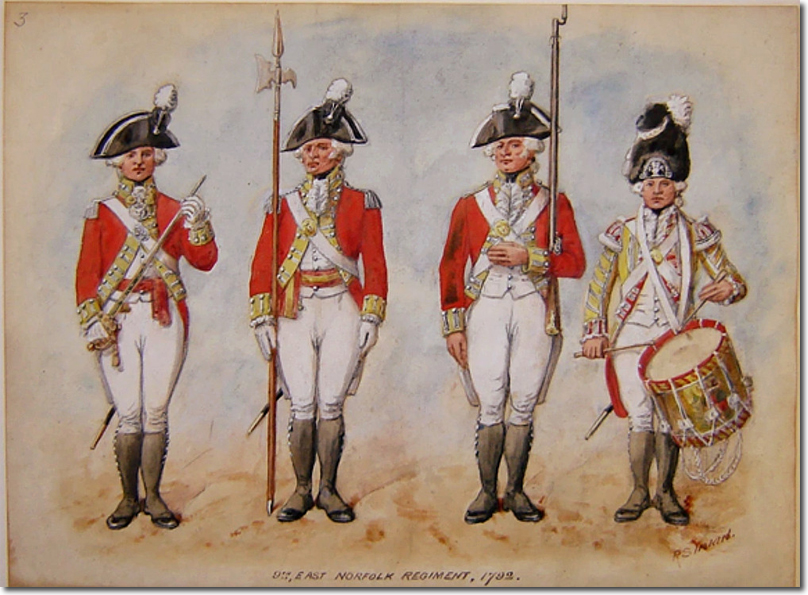
This reconstruction by Richard Simkin was painted in the early 20th century so is not strictly accurate but Simkin was a keen student of military uniform so would have researched the details. The painting is included here to demonstrate the striking difference between the drummer’s uniform and the rest of the men in the 9th East Norfolk Regiment. The left hand figure is an officer, next, a sergeant-major and then a private. They are in parade order so the drummer is not carrying a knapsack, but the uniform is little changed from the Bob Marrion illustration of a drummer of 1780. The officer is armed with a sword only in the battalion companies but grenadier officers carried a musket and bayonet. Up until 1786 the officers carried an ‘esponton’ which was really a spear. An order of 1792 replaced the halberd carried by the sergeant-major for a pike. In 1795 powdered hair was abolished for the men.
The regiment was stationed in the West Indies from 1788 to 1796. On their return to England their strength was depleted, but they called for volunteers from the militia and nearly 3,000 men joined the 9th. This was too many for a single battalion so the regiment was reorganised into three regular battalions in August 1799. Each battalion had 11 companies which had two drummers each. So each of the 3 battalions had a complement of 22 drummers, plus two fifers attached to the grenadier company. The first two battalions went out to Holland for the invasion in September 1799 but the third remained in England.
Regimental Details | Band and Drummers

