|
If Britain's presence changed the
world, so was Britain changed by the
Empire? Long after the Union Jack
had been lowered in the last colony,
the face of Britain will surely reflect the centuries when she presided
over the greatest extent of the
earth's surface to be controlled from a
single point since the Mongol empire of
Genghis Khan.
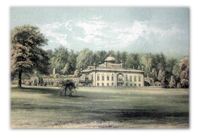
Across the green of hill and dale stand
palaces and country houses - the Royal
Pavilion at Brighton, Sezincote in the
Cotswolds - echoing in their styles travel
and trade and rule in Orient and Occident;
gardens like Wisley and Hidcote, where
rare plants from the Himalayas and the
Rockies have been lovingly reared. And
beneath the haze of industrial towns new
citizens from Asia, Africa and the West
Indies mingle with the descendants of
Celts and Saxons, Danes and Normans suggesting
in the imperial aftermath an
acceptance of reality and responsibility
seldom evident at the Empire's height.
London still evokes the impact of the
Empire on the city that was its heart: the
streets where Gurkhas, Bengal Lancers
and the Anzacs have marched; the Guildhall's
statue of William Pitt the Elder
with its forthright inscription, "He made
commerce to flourish by war"; the magnificent
India Office Library, probably
the greatest collection of works on one
country ever assembled in the capital of
another; the chambers of the Privy
Council, where the Judicial Committee
sat as the supreme dispenser of the
Empire's justice; Kew Gardens, hub of its
botanical management, with its continuing
links to universities and research
stations around the globe; the Imperial
College of Science "and Technology,
founded to spread the fruits of British
discovery through the colonies; and the
Royal Albert Hall, where a generation
that never saw the Empire in its hope and
glory still roars out Elgar's majestic
paean of loyalty:
Soldiers, seamen, explorers, merchants,
missionaries, governors, viceroys: the
great names of Empire have gone, along
with the many more unknown and humble
men from every part of Britain who
executed their orders from the Arctic
Circle to the Antipodes. By their efforts,
they left a world permanently altered; partly by their material works, but partly
also by the imprint of themselves. And the
persistence into our time of that second,
intangible legacy seems to suggest that
they inspired towards themselves a love / hate
attitude of a kind not seen in history
since the decline of Rome.
The hatred inspired by conquerors and
rulers is easy to understand; and the
British could be overbearing, contemptuous,
acquisitive, violent, smug and
short-sighted. But they were teachers and
guardians as well; and with all their faults
they were often generous, heroic, efficient,
passionate, scholarly and sensitive.
Their contradictions can be seen, in
retrospect, as sorting themselves into a
balance: a balance perhaps tilting in
their favour. They had experience, expertise,
energy, certainty: qualities of immense importance in the age of their
ascendancy. And even now, amid the
perplexities of changing values and the
humiliations of dwindled power, they have
not yet forgotten Burke's prophetic admonition: "As long as you have the wisdom
to keep this country as the sanctuary
of liberty, wherever men worship freedom
they will turn their faces towards you."
In 1829, John Wilson made his famous
remark that the sun never sets on the
British Empire. Physically, it has pretty much set
now. But travel westward, into the
imperial sunset, around the tremendous
earth-girdle of Britain's former possessions.
Everywhere you find her ·image
alive and vivid still: here in the practice
of great principles, there in humdrum
daily habit, elsewhere in details odd and
even ludicrous.
Early in the 18th Century a city
grew up between the James and
York rivers, in the south-eastern
corner of Virginia. It was planned
by Virginia's energetic,
choleric Governor, Francis Nicholson, a
man so frequently the worse for wear that
he was said to have been born drunk; and
its layout was to be along "modern" and
"substantial" lines. As its buildings rose,
contemporary observers commented
favourably on them: the Governor's
palace was "the best in all English
America," the church was "adorned as
the best churches in London," even the
gaol was "large and convenient."
For some 80 years, while the first
Empire of Britain rose to its height, the
new city served as the capital of one of her
most important American colonies. Then,
after the Declaration of Independence in
1776, it went into an eclipse. It suffered
a series of disastrous fires. It sustained
serious damage in the American Civil War.
And thereafter its classical purity became
encrusted with the shacks and shops and
stables of an age of rapid economic
expansion, an age with little reverence
for the past.
 |
|
|
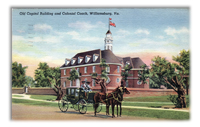
Today the city that was forgotten is
Colonial Williamsburg. Repaired and rebuilt
over a generation by patient research and loving craftsmanship, it stands
exactly as it stood 200 years ago: Cl square
mile of stately salmon-coloured brick and
nestling white clapboard ; of graceful
ironwork and matching balustrades; of
stone beasts and shields emblil.zoned with
the royal arms peeping out from dark
topiary and frothing dogwood; of interiors
rich in mahogany and walnut, marble and
ornamented plaster. And over all, above
the towering elms and whispering mulberries,
flies the Great Union - the British
flag in the 18th Century, the forerunner
of the Union Jack.
Williamsburg is probably the most
generous memorial anywhere to a former
way of life and a vanished rule. It is
essentially a memorial to the British
presence in America; and, in the days of
Empire, that presence pervaded not only
eastern America, but much of the whole
world. For millions upon millions it came
to influence the patterns of doing and
being, the springs of intercourse; the
ordering of belief and behaviour. Moreover,
the British did not merely touch the
world and pass, with the passage of their
power, into oblivion. They lastingly
transformed it. They offered or imposed
their institutions and their attitudes; and
many of their subject peoples adopted
or adapted them permanently.
From Williamsburg, travel north to
Canada, across the undefended frontier,
that invisible testament to the common
trust and friendship of two communities of
British stock.
Until recently, an old gentleman was
wont to stalk the streets of a Canadian
city. He wore a straw boater on his head,
and at his side waddled an elderly bulldog
with a little Union Jack wired upright to
its collar. Both of them and the mystique
they paraded, have disappeared; for
waves of immigrants have reduced the
British element in Canada to a minority.
Not that Canada was ever exclusively
British. There were always les Canadiens.
In many ways the plural, highly technical
society that Canada now is bears the
marks of the British past. Not so many
years ago, a story runs, in the days when
governors-general were still appointed
from London, a newly-arrived representative
of the King came out one morning to
take the air on the steps of Rideau Hall,
his residence in Ottawa. The duty constable
of the Royal Canadian Mounted
Police snapped to the salute. "Good
morning, my man," said the Governor General
affably. "Tell me, what is the
name of your horse?" Perplexed, but
resourceful, the Mountie pointed to his
car parked near by and read off the
figures on the numberplate.
R.C.M.P. patrols these days are more
likely to ride aeroplanes and speedboats
than horses. But the Britishness of that
renowned force survives. Their red fulldress
tunics derive from the lawless frontier days in the North-west, when
red - the colour of the British infantry's
coats - served as a salutary warning.
The Scottish influence in Canada was
especially strong, particularly in the
Maritimes and Ontario. At Caledonian
games kilted stalwarts toss the caber,
and plaids and sporrans swirl to the haunt
of bagpipes. From the Atlantic to the
Pacific the Canadian railways built huge
turreted hotels which recall the medieval
strongholds of the lairds. Long lists of
"Macs" fill columns of the telephone
directories. The English may have acquired
their Empire, absent-mindedly or
otherwise; but the Scots often did the
tough dogwork.
Thus did Alexander Murray find himself
in 1847 transplanted from his Argyllshire
village to the banks of the Porcupine
River at the hinges of the Arctic, whither
the Hudson's Bay Company had sent him
to establish a trading-post. "As I sat
smoking my pipe," he grumbled, "with
my face besmeared with tobacco juice to
keep at bay the damned mosquitoes, my
first impressions were anything but
favourable."
Nowadays: the Canadian North - the
vast expanse of subpolar tundra which
Charles II made over to a group of London
"Adventurers" - the Hudson's Bay Company
is busy with the air traffic which
serves its towns and mining settlements.
Cross the Rockies to Vancouver and
find, set against the white of skyscrapers
and the blue of Pacific inlets, Stanley
Park, perhaps the most beautiful public playground in the world. To the English,
with their green fingers, the making of
parks came naturally; and their handiwork
rings the globe. The botanical gardens
on the West Indian island of
Dominica, at Peradeniya in Sri Lanka
(Ceylon) and at Sydney all reveal that
flair for combining taste with skill, the
wild with the controlled, that amounts
to genius. It has even been remarked that
Empire-building, to the British, was
simply an extended form of gardening.
From Stanley Park cross the Strait of
Juan de Fuca to the city of Victoria on
Vancouver Island - a veritable "Little
Britain." In former days, when soldiers
and officials from India were seeking a
haven of retirement, there was much to
be said for Vancouver Island. Pensions
went a fair way; and, more important,
the climate was temperate. And so, in a
landscape of lumber-mills and salmon canneries,
Victoria became an enclave of
grizzled heads and white moustaches,
carriage-clocks and hot-water bottles,
cloth caps and trousers that somehow
resembled riding-breeches.
And though the Raj and most of its
retired servants have gone, Victoria's
Englishry has taken root. The city still
wears the gracious air of Tunbridge Wells
or Cheltenham. Its more discreet shops
reflect the urbane manners of Harrods
and the Army and Navy Stores. A trio of
musicians in the restaurant makes palmcourt
music amid the tinkle of teacups.
Follow the setting imperial sun into the
Pacific Ocean. Traverse the infinite horizons
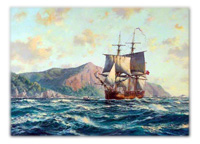
of sea and sky that Cook reduced to
human grasp; the island chains where
Englishmen, voyaging after him, have
left indelible impressions of their thought
and action. Pass the Galapagos group
where a marvelling Charles Darwin, in the
lamplit cabin of the Beagle, was "brought
near to that great fact - that mystery of
mysteries - the first appearance of new
beings on this earth."
Glance at Pitcairn Island, where the
descendants of the Bounty mutineers,
Tahitian bronze darkening Hampshire
features, launch their boats to draw supplies
from a passing ship. And halt for a
moment at the Cook Islands - to glimpse
yet another facet of the British legacy. A
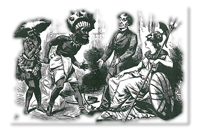
little pair of engravings of the 1870s suggests,
with grotesque overstatement and intolerance of cultural differences, the
Victorian impact on these remote Pacific
isles. The first shows their lamentable
state before the advent of the missionary
movement. The rising sun reveals a dancing
circle of bloodthirsty warriors, decked
with war-paint and brandishing heavy
clubs. Two sinister priests hail the dawn,
one sounding a conch, the other lifting
his arms in heathen worship. A crouching
mother, breasts hanging to her
raffia skirt, tugs viciously at the hair of
her screaming child.
Compare this tableau of idolatry and
beastliness with the second picture showing
the same scene after the arrival
of Christianity. Now, in the rays of the
morning sun, a sturdy British ship rides at
anchor. Along the shore, decent, if uninspired,
housing has appeared. The leaping
warriors have given way to a promising
vegetable plot where a native horticulturist, attended by a fat pig, demonstrates
his new-found skills to his wife.
In the place of the scalp-wrenching hussy
sits a seemly girl feeding a clutch of hens;
and where the priests rehearsed their
pagan rites busy men saw up a tree trunk - presumably for further housing. In the
foreground, hatted and parasolled, her
skirts firmly to her ankles, an English
lady promenades - observing with benevolent
satisfaction the useful arts burgeoning
around her.
Those engravings reflect what a pious
and powerful section of the British people
wanted its emissaries to achieve at the
ends of a savage earth. Sometimes wishful
thinking was founded on fact: in Fiji,
a few hundred miles further on our westward
route, a social revolution occurred.
Little more than a century ago the Fiji
groups were the "Cannibal Isles" of song
and story. The aggressive hostility of
their inhabitants was notorious, their
appetite for human flesh insatiable; a
single chief is said to have eaten nearly a
thousand very unfortunate victims.
Now they are among the most welcoming
of Pacific islanders - and the most
British-orientated. Fijian troops have
served Britain in her wars, and the strains
of "Chase me Charlie" , played by a smartstepping
police band, float on the stir of
the wind through the palms. School playgrounds
echo to the thud of footballs kicked by barefoot children. And from
almost any family dwelling comes the
murmur of the grace that opens and closes
every meal. Preaching, teaching, practising,
the missionaries effected this extraordinary
conversion; and, ironically, their
work has exposed friendly, modern Fiji
to the worst ravages of tourism.
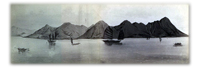
At the Pacific's Asian rim, its peaky
outlines restless among the melting hues
of cloud and water, stands Hong Kong.
Hong Kong, with its wealth stacked
steeply in white mansions up the hills, its
grinding squalor spread below, its four
and a half million shouting, scurrying
people clinging to the terraced island and
overspilling into Kowloon on the Chinese
mainland, is a glass-case British colony.
Here the machinery of colonial administration
purred on until as recently as 1997.
"You must understand," explained an
official to a visiting stranger, "that Hong
Kong is a benevolent autocracy." The
visitor was hard of hearing. "Did you say
benevolent hypocrisy?" he queried. There was a long pause. "I shall dine out on
that," the official finally conceded.
Britons in Hong Kong were always
balanced on a tightrope. The vast bulk of
China was ever uncomfortably close;
and in the 19th Century - no doubt from
a sense of unease - the "red barbarians"
from the West were as arrogant towards
their Chinese subjects as the Sons of
Heaven, the Emperors, were towards
them. Everything possible was done to
prevent "the injury and inconvenience
of intermixture with the Chinese
residents."
Throughout the Twentieth Century, the Hong Kong government faithfully upheld one of the
great British principles: the right of
political sanctuary, and the duty to provide
it. The stream of refugees from China began with the collapse of the Manchu
dynasty in 1911. During the Sino-Japanese
hostilities of the 1930s, it
reached flood proportions. With the coming
of the Maoist regime in 1949, it became
a tidal wave.
Striving to cope with the refugees, Hong
Kong built and built, and contorted
itself to find jobs and livelihoods. Great
tenement blocks, their balconies almost
hidden by cataracts of washing, reared up. Shipyards and factories mushroomed. Taking in the refugees created countless problems; but the
alternative was not acceptable to the
British humanitarian tradition.
Pass down across Vietnam, by the stone
splendours of Angkor into Malaysia - and
Kuala Lumpur. Here you can still see the remnants of a British
colonial capital: its trim official
buildings, like a cluster of miniature
Oriental Oxbridge colleges, set round the
green expanse of the cricket club; its
avenues redolent of high collars above
white duck trousers, mutton-chop sleeves
at the reins of spanking dogcarts. It may
not survive long, this oasis-museum,
for Malaysia is one of the richest
countries in South-East Asia, and the
coloured concrete of a new age advances
inexorably. But, for the moment, at least,
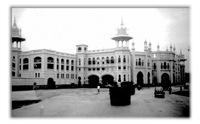
Kuala Lumpur's railway station still
stands, sublime in its Victorian compound
of Eastern invention and strict utility,
its bulbous cupoias rising from the tracks,
its soaring minarets making a mosque of
booking-hall and waiting-room.
Then head south along the fine highway
that cuts through the riightmare jungle
of Malaysia's spine, past planters' Landrovers and 4WDs
lurching in the rubber groves and
a monstrous tin-dredger; past the Cameron Highlands,
half-timbered, rose-clad
retreat of senior executives;
and, rounding a bend at speed, remember
your road manners. For there, in the dark
primeval ferocity of towering trees and
clutching tendrils, will be the familiar red
road sign enjoining the statutory speed
limit, standing primly beside the remains
of a cobra someone has run over.
Kipling said of Singapore that, though
England was supposed to own the island,
the Chinese ran it. But even now that it
is virtually a Chinese city state, Singapore retains a certain stamp set on it by the British.
Overlooking the rash of shipping in the
harbour, St. Andrew's Cathedral and
government offices, side by side, recall
the British union of Church and State. At
close of business, thoughts turn to the
sundowner; for in the old days, alcohol at
sunset was believed to prevent malaria - helped along by infusing tonic water with quinine.
Singapore's location makes it an entrepot
of trade. It is also a meeting-place of
ideas, a city of conferences. And among
the salesmen, strategists and scholars
who throng Singapore's hotels, you may
well find yourself rubbing shoulders with
a herd of briefcase-laden lawyers. They
will have come together from all over the
Commonwealth, and beyond it. At home,
some wear the robes of barristers, some
the fuiI-bottomed wigs of judges; others
practise in sober gowns or merely in dark
suits. But they all serve what has been
described as "the strange amalgam of
case-law and statute" that is English law.
English Common Law forms the
legal framework of many nations
which were once British possessions.
To the layman it often
appears puzzling - an ancient
hotch-potch rather than a modern code.
Yet its lasting value is that it is law
made for ordinary citizens, and not vice
versa; and no one, however powerful,
is above it. One of its greatest American
exponents - Mr Justice Holmes - has
described it as based not on logic but
experience. Every "reasonable man" jurors
and witnesses as well as advocates
and police - play their part in applying
it. And in its practical, pragmatic nature,
it reflects the realities of everyday life.
A court case is less a detached inquiry
after truth than a down-to-earth battle
- more like a football match in which two
opposing sides slug it out in the presence of a referee. And the referee - the judge
- is not a career official but a lawyer drawn
from the ranks of the profession; and
though he is appointed by the State, he
is not its servant. With the prosecution
striving to overthrow the presumed innocence
of the accused man and the defendant
fighting to rebut the plaintiff's
claims, the rules to ensure fair play are
all-important. Hence the apparent technicality,
the typically English expression
of vital principles in practical details.
It has been held, for example, that
each word of the writ of habeas corpus is
worth more than a library of books in
praise of liberty. English law was seldom,
if ever, accepted voluntarily in the areas of
Britain's overseas influence. To some the
British took it with them: on others they
imposed it. But it has shown itself to
be one of the most exportable of
their major institutions. Parliamentary
government may prove a fragile flower;
ties of commerce, culture and sentiment,
may weaken. But the anchor of English
Common Law holds fast, and its basic
appeal may be simple. "We all inherit,"
said an English judge, "the same sense
that individual personaiity is the unique
intrinsic value we know.upon this earth."
And now plunge down, across the volcanoes
of Indonesia, into the great seas
of the Southern Hemisphere, towards the
Antipodes. And on the way, consider the
spreading about the world of the British
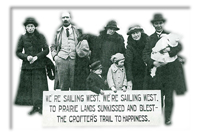
themselves. In the century from 1815 to
1914, in the greatest outpouring in their
history, some 20 million people emigrated
from the British Isles, mainly to the
United States and Canada, Australia,
New Zealand and South Africa. Some
called this process "shovelling out the
paupers"; since its high points often
coincided with the impact of disasters bad
harvests, business slumps, the Highland
clearances, the Irish famines.
Emigration was also a response to the
more steady phenomenon of population
growth. People massed in the overcrowded,
unhealthy new urban centres of
the Industrial Revolution, many of them
displaced agricultural labourers, looked
to the open spaces across the seas for an
escape from squalor and poverty and a
fresh start in life. In the early days the
shipboard conditions they faced were
often as appalling as those prevailing in the slave-ships. The first Lord Durham
remarked that you could always tell an
emigrant ship, even at gunshot range, by
her terrible smell.
Dumped with some 700 convicts on a
remote Australian beach in a welter of discomfort
and danger, a lady was soon
noting in her diary: "We do not see Mr.
Dawes frequently. He is so much engaged
with the stars." And less than 50 years
later another new arrival in the same
country marvelled at the achievement of
his compatriots. "Here am I, partaking of
an excellent repast served in a way which
would be creditable in London or Paris.
What wonderful civilizing tendencies the
Anglo-Saxon race seems to have! How
does it come to pass? It is that every
Englishman is brought up to read, learn
and digest the word of God. This prevents
vacillation of character, gives him an
object in life, a tenacious perseverance."
The divine ally of the British adapted
his miracles to the needs and natures of
his chosen pioneers. Samuel Goldswain;
son of the Buckinghamshire soil, lost and
famished in the South African wilderness. sought the Almighty's aid."As soon as I
had nelt down I saw sum thing wite in
sum grass. I puled it out and to my
astunishment wen I onfoulded a sheet of
fulcap paper I found a round cut off of a
sixpenny wite lofe of bread spread with
very nice freash Butter and then a slice
of salted tung and an other round of
bread. Glorey be to his holey name."
And if the Lord pushed sandwiches
under British noses in the nick of time,
he also fortified British purposes in due
season. "I commenced plowing," Samuel
continues, "but I had not gon more than
two furrowers before my plow braek all
into peaces and what to do I did not know.
At last I deturmined to make a new one:
I did so and it ancerd quit well."
New climates and new forces worked on
the generations of British emigrants - on
country bumpkins and slum-dwellers
seeking a better lot, on younger sons
of the gentry with no inheritance of
land and no expectations, on black sheep
"packed off to the colonies," on men
adventurous or on the run - to create a
new variety of Homo Britannicus. This
new man, British in origin, but changed
by fortune, environment, and the pressures
of the country of his choice, has no
recognized generic name. He might, perhaps,
be called "Commonwealth Man,"
except that he is not one but many.
New Zealanders differ from Australians,
Australians from Canadians. Certain characteristics,
nevertheless, tend to mark
them all. They are frequently better
developed physically than their forebears,
and also less reserved, less class-conscious,
and harder-working. There can be tensions,
though, in their relations with their
British cousins. They sometimes mistrust
perceived Britishers' sophistication, watchful
for the nuances of slight, and they may
defend themselves by implying how much
better things are done where they come
from. But in the subtle, sweet-and-sour
mystique of British Commonwealth contact,
the divergence is not simply between
home stock and offspring In the Antipodes
today are two neighbouring offspring-
nations which are remarkably different
from each other.
On the gentle slopes that fringe New
Zealand's majestic Alpine core lives a
people so well ordered and responsible
as to approach the ideal of the "reasonable man" beloved of English law. The
roots of this temperament are essentially
British. And New Zealand retains a special
place in British hearts. The All Black
Rugby side are received at Twickenham
and Murrayfield with more affection than
any other touring side. Perhaps that is
because New Zealand, as far away from
her origins as the surface of the earth
allows, is in many respects a replica of Britain. Policemen wear helmets. A stream
of men clocking in at an Auckland factory
could be mistaken for their counterparts
in Birmingham. At country shows velvet capped
girls and bowler-hatted judges
faithfully mirror Pony Club rallies in the
English shires.
In the 1840s, Edward Gibbon Wakefield
and his colleagues-colonial reformers
who wished to relieve British poverty and over-population by schemes of "systematic
colonization" - sought to establish in
New Zealand a community, based on
British mores, but more encouraging to
enterprise and merit. Despite set-backs
and dissensions they succeeded in making
the "island of the Long White Cloud" a
place: "where men but talk of gold and sheep
And think of sheep and gold."
Cheese and butter, lamb and apples
made lasting links with Britain; close
studies of her tastes and habits become
of vital day-to-day concern. And the
market ties of farming were reinforced by
those of growing industry: shoe polish in
tins bearing the kiwi, New Zealand's
national bird, have long figured on British
shopping lists. Evangelical, as well as
market forces, moulded the character of New Zealand. Missionary societies, active
throughout the Pacific, strove to protect
the native Maori civilization against
the capitalist intruder, and, indeed,
attempted to prevent the colonization of
New Zealand at all.
That they were unable to do; but it may
be that the clashand compromise of these
two forces - commercial enterprise and
Christian ethics - have much to do with
the modern New Zealander's approach to
life. "The fact is," wrote the novelist,
Samuel Butler, a successfill New Zealand
sheep-farmer as a young man "that
people here are busy making money. Yet
it may be questioned whether the intellect
is not as well schooled here as at home.
"There is much nonsense in the old
country from which people here are free.
There is little conventionalism, little
formality, much liberality of sentiment,
and a healthy sensible tone." While carefully maintaining her ties with Britain,
New Zealand has managed to slough off the vestiges of feudalism in the British
way of life. She was one of the earliest
nations to embrace the concept of the
welfare state. Here native-white relations
eventually became the envy of less
successfully integrated plural societies.
Her citizens sometimes complain of the
provincialism born of isolation; and it is
true that many of her best men - Ernest
Rutherford, the physicist, was but one
example - tended to gravitate to Britain.
But in many fields of public policy - such
as the provision of comprehensive secondary
education of high quality and the
redistribution of the national wealth she
is ahead of her prototype and is what many people in Britain
would like their own country to be like.
It is hard to believe that Australia's
people, only 1,500 miles away across
the Tasman Sea, stem from the same
British stock as the New Zealanders.
In Australia, the early British
settler - sheep-squatting, farming, gold digging
- pitted himself against a huge
and hostile Continent, most of which was
proof against his advance. Even now, over two centuries later, only its outer
seaboard rim has been fully subdued: the
great, red, desiccated interior still presents a forbidding natural barrier to development.
In an environment so formidable,
extremes of success and failure were always
on the cards. The pioneer could win
a dazzling fortune or he could become the
victim of utter ruin. In any event, he had
to fend for himself; and, in emergency, for his companion as well. His descendant
of today is, perhaps, not noted for the
quiet, collaborative outlook of his New
Zealand neighbour. He tends to be more
combative and competitive. An English
businessman visiting Australia for the
first time exclaimed in bewilderment:
"Whatever you try to do here, a million
hands reach for your throat."
The Australian reaches also for the
moon. He takes a chance, gives it a go,
preferably and a scale commensurate with
his surroundings: the Sydney opera house,
with its tremendous ultra-modern
shell-backed roofs, is probably the biggest
act of faith or folly in the Southern
Hemisphere. Australia has more of the
"frontier spirit" than New Zealand: it is
doubtful if any other country would have
welcomed the Pope on a racecourse.
The Australian's ties with Britain are
everywhere evident. The billy-can, slung
from the stockman's saddle, is the outback
version of the English teapot. He is a
confirmed, not to say renowned, beerdrinker;
and he downs his light, potent,
bitingly cold draughts - nectar after a
day's work in semi-tropical heat - in an
establishment called a pub.
Many of his older buildings are decorated
with "lace" - the delicate, filigreed,
wrought-ironwork, reminder of a gracious
Georgian London, brought out as ballast
in returning wool ships. In Newcastle,
New South Wales, as in Newcastle upon
Tyne, when a Test Match is in progress,
assessment of the latest score is as essential
a prelude to business as coffee in the
Arab world.
The laconic independence of the Australian
is proverbial. He profoundly
suspects imposed authority. A cop is a
cop is a cop, and a Sydney saying has it
that "everything in Australia strikes
except matches."
Sheep and cattle stations reflect his traditional
respect for British stock-breeding;
but Charolais and Brahmin herds are
gaining ground.
And independence has led to orginality:
the Australian arts - especially painting,
music, ballet - have struck out into
new and virile themes of sun and space,
owing little to European influence. Collectively,
he is among Britain's firmest
friends; but he demands that each Briton
prove himself on his merits, not on his
genealogy. "Bloody Pom" (said to derive
from the initials P.O.H.M., "Prisoner of
his Majesty," stencilled on the early convicts'
backs) can be a term of pitying
endearment or of vicious abuse.
In colonial times the Australian was
known for his prickly defensiveness. But a
yardstick of his modern self-confidence is
the pleasure he now takes in laughing at
himself. One expression of this amiable
trait is the cult of "Strine," - "Australian"
language. Dr. Affabeck Lauder, originator
of that esoteric tongue, might regard an exercise along the following lines as
suitable for a beginner:
Trenslite inner Inglish (Translate into
English):
1. Yurra nong sheila, buttcher bute
inyerhwy. = You're a no-good girl, but you're
attractive in your way
2. Thairtbex fuller crud - kensensetch. Tortabey cline dup. = The outback's full of junk - cans and
such. It ought to be cleaned up.
3. Doughby grady. Youvad nuf. = Don't be greedy. You've had enough.
4. Ess eezowta jile - godjobza bairndryroider. = Yes he's out of gaol- got a job as a
boundary-rider.
5. Things crook nInglen? = Things bad in England?
If Australia changed the British, the
converse is also true. Travel in the train
known as "The Ghan" the thousand miles
from the south coast, across some of the
most barren deserts in the world, to Alice
Springs at the continent's heart. With
luck you may catch a passing glimpse of
a herd of wild camels, plodding through
the scrub and gravel at the horizon's edge.
Their ancestors were brought from India
to serve as transport in these wastes.
Australia exemplifies the perseverance
that the British applied to transplanting
animals and crops about their Empire and
the scale on which they did it. To the vast
continent inhabited by marsupial species
they imported the entire range of Australia's
present domestic livestock: sheep,
cattle, pigs, horses, dogs and cats. And,
by some lack of foresight, rabbits.
From Australia went droves of
"Walers," the weight-carrying stockhorses
that became the favourite mounts
of the Indian Army. And as they shunted
sugar, tea, tobacco, potatoes, bread-fruit,
rubber, to and fro across the globe, so the
British, in the belief that its gum, like
alcohol, was effective against malaria,
took the eucalyptus tree to India and set
it in arching avenues along their trunk
roads, in shimmering stands around their
compounds and cantonments. At the
same time, in Australia, they sowed English
grass, vegetables and cereals, and '
planted the weeping willow cuttings
which, tradition holds, came from Napoleon's
tomb on St. Helena.
From Australia, wing your way across
the Indian Ocean and the great arc of the
Bay of Bengal, to the subcontinent that
stretches from the curtain of the Himalayas
to the surf of the Malabar Coast.
Here the British viceroys governed an
Empire within an Empire, larger in itself
than all the territories ruled by ancient
Rome. Their executive instrument was the Indian Civil Service, the hand-picked
elite of a few hundred men whom Gandhi
called "the most powerful secret corporation
ever known," and Curzon dubbed "a
mighty and meticulous machine for doing
nothing."
 |
|
|
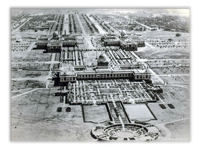
Their memorial stands intact in the
enormous terracotta complex of Sir Edwin
Lutyens's New Delhi - combining, in its
stretching vistas and austere facades,
echoes of both Washington and Whitehall.
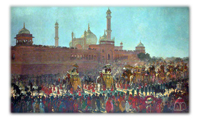
Nearby, on Independence Day in 1947,
the standard of the Indian Republic was
raised on the walls of the Red Fort; and
while Churchill spoke in Westminster of
the great ship sinking in the calm sea,
the little flag, watched by white-clad
multitudes, climbed from the frowning
Mughal bastions to signal the end of an
era.
India had always fascinated the British
with a magic at once magnetic and
repellent. In the opening decades of their
presence there, the British plundered
India with cheerful zest, while at the same
time assuming an attitude of almost
friendly intimacy with the natives. The blood bath of the Mutiny in 1857 dispelled
that mood of easy assurance and replaced
it with one of apprehension and anxiety.
It bred the aloof, distant manners that
shocked sensitive men like E. M. Forster.
But, though the Mutiny changed British
attitudes towards Indians, its suppression
confirmed in British minds the rights and
duties of sovereignty. Thereafter, what
the British did in India was done with
posterity in view; what they built was
built to last. Even now, evidence of their permanent intentions remain despite having left the sub-continent many decades ago.
In India, imperial architecture reached
its zenith. Hill stations, with their cosy
jumble of church towers, red-brick lodgings,
fretwork balconies; barrack squares,
their windows shaded from the sun by
heavy fibre matting; English suburban
villas - "Acacia Nook," "Windermere,"
"Rest Haven" - in their tropical guise
of bungalows with broad verandas and
rows of potted plants; graceful pavilions,
slender-pillared bandstands, ornamented
clock-towers; examples of them everywhere abound, though time has gIven
them new uses and fresh tenants.
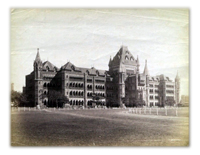
Still the heart of Bombay is dominated
by the domes and pinnacles of gargantuan
public buildings, their scale seldom exceeded
even in London, their styles ranging
from Gothic to classical Italian: secretariat
and library, law courts and post
office, a herd of elephants frozen in brick
and metal. The crowning colossus is the
Victoria Railway Terminus, its
approaches ornamented with fountains
and statues, its ponderous masses
towered, columned, rose-windowed.
Indians today tend to smile when complimented
on their efficient railway system;
for in imperial times its British
originators never tired of singing its
praises. And in their former steam-hauled
glory, the Indian railways were indeed a
wonder. Uniforms were spick and span,
locomotives gleamed, training-schools
and sports grounds were the equal of
anything at Crewe or Swindon.
Station-masters, drivers, guards, even
plate layers, were mostly British; and the
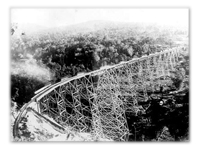
railways were but one part of the economic infrastructure that the British laid from
end to end of the subcontinent: roads,
dams, telecommunications, power. Insufficient,
possibly; built for alien purposes,
often: but these foundations, since
extended, deepened, multiplied, did much to equip the modern Indian
economy for industrial growth.
The British upper crust enjoyed a life
of leisure, cushioned by the household
retinue of bearers, syces (grooms), ayahs
(nursemaids), mahs (gardeners), dhobis
(washermen). For anyone of consequence,
membership of a club was almost mandatory.
Wherever the British went, clubs
were formed.
In the smaller towns they might be
merely unpretentious bolt-holes, refuges
from the chatter of the memsahibs. But
in the bigger centres they were stately
palaces of marble, leather-appointed,
filled with the murmur of small talk, the
sudden rasp of snores, the rustle of The
Times of India, the soft pad of salverladen
servants swathed in brilliant sashes.
Lists of candidates were closely scrutinized;
in the more exclusive clubs no one tainted with trade could hope to escape
the blackball. The number of merchants
who discovered links with a profession
was surprising; so was that of planters
who found that they were also agricultural
scientists. In the Bombay Gymkhana
hung a famous placard: "Dogs and Women
Not Admitted."
Indians, it went without saying, were
even less acceptable. Many of these clubs
flourish still. But any British visitors will
enter as guests of Indian members; and
the talk is less likely to be of port and'
polo than of refineries or steel-making.
In 1835, Thomas Babington Macaulay,
then a member of the Supreme Council
under the East India Company, wrote his famous minute urging the teaching
"of English literature and science through
the medium of the English language."
The aim was less philanthropic than
political. It was "to form a class of interpreters
between us and the natives we
govern," to create, in effect, a body of
Indian propagandists who would help to
strengthen the British Raj.
Macaulay was not proposing education
for the masses, and long after Victoria
became Empress of India in 1877, only
one in a hundred of her Indian subjects
attended any kind of school. Yet Macaulay
might have been astonished at the results
of what he set in motion, at how widespread
the use of English in India became.
Recently, an English tourist found himself
in Travancore, in the far south. The
road which he was travelling led through
fields of an unfamiliar crop, and he was
interested to know what it was. The landscape
was empty save for a dark figure
clad only in a loin-cloth and a puggaree;
and with him, clearly, no fruitful contact
was possible. The visitor was turning
away when the figure spoke. "Good day,"
came an accent almost indistinguishable
from that of a BBC announcer. "Can
I help you ?" Taken aback, the tourist
put his question. "That's tapioca," his
informant replied. "I've heard that in Britain children are forced to eat puddings made of it."
Conversely, the British in India spoke
a language that can still be heard. It was
a patois of words drawn from native
tongues, and from those of previous conquerors
or settlers - Arab, Mongol,
Portuguese, French, Chinese. It was
called "Hobson-Jobson" - which meant,
in Army slang, a confused uproar, and
was said to be a corruption of the cry
"Ya, Hassan! Ya, Hussein!" wailed by
mourning Muslims during the Moharram
procession.
"The bukshee is an awful bahadur, but
he keeps a first-rate bobachee," a subaltern
of Skinner's Horse might whisper
in the mess, referring to the excellence of the cook in the service of a pompous ass
of a paymaster. When he woke you in the
morning, your bearer brought your chotahazri
(little breakfast). At midday, if you
had no time for tiffin (lunch) you might
have a bowl of mish-mash (rice soup) at
your desk, mopping your brow with your
roomaul (handkerchief). And your wife's
jomponnies (chair-bearers) might come
upon the pug (track) of a tiger. Buggy,
cheroot, coolie, curry, kedgeree, loot, mulligatawny,
paddy, pukka, veranda, all passed
into English via Hobson-Jobson. So did
the phrase,"I don't give a damn," from
the copper coin of little value called a
dam. "It was," observed a disapproving
commentator, "the Duke of Wellington
who invented this oath, so disproportionate
to the greatness of its author."
The collision of British and Indian
cultures produced some bizarre effects,
such as the introduction into India of the
public notice, a form of official communication
for which the British bureaucracy
has always had a weakness. Trudging,
a century ago, along the corridors of
Indian hotels, guests were frequently
reminded that "Gentlemen do not strike
the Servants." More recently, strollers in a municipal park in Kashmir have come
upon a notice which, in its combination
of the didactic and the vague, seems to
summarize both the Western and Eastern
approaches to authority. It says, so those
who claim to have studied it affirm, "Do
not Urinate near this Notice."
Disraeli said of the British Empire that
it represented "the union of those two
qualities for which a Roman emperor was
deified : Imperium et Libertas." India, in
her British days, saw much of the former
quality. Yet modern, independent India
is among the most liberal of countries,
open-minded and experimental. Beset
with grievous problems of poverty, corruption
and over-population, she seldom
seeks to conceal them; she equally seldom
complains of their existence.
Frank and objective in her assault on
them, she acts as something of a beacon
to those people, in the advanced as well
as the emergent world, concerned with the
establishment of new social priorities. If,
down the years, she reached beyond the
"imperium," and drew from the British a measure of their "libertas" to add to
her own spirit, it surely stands to the
credit of both nations.
Beneath the westering sun a long,
low-lying line rises from the
Arabian Sea, passing into infinity
to north and south. It is the seaboard
of Africa-where Britain's
withdrawal did not end that continent's tragedies and problems. Just as the ideas of scientists and
settlers suggested the transference of
animals and plants across the Empire, so
the demands of development called for the
redistribution of labour among Britain's
possessions - sometimes on a large scale.
In the 19th Century these secondary
cross-migrations within the overseas Empire
were stimulated partly by the abolition
of slavery under the British flag,
partly by shortages of local manpower for
major construction projects, partly by
the disinclination of workers to face unfamiliar conditions
or unpleasant climates, and partly by the
simple hope of getting labour cheap.
Chinese coolies, for example, became a
common sight on the sugar plantations
of Queensland, and Lascar stokers often
worked in British vessels on the Eastern
run. Nor were these movements confined
to subject peoples: the British Isles contributed
their quota to a nomadic imperial
iabour force. Navvies moved about to
wherever there was a market for their
muscle-power.
By far the largest source of migrant
labour was India. All round the shores of
the Indian Ocean and far beyond, Indians
with little hope at home found a living comfortable
or the reverse - in the imperial
structure. There were skilled Indian
pilots on the St. Lawrence river; Indian
masons, clerks, accountants, in the Persian
Gulf and the Middle East; Indian
labourers by the thousands in the ~anefields
of the West Indies and the teagardens
of Ceylon.
So great, at times, was the demand for
Indian hands, and so easily was it met,
that employment agents from many colonies were based in Calcutta, and the
processing of applicants was government controlled.
The system was one of indenture:
a man agreed to work abroad
for a given period of years; then, his term
completed, he could either accept a paid
passage home or remain where he was as
a free settler.
Officially, such arrangements might
seem open and above board: but, in practice,
crowds of illiterate, hungry men fell
ready prey to unscrupulous recruitment.
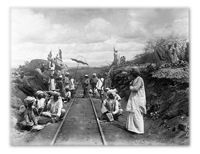
In eastern Africa, as a result, the Indian
presence became to some extent synonymous
with the British. To speed the building
of the Uganda railway in the 1890s,
Indian labourers were brought in by the
shipload. Many chose to stay on afterwards,
and others joined them.
Intelligent and industrious families
grew up, often better equipped than their
African neighbours to prosper in the
offices and banks, factories and shops of
a commercially orientated society. The
unfortunate result is that their abilities
- and their tendency to remain apart
come to be resented as in Uganda;
and were rejected by politically
independent African communities struggling
to improve their own fortunes.
"When you have made up your mind
to go to West Africa," Mary Kingsley, the
trader-explorer of West Africa, said in
1893, "the best thing you can do is to get
it unmade again." The thick, damp mists
of the Gulf of Guinea, the lethal, little
understood diseases - especially cholera
and yellow fever - made the west coast
the white man's grave. "No philanthropist,"
a magistrate wrote from Gambia,
"comes here for purposes of disinterested
teaching, no professional man settles to practice, no emigrant brings his wife or
children."
Few Britons passed their lives here
who were not essential to the maintenance
of government or the conduct of trade.
Medicine changed all that, and
Britain's ties with West Africa are now
stronger than before and rather different
from those with other ex-colonial regions .
The British presence today is commercial
and collaborative; there is less weight of
tradition than is sometimes felt elsewhere, less consciousness of a hierarchical past.
True, on state occasions the mingling
of chiefly robes with those of judges and
parliamentary officials perpetuates the
pageantry of Westminster. Soldiers wear
the berets familiar in Aldershot, ride in
army vehicles beside officers bearing the
unmistakable stamp of Sandhurst. And
in schools where African principals preside
over teaching staffs who often reflect
a cross-section of the Commonwealth Pakistanis,
New Zealanders, Indians,
Canadians - there are prefects, games and
prep, and the talk is of GCSEs and A-levels
and Cambridge Entrance papers.
But out in the swelter of street and
bush, the flavour of Britain that you meet
is husky, homely, everyday. On market
days women unload lorries painted with
arresting texts: "Jesus Saves," "Death where is thy Sting?" - reminders of missionary
effort. Through the chaffer and
guffaws of bargaining you weave your
way to stalls where the staples of the
British kitchen shelf can still be found in evidence: Red
Label tea, butter-puff biscuits, sauces by
appointment to Her Majesty; and among
the rolls of gorgeous cottons, African designed
and Manchester-made, you find
swim-suits from Marks and Spencer.
At tin-roofed counters, in plastic seated
cafes, there is
instant coffee, fish and chips, bangers and
mash. And driving home you may pass a
a roadside hoarding, startling in its
evocation of British advertising style:
Mrs. Okezie's Circumcision - For Meticulous
and Unrisky Circumcision of All
Male Babies. A Trial Will Convince You.
Our journey into the setting sun of
Empire is nearly done. Atlantic rollers
give way to Channel chop, to chalk cliffs
and grey skies, to the island landscapes
where the people speak, in slow broad
vowels or swift clipped idiom, the language
that has been the cement of nations
all along our route. It is the language
fused from ancient European tongues and '
brought into cohesive usage more than a '
thousand years ago by an Anglo-Saxon
king, Alfred the Great, as the only vernacular acceptable to the mosaic of men,
indigenous and invading, who formed the
ancestors of the British people.
In recent decades, governments at former British colonies, seeking to cut
clear of the past, have made attempts to
discourage the use of English within their
borders. Most of them have been quietly
shelved; for the advantages of a lingua
franca widespread enough to provide an
international medium, poetic enough to
crystallize the reaches of the human,
spirit, sufficiently precise to convey the
concepts of scientifict hought have proved
overwhelming. Perhaps the "English speaking
world" will be Britain's most
enduring monument to the era of her
universal presence.
|