|
The colonial governor, no longer so readily met in Government House or even the
Athenaeum, is today making a notable comeback in the literature. The most
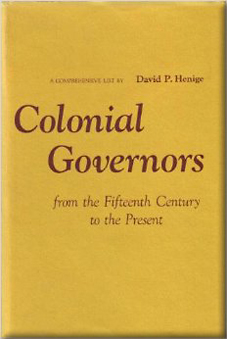
complete factual guide remains David Henige's Colonial Governors (1970), an
indispensable record of 'who was who' among colonial governors across the world from
the 15th to the 20th century. This, however, does not set out to be more than a list,
primarily for quick reference, of names and the dates of holding office.
Following my 1980 Biographical Dictionary of the British Colonial Governor, Vol I: Africa
(it may now be confessed that the reason Vol II never saw the light of day was
because a cost-conscious publisher balked at my calculations that up to a third of the
non-African colonial governors already featured in Vol I due to their one-time African
connections), today, in the 21st century, the colonial governor has earned a distinguished
place in the new (2004) Oxford Dictionary of National Biography (ODNB).
The ODNB carries entries on more than fifty colonial governors who died before
2000, all authoritative in basic biographical details and each enhanced with narrative
accounts of the subject's career, along with a critical attempt to put his record in an
evaluatory perspective. Every entry averages some 1,250 words but extending to twice that in the case of a few 'giants' like Malcolm Macdonald and reaching 5,000 for the venerable Lugard and
has been written by an invited and signed specialist. Besides the many new entries,
none which appeared in the original 33 volume DNB has been dropped, though all
these have been revised. In some cases the narrative profile is accompanied by a
photograph. In our Colonial Service context, members will be glad to find entries also
for such 'honorary members' as Sir Ralph Purse and Dame Margery Perham. My only
complaint (it would be, wouldn't it?) is the Oxford University Press's solecistic
disregard for the exactitude and common social observance of hyphenated surnames,
so that Arden-Clarke, quite illiterately, is listed under Clarke, Wyn-Harris as Harris
and Sharwood-Smith as Smith.
Covering 2,400 years of Britain's history, published in 60 volumes at #7,500 and
taking up as much as eleven feet of shelf-space, with 50,000 biographies and 10,000
contributors, it will come as a relief to learn that the ODNB is
also available by annual subscription to individuals and institutions on line at
www.oxforddnb.com providing desktop access to every biographical entry. In their
creation of people who "have shaped all aspects of British history", the editors reckon
that the ODNB outlines "the life story of Britain".
Also appearing in the opening years of the new century are two studies of linked
interest. The first examines the pedigrees of Britain's top diplomats to Africa during
the period since independence. The second study offers a career analysis of what I
once labelled Britain's 'post-colonial colonial governors', that is to say the latter-day
governors of Britain's overseas territories appointed by the ECO following the
landmark closure of the Colonial Office in 1966 (rather than the largely symbolic
date of 1997 when the Colonial Service officially ended, following the handback of
Hong Kong).
In Accredited to Africa: the British Diplomatic Representation and African Experience
(Diplomacy and Statecraft, 2004, 11, 79-128) I examine the career chronologies of every
British Head of Mission to 19 independent African States between c.1960
('independence') and 1995, setting out to identify the often-prized and one-time virtually
indispensable qualification of "African experience" among the 200 or so appointments
made by the ECO to Ambassador or High Commissioner to an African country during this period. What the detailed tables of biodata also reveal, maybe surprisingly to some
but not to most OSPA members, is the sizeable number of former DOs who, having
gained admission into the Diplomatic Service when their CO career came to an end,
concluded their 'second career' in a top FCO post in Africa.
On the related theme of charting the careers of Britain's overseas representatives on
a wider canvas than Africa alone, D G P Taylor has recently published a profoundly
researched and exceptionally interesting article, The Pedigrees of Post-Colonial
Governors, 1966-2003 (Diplomacy and Statecraft, 2006, 17, 425-446). His focus is on the previous experience of those appointed by the
FCO to governorships in Britain's "Dependent Territories", restyled "Overseas
Territories" in 1997. Based on dedicated research into the FCO files, he examines how
the FCO thought about and handled the appointment of some 100 'post-colonial
governors', a process now calling for very different representational responsibilities and
personal requirements from those obtaining in the CO territories before 1966. In
particular, Taylor asks how appropriate the prior experience of the post-colonial
governor has been in the FCO's assessment of his suitability for an appointment to an
overseas territory, during the period 1966-2003. "How far", he asks, "has the FCO
come to terms with the difference in the nature of appointment and what sort of people
have been appointed?" Once again, what is at issue is the relevance of the definition of
and the need for "previous experience" in the FCO's selection criteria and how
appropriate that experience turned out to be in the tasks which the governor was
required to perform. Hence Taylor's underlying thematic question of "What sort of
people have been appointed?". He is particularly strong in his account of the post-1966
FCO system for selecting its governors of overseas territories and in his interpretation
of the evolving policy background against which such appointments have been made.
On the Colonial Service impact Taylor notes that as many as one third of the governors
appointed from within the Diplomatic Service had been colonial administrators at some
stage in their careers. It is to be regretted that in research terms the publishers have
woefully undermined the value of this first-class article by failing to include the critical
tables of meticulously gathered biodata from which Taylor's interpretations derive and
on which his conclusions are based.
Overall, then, for the present generation of post-imperial historians such variables as
the background, career, mission, local achievements and political challenges, the
biographical presentation and the ultimate interpretation of the colonial governor, all
continue to reflect in - and maybe colour - the portrayal of Britain's 20th century
history. On the wider picture, such presentations are equally valid in helping the former
colonial territories and their citizens to fashion their view of their country's history in the
20th century. As the new (2007) school curriculum proposals aptly put it, "people and
societies involved in the same historical event may have different experiences and views
and develop a variety of stories, version, opinions and interpretations of that event".
Today, forty years after the closing of the Colonial Office, the literature on the CO's
colonial governors and now the FCO's post-colonial governors and heads of mission is
significantly enriched by the biographical profiles and analyses described in this article.
|