 |
|
|
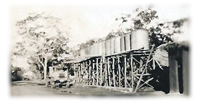
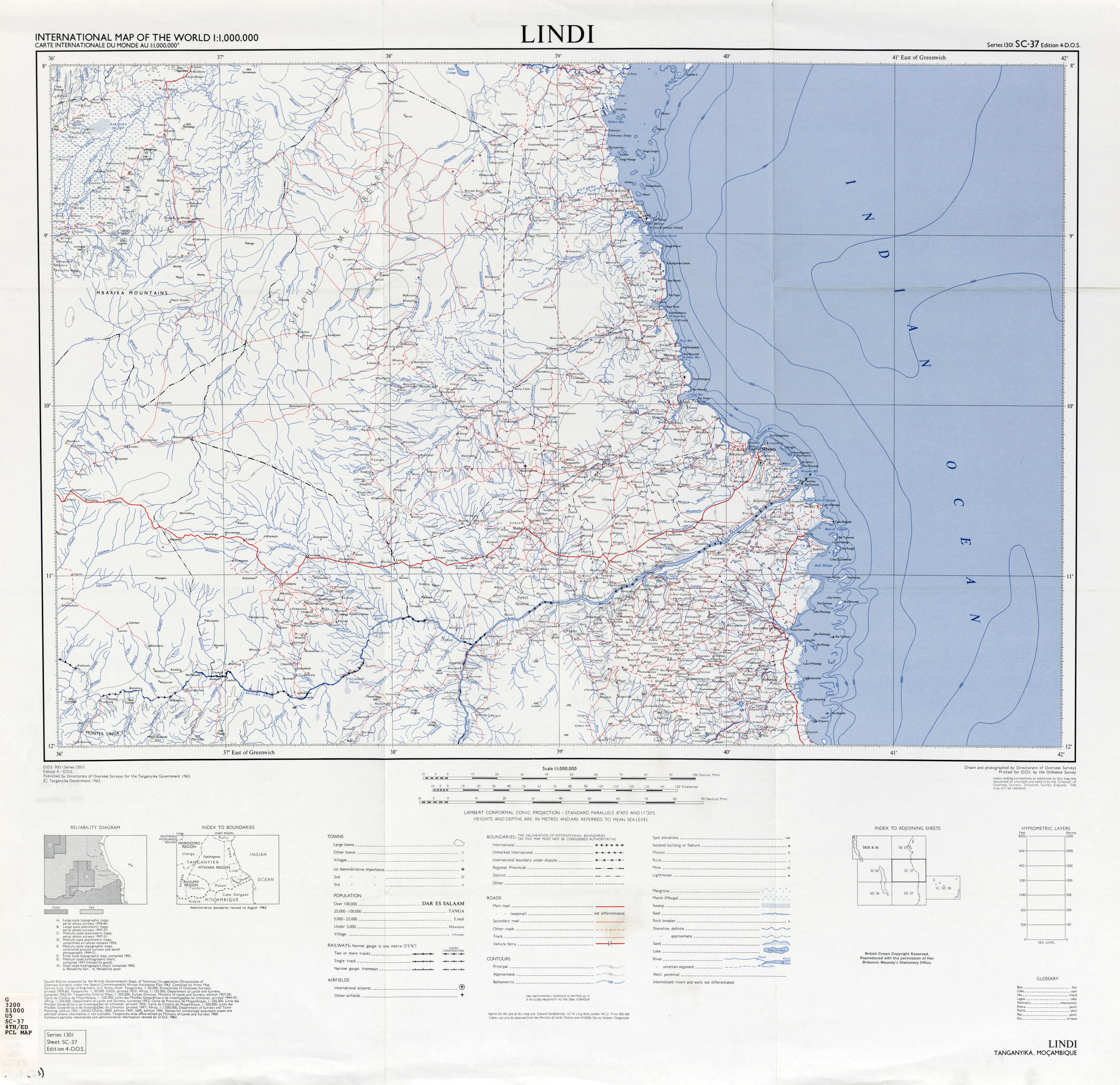
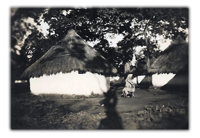
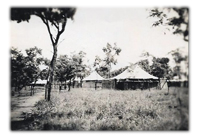
Here we are, on the edge of the jungle, about one hundred miles inland from the coastal town of Lindi in Tanganyika. It must have been quite primitive in terms of services, accommodation, facilities and such, but after six years of war, the blue skies, fresh air, peace and serenity probably blunted any misgivings such as ‘what on earth have we done?’ And of course Dad had already lived there for several months, which probably smoothed our pathway somewhat.
 |
|
|
Nach was more or less built from scratch to house those associated with the OFC (Overseas Food Corporation) project, which was mainly to produce a financially viable crop of peanuts, and this project was locally referred to as ‘the ground-nut scheme’.
I have written some detail of our time there in my biography of Dad, particularly regarding the various houses in which we lived. In terms of things creepy-crawly and poisonous, it was a veritable menagerie; certainly things we had not contended with in England. The ever present mosquito, necessitating we all swallow very large and vile tasting pills to guard against malaria. Large scorpions on patrol with their stinging tails curled up over their spine. The soldier ants who marched two by two in fascinating formation across the road, and woe betide anyone who dared split their ranks asunder. Snakes of course, but apart from having nearly trodden on one whilst on my way to our outside toilet, I cannot recall that we were ever really concerned about, or by, them. There were lions. We know this because one night, one of them decided to pay us a visit, and wandered around our verandah for a short time. We kept chickens which, despite being penned up at night, frequently became dinner for something else. I always was told the Dik Dik came and took them, but these are small antelope, vegetarians, so this is unlikely. It’s possible that one of the natives took the chooks, and blamed the wildlife.
 |
|
|
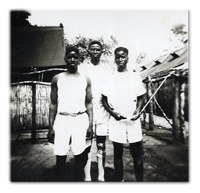
The jungle itself almost abutted our third and last house, being separated from our property only by a road. A dirt road, as were all roads in the district. ‘The jungle’ is probably an over-statement in that it was not wall to wall vegetation needing a machete to hack through. It was not hanging lianas and other vines that Tarzan could swing on. Our jungle was mostly very tall trees, with a leafy upper storey, through which little light penetrated, leaving the lower trunks relatively bare. There was little shrubby flora at ground level, just much leaf litter, quite gloomy, and we could not see the sun through the canopy. It was slightly hilly, and there was much space to run around. Often, when playing amid the trees, someone would yell, ‘monkeys’, sending us into panic. We turned tail and raced back across the road to the safety of home. Why we did so, is a bit of a mystery; if there were monkeys, they would not have been anything to worry about, unless we somehow managed to be bitten, and who was going to get that close?
 |
|
|
Apart from a few visits to kindergarten, I had not received any formal education prior to arriving in Tanganyika. There was no official, recognized school, not even a proper teacher, and in the early days, the number of school-age children may have been too low to be of concern. Despite this, we were still required to attend lessons, and each day we gathered in a small room, all ages together, and attempted to learn the necessary.
 |
|
|
Once a month, our lessons were flown into us. Each child received an individual hessian parcel that contained all the books and learning instructions appropriate to that particular child. The mothers took turns to supervise the class, and help each child with their lesson as best they could. There may have been a professional teacher among these mothers, but I remember it being informal and unstructured. The lessons we were sent were not onerous, the one thing we did all learn was that if we raced through all the exercises contained in the hessian sack within the first two weeks, sent the packs back whence they came, for correction, then we had absolute freedom from learning until the next lesson-drop, the following month.
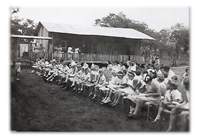
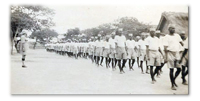
It was not until the second year that a purpose-built school was erected, with separate classrooms, and proper teachers arrived to keep us all in line, and make sure we did not remain uneducated, or enjoy as much freedom. Photos show two long buildings, made entirely of timber, set at right-angles to each other. The timber was probably the very trees that had been felled to make space for the school. Along one side of each building was a wide walkway, edged with a wooden slatted fence, with the roof overhanging to the fence-line to provide maximum shade. This school was for Europeans only.
 |
|
|
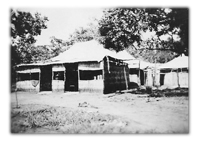
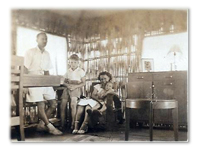
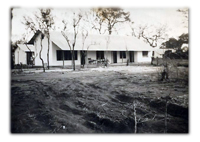
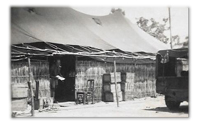
The first house we lived in had walls made of bamboo stakes, with a canvas slung over the top for a roof, and exposed earth for flooring. Apart from my encounter with the aforementioned snake, I have no memory of our time in this particular dwelling. It may have been a very temporary stopgap between our arrival and our ‘real’ house. This second house looked more normal; mud walls that had been whitewashed, an iron roof, and proper windows. It had three bedrooms, living room, and bathroom, although the toilet was still located outside, away from the house. The kitchen was separate from the main house, but joined thereto by a concrete path about six feet long, and contained a wood stove and a sink. It was separate because most households employed a native cook-boi, whose sole domain was the kitchen, and this configuration restricted his access to the main house. It could also have been a safety measure to not have the stove in the house in case of fire. In turn, we did not routinely venture into ‘his’ kitchen. Another small dwelling was built near the kitchen, the boi-house, where at least one of our domestic staff would reside, often with wife and children, all crammed into a tiny space.
 |
|
|
From the vantage point of our verandah on the mud house, we could watch both bush-fires and rain-storms approaching. Luckily the bush-fires remained at a safe distance but watching a rain-storm approach was fascinating. We would see storm clouds on the horizon, moving ever closer, until we could see the actual rain drops sheeting down in the distance. The rain seemed to move forward ‘en masse’, an enormous vertical block of water advancing our way. When it finally reached our garden, we watched this wall of water, as it sped towards us, soaking all in its path, then passing over the house to continue on its watery way.
 |
|
|
Our furniture was Government Issue, basic but functional, and the addition of personal purchases and things brought from England made this mud hut in the middle of Africa both comfortable and a real home. We had a gramophone of the old Edison variety with a brass ‘hearing-aid’ loudspeaker; of course it was not electric, but had to be hand-cranked and a goodly speed obtained before putting needle onto groove of a 78rpm record, accompanied by much teeth-clenching scratching. If we were lucky, we would get to the end of the music before the revs. ran down, but mostly we had to race to the machine and start cranking half-way through, this action upsetting the equilibrium and producing some interesting sound effects.
One day I was excused from class to go to the toilet. For some reason I did not want to use the school toilets, which, like all our toilets, were located away from the building, and were simply a seat over a substantial hole in the ground, ‘the cho’. Our house was on a corner just opposite the school, and I decided, without telling anyone, that I would run home and use our own toilet. When home, I went to see if the cook-boi was there, and in my haste, whilst flying across the path from the house to the kitchen, I fell over, taking all the skin off my nose. I did not go back to school, and when I did not return to class, they eventually sent someone to find out what had happened.
 |
|
|
The year after we arrived, I turned six, and was added to the tonsil take-out menu. Because we were so isolated, with only limited medical services, once a year the Surgeon would arrive, and all children who’d turned six since his last visit had to have their tonsils removed. There must have been at least ten of us scheduled at this same time. We were all gathered up late in the afternoon, and taken to the hospital. The ward we were put in was the same construction as our first house, that is bamboo walls and canvas roof, and it was furnished with a camp bed for each young patient. After we had all settled, Mother Nature decided that a tropical downpour might prove distracting for nervous young patients, and, accordingly, delivered one. It bucketed down, we all got soaked, and had to be relocated into a more water-proof environment, and were transferred into a permanent ward, made of mud with iron roof as was our present house. Proper beds too, with fresh, dry, linen. We were given an ‘inside’ toilet, located at the end of the ward, consisting of a large white chamber pot, resting on the seat of a low wooden chair, surrounded by a triple screen with metal frame and curtain material in each segment for modesty.
As a precaution against infection, before the operation we were given penicillin tablets. Large white pills that left a slightly sweet and slightly sticky after-taste. One young lad, Peter his name, did not want to take them, and each time he was given one, he would put it in his mouth, trot down to the toilet, and the next person to visit would find a large white pill residing on the bottom of the chamber pot. We were carted off, one by one, from the ward to the operating theatre. I have, probably a pre-op drug induced, hazy memory of being gurneyed past Dad who was standing at the door of his X-ray department, waving as he watched my progress.
 |
|
|
After the operation when we had all recovered, we received the bowls of ice-cream we had been promised, a bribe really, when trying to convince us, prior to the event, that this was a good thing. We spent a few more days in hospital, it being the safest, most hygienic place for us. It must have been close to Christmas, because as a reward, whilst still in the ward, I was given the doll that had been bought for my Christmas present.
Most of our food was regularly flown into us. Presumably we had no refrigeration; it must have been a challenge to store food for any length of time, and it is surprising we did not frequently become ill from a variety of reasons. The rations were initially taken into the ‘Store’ which acted as our grocery shop, and items were collected as and when needed, and when available.
Our butter came in large green and gold tins. Chocolates too. Cadbury’s Dairy Milk in a cream-coloured flattened oval tin, and Quality Street in a similar, but different coloured tin. Ordinary bar chocolate, always soft from heat, usually covered more of our fingers than we managed to eat. Most vegetables came in tins, it being virtually impossible to supply us with fresh produce. Entrepreneurial natives, both male and female, set themselves up as door to door salesmen, and would go from house to house selling various items. The most common food being bananas, which they would carry in a bowl on their head, and try to persuade us to buy. They would have several hands of bananas, in varying states of ripeness, and would pick up each hand, spruiking its virtues until we made a choice. Eggs too came via the home-delivery service. With these, we had to be more careful and test each egg for freshness before agreeing to buy it. This would be done by filling a bowl with water, placing each egg therein and waiting to see if it floated or not. If it sank it was deemed fresh, for if it floated, it meant there were pockets of air inside the shell which occurred as the egg aged and the contents shrank with the ageing. Sweet corn was another item that was hawked house to house, and it was obvious, by slightly peeling the silk back, whether the corn was of good quality. There must have been a local market where these items were for sale to all comers that would have been regularly visited, or the cook-boi despatched to make appropriate purchases.
 |
|
|
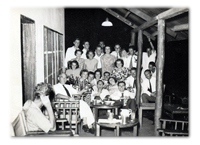
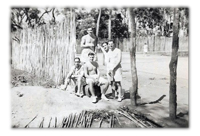
By nature of the location, proximity, and necessity, the social life was generated by those that lived there. A club-house was built, the ‘Four-mile Club’, where all would gather after work for ‘tiffin’ from the well-stocked bar. A tennis-court had been fashioned from a clearing in the jungle, a primitive clay-court surface, with a net and surrounded by bamboo fencing. It was a short walk to the court, the players would cheerfully make their way, all clutching tennis racquets, the men often playing bare-chested. Some carrying a panga to slash the odd recalcitrant piece of jungle attempting to block their path. All of them would be carrying a rifle, just in case. Most social events were drinks and dinner affairs which travelled from one house to another. Not surprisingly, this life-style attracted its share of misfits, remittance men, ne’er-do-wells and ‘fallen’ women. Gossip was rife, affairs started and finished, marriages began and ended. Men out-numbered women which did not always help the situation, flirting became an occupational hazard. Mum certainly had her share of admirers.
 |
|
|
Mum and Dad were close friends with Gladys and Arthur Hargreaves. Arthur was an architect. They had two daughters, Valerie, and a younger child, Ann who was my best friend. We were almost the same age, would wear each other’s clothes, and got into as much mischief as was possible. After playing with Ann at her home, around dinner-time, Arthur would walk me back to my house, maybe a mile or so away. We walked down a dirt road graded out of the jungle, Arthur swinging his walking stick, smoking his pipe, and conversing as though I were an adult. I enjoyed these promenades. Once he safely delivered me home, he then had a solitary walk back to his, which, as night was falling, when the sounds and smells of the jungle become amplified, must have been a little daunting. I suspect his walking stick was not carried, specifically, as an aid to walking.
Like all couples, Gladys and Arthur would entertain at home, with much alcohol being consumed at such times. Returning home after work one day, they found their house somewhat in disarray, with evidence of alcohol having been consumed during their absence. When asking young Ann what on earth had happened, she blithely replied, “you entertain your friends Mummy, I just entertained mine.” No children seemed to have been unduly affected, so what could they say?
Another time, Ann and I were larking about in the garden, and had borrowed the cook-boi’s washing-up bowl, filling it with water. He came looking for his bowl, finding said bowl with the young memsahib’s, demanded it back. Ann refused to give it to him. He got stroppy, she tipped the bowl of water all over him, dropped the bowl, and we ran away. Young lady’s indeed!
My hair was always very fine and very straight, and one day Mum decided to give nature a hand to improve it, by giving me a ‘home-perm’ using a ‘which twin has the Toni’ concoction. Despite her best attempts, and the awful smell of the perm solution, it did not ‘take’ and the whole exercise proved so fruitless that, fortunately, she never attempted it again. However she then tried to curl my hair the old-fashioned way. That is, twisting great locks of my hair into ringlets around a length of rag, then tying each of them off with a large knot. I was supposed to sleep each night wearing this crown of cotton thorns, then miraculously, the next morning, I would awaken with a mass of curls. It just never happened, and after a few futile and sleepless nights, my hair was left in all its straightness until it was professionally ‘afro’d’ in my late twenties – most successfully!
In those days, photography for the masses was simply ownership of a Box Brownie camera, and we were no exception. Dad took most of the photos, and because of his access to the dark-room in his X-ray department, he would develop and print our own black and white films. He probably did the same for others in the community, their only option being to send the films off, I suppose, to Dar es Salaam, or perhaps they had to be sent back to England for processing.
After having taken the photos, the reel of film was developed and then the roll cut into individual photos. To produce the actual photograph, Dad made a printing box. This was a hollow wooden cube, each side approx. A4. Inside he mounted an ordinary light bulb, and the switch to turn it on, was on the outside of the box. One wooden side, to be the top, was removed and replaced with a sheet of opaque glass. A sheet of cardboard the same size was placed on top of the glass, this cardboard having an oblong cut out of the middle to correspond with the size of the negative. The negative to be printed was placed on the glass in the cut out area, a piece of photographic paper was then placed over the negative, and another piece of card on top of that to keep the whole thing in place and keep the light in. The light switch was then turned on for the requisite amount of time and then turned off. The white photographic paper would be placed in a tray of developer and jiggled around until the picture appeared at a satisfactory depth of black and white contrast. The photo would be washed in another tray and placed in a tray of fixer to ‘fix’ the image. It was then washed again and hung up to dry - and voila - we have a photo. It was a very time consuming process, with each one being a completely separate operation. David and I were allowed to help by turning the light switch on whilst Dad counted out the number of seconds until we had to turn it off again. All very magical for a child, and every photo we still have from this time was produced with this process.
 |
|
|
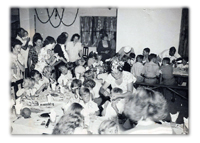
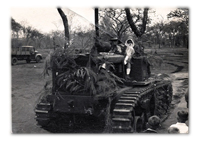
At Christmas time, a big party was held in the school grounds for pupils and parents. As expected, there was a large amount of cake and fizzy drinks to slake young appetites, and we all tried to do justice to the effort taken to provide the feast. The highlight of the day was the arrival of Santa Claus with his bag of gifts. No ordinary Santa with reindeer and sleigh for us, ‘Our’ Santa arrived on a bull-dozer, carefully manoeuvring his way across the school grounds. We were not deprived of Christmas gifts, and the selection and ordering of these had to be made well in advance to make sure they arrived in time for the big day. Someone may well have been despatched to drive to Dar with a big shopping list, being told not to return unless, and until, they had everything on that list. I was the proud owner of a tricycle, replete with bell and basket and shiny white mudguards. Also a large navy blue doll’s pram, for the doll I had been given when in hospital, and a doll’s house. David was given an air-rifle with which he took pot-shots at all and sundry, fortunately never causing serious damage to life or limb. An ‘A’ frame was erected in our back garden and a swing attached for us to play on.
We were also given a Christmas party in the clubhouse, with food arrayed on tables with cloths no less, and chairs that we had to actually sit on, rather than race around like the little savages some of us had become. There was a piano, and after feeding our faces, we had a sing-along.
I attended a fancy-dress party dressed as a Bibi, a child’s nanny. It may have been difficult to grasp what I was supposed to be, but it was easy to see that I appeared to be wearing the family curtains.
During our time in Nach we had four cats and four dogs, not at one time, but they must all have variously succumbed to one disaster or another, as the only photos of this menagerie are of me holding a cat, and probably the cat that nobody wanted because when a kitten, it had fallen down the big pit that was the toilet. The other animals certainly never died of old age, so maybe disease, distemper, snake-bite was the culprit, or they were taken by a passing native, as a pet, or an unexpected delicacy. My parent’s friend Tom, who spent much time with us, had a lovely dog, who tolerated our childish protestations of love with equanimity, and managed to survive all the tragedies that may have befallen ours!
 |
|
|
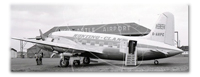
David did not want to stay in Nach, and after badgering Mum and Dad for a while, they agreed he could go back to England. This was August 1949, not long after we had first arrived. He was eight years old, and as now travelling on his own, he had to have his own passport, having travelled from England on Mum’s, as did I. It was quite an event having your own passport at such a young age. We had flown into Tanganyika on an ordinary plane, one with wheels and propellers, but lucky David, he got to fly back on a seaplane – a Somerset, and quite an adventure travelling all that distance on his own. It must have been a wrench for Mum and Dad to wave goodbye to their son at this time. I seem to have been nonplussed about it, and had no trouble instantly becoming an only child.
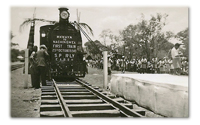
In October of that year, there was much excitement and anticipation, for a great iron monster was due to arrive; the railway was coming to Nachingwea. A line had been built from Mkwaya, near Lindi, on the coast, about sixty miles away. A platform and station had been built in Nach and an official ceremony celebrated the arrival of the first train on October 25th. The steaming monster duly arrived, and the front of the engine proudly carried the testimonial, ‘Mkwaya to Nachingwea. First train, 25th October 1949, S.P.RLY., E.A.R. & H’. There was a large crowd in attendance, many, many natives, most of whom would never have known what a train was, let alone seen one.
 |
|
|
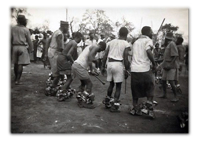
From time to time the natives would have a large gathering to celebrate some tribal or social event, such as marriage. They would gather in their hundreds on the outskirts of the town, complete the business, whatever it may be, and then party. There was much noise, probably fuelled by local alcohol, and as the night progressed the noise got louder and the dancing became more frenetic. Someone along the way had decided that some form of portable ‘music’ would be a good idea, and to that end had developed what was, essentially, a human tambourine. Many empty food tins were collected, a couple of holes pierced in them and they were tied around the lower leg and ankle of almost every attendee at any such gathering. Quite a sight to see all the people dancing up and down wearing a couple of dozen tin cans on their legs; not to mention the clanking noise it caused.
We did manage to learn a smattering of Swahili, certainly enough to get by. We learned to sing ‘One man Went to Mow’ in Swahili, and I can still count to ten in that language.
 |
|
|
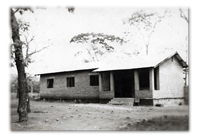
Our third house was in another new development, and was built of brick. It had security screens on all the windows, the façade was very plain giving it the appearance of a prison. The layout was very similar to the mud house, with the kitchen being separate to the house but connected by a path with a covered roof. We did have a garden boi, but there does not seem to have been much of a garden for him to tend. It certainly was not the lush tropical paradise one would expect. The only thing that seems to have been grown was a generous crop of sunflowers, which in every photo, are all taller than young Ann Hargreaves and I. There was no lawn, even though our block was quite large. The garden boi probably spent most of his time with a panga chipping away at the few patches of sparse native grass that popped up from time to time. The day we moved into this house, I was recovering from a bout of malaria, and not at all well. I travelled from our old house to the new one lying atop our furniture on the back of the removal truck. Another time, I developed a small spot on my cheek, just below my eye. It grew somewhat, becoming a trifle unsightly, so Mum decided to perform surgery – she squeezed the offending pustule. She was amazed, that for her trouble, she was now the proud owner of a mango worm! The egg must have somehow lodged itself under my skin, where it grew in comfort until Mum disrupted its gestation. I bore the scar of its birth for many years.
We'd always had a variety of servants at each of the houses, but for this one, we had four of them. A dhobi-boi who did the washing, a gardener, a house-boi who did the house work, and a cook, who produced the most amazing meals under the most primitive of conditions. David and I, in the early days, had been given an ayah, an Indian nursemaid, to look after us, but we so hated the intrusion in our affairs that we always chased them away, one after another. Mum and Dad, finally getting the message, left us to our own, perfectly safe (well, mostly) devices thereafter.
 |
|
|
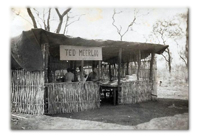
Dad was working at the hospital whilest Mum worked in one of the local Indian shops, I was at school, and our contingent of four domestic servants were left at home, ostensibly to take care of their individual chores. Our dining table was a large polished wooden one, of which Mum was quite proud. She had noticed a few unseemly rings marking its surface, but could not figure out how they had happened. One day, unbeknownst to the servants, instead of going to work, she was still at home. When she suddenly appeared in the dining room, the servants were flabbergasted, and suitably embarrassed, and Mum discovered the origin of the mysterious rings. It seems that, every day after we had all left, the servants would take morning tea in our dining room, seating themselves around our dining table, and the rings were caused by them placing the hot teapot directly onto the wooden tabletop. If they had used a pot coaster, Mum would never have known.
 |
|
|
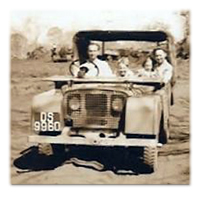
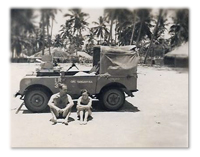
Dad had access to an OFC gharry (a land rover). It was a very basic means of transport, all metal, no padding, two seats in the front, the back tray being sheltered by a canvas strung over some supports. There was no cover over the two front seats, the occupants being at the mercy of the elements, and for some reason, the windscreen remained folded down flat against the bonnet. Probably to save it being constantly broken by stones thrown up whilst travelling over unmade roads. We travelled over much of the area in this machine, Mum and Dad in the front and us kids in the back. David and I surrounded with blankets and cushions, to prevent us finishing the trip covered in bruises from sitting on the gharry floor whilst it bounced and bucked its way over the dirt roads.
 |
|
|
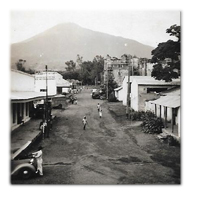
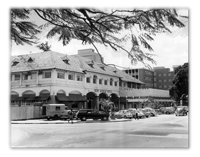
We had brief holidays, travelling to Zanzibar to spend a week on the island, or to Dar-es-Salaam, staying at the New Africa Hotel. Most memorable for its location across from a small side street housing the best ice-cream bar in the world. Seventy years later I still recall the taste of the banana splits they served; perfectly ripened slices of banana topped with fresh cream and home-made ice-cream. Our most frequent and preferred destination was Lindi, the nearest seaside town to Nach. We would drive there as often as possible and use the gharry as our hotel. David and I would sleep in the back of the vehicle, and Mum and Dad, and any others that had travelled with us, would sleep under the stars, a not unpleasant event given our location.
 |
|
|
In 1951 when Dad had completed his three years’ service, he was due for leave. We packed personal belongings to take with us, leaving everything else to await our return in three months’ time. Mum had bought silver and gold bangles to take as gifts for friends in England. Not wanting to declare them, thereby possibly paying import tax, it was decided to ‘hide’ them on their daughter. They were firmly wedged on my upper arm where they were hidden by the sleeve on my dress. However, they worked their way down to my wrist, and apparently I ran through the terminal calling out to my parents that my bangles had fallen down. Luckily, it was of no consequence to anyone. We flew back to England to a reunion with family and David. We did not know at this point in time that we were not to return to Nach and consequently never saw most of our treasured possessions again. |