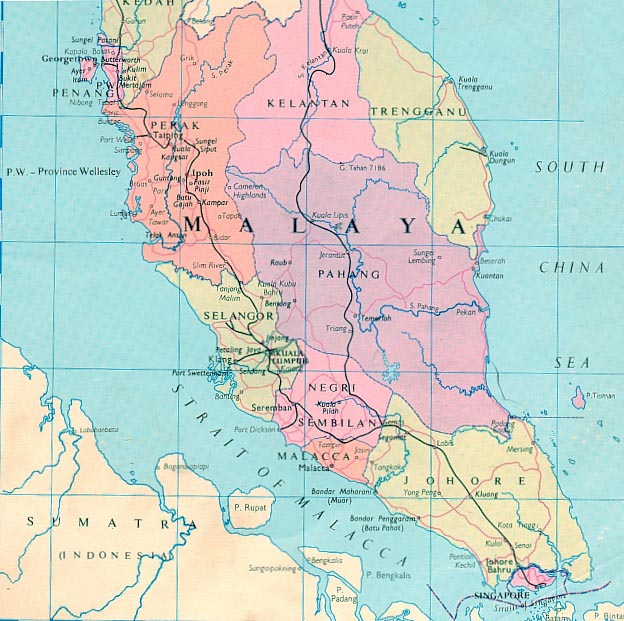
|
by Brian Stewart (Malayan Civil Service 1945 - 1957
|
I had just left hospital in late 1944 after an unequal fight with a tank in Normandy
and was told to report to the Colonial Office for an interview with Sir Ralph
Furse, the legendary recruiter of many Colonial Service cadets. It went as follows:
Furse: So you want to join the Colonial Service. Why?
Stewart: Well, Sir, it sounds like an interesting and worthwhile job.
Furse: Quite right! Would you like Kenya or Malaya?
Stewart: Malaya, Sir, since I am going there in the Army.
Furse: Right! Good luck in Malaya.
His system was roughly to read the applicant's face rather than reading the file
and it worked well as far as I could see. My colleagues were a pleasant, hardworking,
sensible bunch and we had no traitors.
About a year later in September 1945 I found myself still in the uniform of a Black
Watch Officer and officially a Staff Officer, wending my way east on slow Dakotas.
Then by train across India, troop ship to Singapore and finally puffing up the
railway line to Penang, stopping frequently to gather wood for our hungry engine.
It was a better way of entering Malaya than the previous plan which had assumed
an opposed landing on a beach on the west coast. Fortunately the atom bombs
had been dropped and the Japanese had surrendered.
It was late at night when we reached Penang so we went to sleep on the jetty under
the stars. The next morning I was off on a retired Japanese motor torpedo boat to
take command of the Refugee and Displaced Persons camp on Pulau Jerejak, an
island close by. I knew little about the island or the job. It had been an immigration
station before the war and was now the temporary home for thousands of Asians
who had been displaced by the Japanese and were anxious to get back to their
own countries.
There could not have been a more idyllic posting and a better introduction to the
varied peoples of Asia. But it was also a magical experience of rural Malaya. I still
remember vividly the beauty of the velvety nights with moonlight laying a silver
highway across the sea and phosphorescent droplets showering from the paddle
blade as I canoed around my little kingdom. But it was no use pretending that
OC Refugee Camp was likely to gain me a reputation in the Civil Service and so,
sadly, I asked for a normal posting and said farewell to my paradise.
I had a spell as a District Officer (DO) and then as Secretary to the Resident
Commissioner in Johore. In both places the local staff were immensely kind
and tolerant to the new boy but I was soon posted to the Chinese Secretariat
in Singapore to study Cantonese. It was a major step which affected the rest of
my life. My Resident Commissioner was displeased. "It would", he said, "ruin
my career", and he might well have been right had it not been for the imminent Emergency when Chinese speakers became greatly in demand. By the time I had
been to China and passed my Chinese exams the Emergency was in full swing.
I never had a normal administrative job for the rest of my time in Malaya and was
seldom to be found in an office. My in-trays were lightly burdened and I became
in effect a political intelligence officer with responsibilities more akin to those of the
Indian Political Service than to those of a DO or Secretariat wallah.
This was not the North West Frontier, however. I had lost my fodder allowance
when I left the payroll of the Indian Army and I travelled by boring car, but the
job was paramilitary and I kept my revolver handy, remembering the fate of my
predecessor who had been ambushed and killed on a back road in Malacca. It
was called the Emergency but it was of course a war.
I shall write about the sort of life we led and the work we did later but I want first to describe the organization to which I was very loosely
attached for the rest of my Malayan Civil Service career. It was known officially as
the Chinese Secretariat, and more colloquially as the Chinese Protectorate. There
has not, I think, yet been a historical account written about this curious colonial
institution. By the time I joined, it was no longer an influential department wielding
power under several Ordinances, considered to be an important liaison link to the
Chinese community, but had become a tiny rump of specialists with its tentacles
gone and its authority questionable. The Colonial Office had all but abolished
the Protectorate as part of constitutional changes undertaken during the war. In
effect I spent my years in Malaya trying to revive our prestige and rebuild the
links to the Chinese population, which had been so thoughtlessly destroyed but
were now needed more than ever, since the Emergency was basically a Chinese
insurrection in a territory where almost half the population were of the Chinese
(Han) race and rarely English-educated.
In my view the Colonial Office had been seriously at fault In the way It tinkered with
the constitution during a time when most of the Chinese specialists were either in
the jungle fighting the Japanese or in prison. Our first priority should have been
restoration of the status quo and restoring our "face" after the disgraceful defeat
at the hands of the Japanese. The Mandarins in Whitehall were unfortunate In
the timing of their decision to abolish the Chinese Protectorate just as the Malayan
Communist Party was preparing to move from subversion to armed struggle. Their
approach to intelligence seems to have been singularly unsophisticated and it
was extremely naive to expect that an effective Security Service could be created
simply by promoting the Director of the CID and seconding a few police officers.
To return to the Chinese Protectorate. It had originally got its name from an old
Ordinance entitled "Protection of Women and Girls", which was a law aimed above
all against the pimps and brothel keepers who made their living by exploiting
women and girls coming from China. This Ordinance was still In force and young Chinese girls would be brought before me and my job was to persuade them
that to go on the streets or be in a brothel was a bad idea. The alternative was
to enter our Po Leung Kuk (Institute for the Preservation of Virtue) where they
learnt housewifely arts and crafts and were eventually introduced to respectable
young men who could not afford the cost of bringing a bride from China. This was
a worthwhile endeavour but I remember one girl sobbing her heart out because
she did not want to change her ways since she was making so much money "on
the game". The pre-war Protectorate had also been engaged in immigration
work and Chinese Education but had in addition the much more vital function of
combating the Chinese secret societies or triads and this battle continued.
The triads were, like the Mafia, responsible for a wide range of criminal activities.
They had accompanied the growth of the Chinese population when immigrants
rushed in to take the tin-mining jobs which the Malays did not fancy, and since
they did not have their families with them there was inevitably a growing sex
industry. The triads battened on this rapidly increasing Chinese immigrant
community, running opium and gambling dens, the sex industry and protection
rackets. When the triads had originally progressed from crime to gang warfare the
Malayan Government sought help from Hong Kong, and Mr Pickering, a Chinese
specialist, was posted from Hong Kong towards the end of the Nineteenth Century.
He undertook an enquiry into the problems caused by the triads and made
recommendations as a result of which the Registration of Societies Ordinance
was born. The triad problem had roots in Chinese Imperial customs at the end
of the Ming dynasty. Mr Pickering had started his work from the proposition that
they had their origins in patriotic societies formed against barbarian invaders and
had developed into benevolent societies. He changed his direction later when, as
he was working on an Ordinance which would register these apparently virtuous
societies, an enraged Chinese, who presumably objected to his interference in
Chinese affairs, charged into his office with a meat cleaver and hacked at him.
The final version of the Ordinance made it a criminal offence to participate in an
assembly of more than six people and put the onus on those present to prove that
they were not members of a secret society.
The Chinese Secretariat worked with the police against the triads and provided
expert evidence of the esoterica of these secret societies. "Grass sandal", I
remember, was the title of a secret society's "Chief Detective". There was plenty
of mumbo-jumbo, spilling of cocks' blood and so on in ritual oath-takings.
But although the courteous Chinese still addressed us by fancy titles, such as
dai yan (great man) derived from Imperial China, and flattered us with reminders
that we were their "father and mother" officials, we were in fact toothless tigers.
The work was interesting: secret societies; banishment enquiries and adjudication
over Chinese disputes, but it was hardly at the centre of government and I felt
distinctly uneasy about the validity of our advice on Chinese affairs when our
official contacts were so limited.
The adjudication function was not governed by any Ordinance. We were mainly
faced with Chinese piaintiffs wrangling over rights to a share in the estate of some
deceased millionaire. They were mostly Chinese ladies all claiming to be widows
and might be principal wives (tsai)] secondary wives; concubines (tsip) or even
mistresses, all alleging they were entitled to a share in the estate. The chaos
was caused by the fact that the Chinese in Imperial times had no marriage law
or marriage certificates. The proof of marriage, in whatever degree, lay not in
a register but in the evidence that appropriate ceremonies and rituals had been
carried out.
It was not surprising this situation led to very acrimonious disputes. I don't suppose
a Scot in his twenties without any legal training was any less likely to arrive at the
truth than a Privy Council Judge. It was not legal niceties but the facts that were
at issue and at least, unlike the Western lawyers, I knew some Chinese. My bible
was a collection of studies going back to Captain Eliot RN's time in Hong Kong in
the middle of the Nineteenth Century. It made clear that there was little agreement
among lawyers, but since the Privy Council had decided in 1922 that six Chinese
ladies were each entitled to a share in one contested case, it seemed to me that
common sense, not legal training, was what was required. None of my cases
ever got anywhere near a court of law. The only serious problem that arose
was when a Cadet standing in for me was foolish enough to try to separate three
Chinese ladies engaged in a scratching match in front of his desk: he got badly
scratched for his pains. The best evidence of all was a photograph of a bride (of
whatever title) and bridegroom, appropriately dressed and surrounded by family
on the day of their union. Unfortunately such evidence was seldom available and
principal wives tended to have highly selective memories about the status of the
other plaintiffs. I found, however, when I was a Registrar of Marriages that great
importance was given to my being in photos of the couple being married as a
safeguard for the future.
| | Part 2 | |
I was finishing my Chinese language studies when the Emergency started
and the rest of my Malayan Civil Service (MCS) time was dominated by it,
with my knowledge of Chinese at a premium in the fight against a
predominantly Chinese rebellion. By the time I sailed sadly away in 1957 the
insurgents had been thrashed and had mostly retired across the border to
southern Thailand. Three years later, in 1960, the Emergency officially
ended.
Our victory was the only case in Asia of a colonial government beating off a
local insurgency and departing with honour. It showed that it was possible
for a western power to bring a colony successfully to independence, and that
the end of an Asian empire did not have to be the sad mess which it had been
for the Dutch in Indonesia and the French in Vietnam. The Malayan story
remains an important case study in many staff colleges with serious attempts
to learn lessons from it. Unfortunately, however, although the main
ingredients in our successful counter-insurgency campaign are not difficult to
identify, the formula is an almost impossible one to transplant to other places
where culture and society are bound to be different.
The problems were highlighted when Malaysia sent a small advisory mission
of former police and MCS officers to Saigon to advise the United States after
they had Intervened in Vietnam, where they tried for over ten years with vast
military and intelligence forces to defeat the Vietnamese communists there.
The two countries were very different. Both were In South-East Asia, had
been western colonies, and were battling Chinese-influenced communists,
but there the similarities ended. Malaya was predominantly a monarchic,
Islamist, traditional Malay society, and the insurgents were mostly atheist,
immigrant Chinese. The government was stable and the British back in
command after the Japanese occupation. In Vietnam, on the other hand,
there had been civil war since 1941; the enemy were ethnically Vietnamese,
not immigrant Chinese, and the US were only advisers to the ever-changing
and corrupt governments. There was no effective body to whom the
Malaysian mission could impart its experience. In these circumstances the
chances of replicating the Malayan success story were indeed slim, and the
communists duly won. Few international interventions in the post-colonial
world have had much success, however well-intentioned the foreign invaders
and whatever their military prowess and resources. Only a strong local
government has a chance of finding a satisfactory long-term solution.
The twelve years of the Malayan Emergency took place in stormy times when
the Dutch and the French had been forced ignominiously out of their
South-East Asian dependencies, and the Chinese Communists, having won
in China, were competing vigorously with the Soviet Union for leadership of
the Third World. Non-communists feared a domino effect with the smaller
Asian countries succumbing one by one to communism.
But the Malayan Government in 1948 was worried not about communism but
about Malay extremists, egged on by religious zealots from newly
independent Indonesia. The Malayan Communist Party's (MCP) move from
political action to armed struggle came as a complete surprise; even though it
was a continuing nuisance and causing industrial unrest, it had not been
seen as a serious problem. The minute, inexperienced, understaffed Malayan
Security Service (MSS) remained convinced until the day when the first
assassinations (of two British rubber plantation managers) occurred that the
only serious threat was from nationalist extremists. The MCP never rated
more than a paragraph in the MSS fortnightly summaries.
Strangely enough I have seen no reference in the history books to this
egregious failure., which is reminiscent, though on a far smaller scale, of the
obstinate refusal of the US Government to act on the 1941 assessment that
the Japanese might go to war and even attack Pearl Harbour, or of Stalin to
accept that Hitler had actually invaded the Soviet Union. There were several
reasons for the failure. One was that the Malayan Communists had been our
allies in the war against the Japanese, which had ended only three years
before. More importantly, the MSS no longer had a high level source within
the MCP while previously, up until 1947, the Party Secretary-General, Loi
Tak, had been on their books. Had he still been in position, the fact that the
MCP planned to move from agitprop to armed struggle would have been
known immediately. In 1947, however, Loi realised that he was in danger of
discovery and, taking with him his mistresses and the Party funds,
absconded to Thailand - where, however, he soon met a sticky end at the
hands of the local communists at the behest of their Malayan comrades - and
the MSS had not yet found a replacement.
I am not sure that any historians have seen the record of a somewhat less
than impressive meeting summoned by the Commissioner-General, Malcolm
Macdonald, to discuss threats to the country just before the start of the
Emergency. I found the minutes, among a complete set of MSS summaries,
in a shoe box in Rhodes House, Oxford. They were labelled as private
papers of Colonel Dailey, the Director of the MSS, with whom I myself had
worked on Secret Societies and on the demands for back payment by the
Chinese, many of whom were Communists, who had been recruited in 1941 to fight the Japanese. The nearest the august body of senior officers at
that meeting came to discussing the MCP was a proposal by the senior
Admiral present that it should be banned, as it had been before 1941.
Macdonald, son of a Labour Prime Minister, gave that suggestion short shrift
and reminded the old sea dog that Britain was a democracy.
I had by chance had dealings with some of the leaders of the MCP in 1946-47
and heard their complaints that the British Government owed them money for
their military service against the Japanese in the jungle alongside Force 136.
They were a nuisance, parading and gesticulating outside my office, but I had
no idea that they would soon return to the jungle this time to fight against us.
I was only concerned with their claims for back pay and one day, saying that I
seemed to understand the problem, they invited me to lead them on a march
to Government House. It was an amusing notion but I had to explain that I
did not want to lose my job.
There were perhaps twelve thousand armed terrorists In the jungle at the
beginning of the Emergency, among whom some who had been trained and
armed by us during the war against the Japanese had successfully
concealed many of their weapons when disbanded. The Communist
Terrorists (CTs) augmented their armoury with weapons captured In
ambushes, but there is no evidence that they ever received arms from
outside the country. The situation was dire, since although we had many
more armed forces the terrorists could choose the time and place for
ambushes or attacks on isolated posts and estates, roads and railways. It
took time to build an intelligence machine that could provide our jungle
patrols with the information they needed to bring the enemy to battle. Until
then superiority in numbers was no use, since fighting patrols might spend
weeks in the jungle seeking blindly for the wills-o-the-wisp with the only
enemies manifesting themselves being leeches, malaria, extreme humidity
and vast discomfort.
Although I was badged as an officer in the Malayan Civil Service and wore
the starched white linen MCS uniform on occasion, my duties were more
often of a para-military rather than civilian nature. This became even more
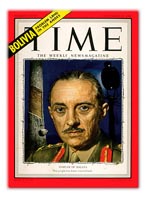
the case when General Templer arrived to take over the leadership of the
Malayan Government. Many New Villages, as the fortified settlements to
which most rural Chinese were eventually moved were designated, had
already been established. Night curfews, food controls and routine searching
of travellers and workers were already having some effect on the morale and
operations of the CTs. It was Templer, however, who brought government,
security forces and the loyal population together in concerted action against
the guerrillas. The New Villages were not, as some critics and fanciful
novelists averred, concentration camps but nor were they paradises. They
did, however, protect the Chinese rural population against the predatory and
cruel CTs.
General Templer Imported outstanding talent and an Emergency Information
Service was established. We worked all hours to enlist the public and I, for
instance, built twelve new schools, which would have won no prizes for
architectural excellence but did the job and one or two were still in existence
when I revisited them thirty odd years later. Great efforts were made to
encourage CTs to surrender and the invitation was delivered in a variety of
ways, including broadcasts from lorries and aircraft (using very loud hailers)
and leaflets dropped in the jungle.
The most successful pamphlets were probably those showing a beaming,
well-dressed Surrendered Enemy Personnel (SEP) carousing with his family
and inviting his comrades in the jungle to give up and join their families too.
They were a death warrant for any CTs caught by their leaders with them, but
many a tired, hungry, perhaps sick and certainly uncomfortable, terrorist
would have paused to think if he saw them, particularly if the person
portrayed was a senior cadre who had previously preached undying loyalty to
the communist cause. Soon the trickle of SEPs became a stream and then a
river.
My very independent life as Secretary for Chinese Affairs, Malacca, was
hugely satisfying and I spent my time plotting and planning with the police
and the army, or at some ungodly hour interpreting for a Special Branch
officer faced with a Chinese who wanted to confide in a British officer rather
than a local one. I had tied myself closely to Sir Cheng Lok Tan, the leader of
the Malayan Chinese who lived in Malacca, so whenever General Templer
visited Sir Cheng I was present and could put ideas directly to the
Commander-in-Chief, who in common with many outstanding officers liked to
deal with juniors as well as with the hierarchy.
Ideas which were usually too strong meat for the local committees always
found favour with the General and became directives and I won several
rounds with the hierarchy in this fashion. The most exciting example was his
backing of my proposal that we should nominate the Malacca Central District
as a "White Area", praising it as helpful to the government and sparing it the
discomfort and Inconveniences of the Emergency Regulations, which were
much disliked. General Templer, unlike my Malacca colleagues, saw the
point immediately: "tell the silly b........ to get on with it". So I did and soon the map of Malaya was peppered with white areas. The Communist high
command was perturbed by the claim that the population were beginning to
side with the government and the people were encouraged to help us.
Historians have not always given sufficient credit to Templer but I still believe
that without his drive and inspirational leadership the struggle might have
dragged on for much longer. His acerbic style and insistence on immediate
action must have been uncomfortable for many of those around him, but he
was the right man for the job. Lady Templer's contribution must also be
celebrated. When I brashly asked whether I could bring my Malacca Civics
Course students to their home. King's House, for tea, she agreed
enthusiastically and fully understood the importance of winning hearts and
minds. These tea parties were doubtless highlights in the lives of the people
who were bussed in to Kuala Lumpur, which may have been their first ever
visit.
Those were the days! Anyone interested in more personal memories will find
some good stories in the collection I published called Operation Sharp End: Smashing Terrorism in Malaya 1948-58. Memories of the Malayan Police. ,
(Acorn Publications, 2003, ISBN 978 1903263761) which was a tribute to the
Malayan Police who bravely fought the good fight to its successful
conclusion. ,
(Acorn Publications, 2003, ISBN 978 1903263761) which was a tribute to the
Malayan Police who bravely fought the good fight to its successful
conclusion.
|
|
|