|
In 1900, Lord Cromer, the magisterial
occupant of the British
Agency in Cairo, had cause to be
pleased with the shape of events.
In the 17 years during which he had
held power, the country had been transformed.
The Egypt that he had found
when he arrived in the summer of 1883 -
one year after British troops had landed
to crush Colonel Arabi's national revolt
at the Battle of Tel-el-Kebir - was sullen,
miserable and loaded with debt. Soon
after his arrival a series of military
disasters in Egypt's quasi-empire in the
Sudan had led to the triumph of the
Mahdi, the Sudanese Muslim "Messiah,"
and the death of the brave but eccentric
General Gordon in Khartoum.
By means of ruthless economies in every government department, Egypt’s financial credit had been restored and foreign capital was once again pouring into the country. British irrigation engineers, headed by a Scotsman of genius, Colin Scott-Moncrieff, had repaired and extended the ruined dams and irrigation canals. In 1900 the great Aswan Dam, an engineering wonder was nearing completion.
Cotton output and exports had greatly increased. The efficiency and honesty of all government departments had been improved by the introduction of upright salaried British officials. The burden of taxation on the peasants had been lightened and the use of the whip and forced labour drastically reduced. The police and the army had been re-organised and retrained so that by 1898 the methodical young Sirdar (Commander) of the Egyptian Army - Sir Herbert Kitchener, could defeat the Mahdist forces at the Battle of Omdurman. Nominally Britain and Egypt enjoyed equal sovereignty; in fact, Britain held the real power in the Sudan as it did in Egypt.
It was an odd situation. For both
constitutional and political reasons,
Egypt was most unlikely to become part
of the Empire. Theoretically, Egypt was
still part of the Ottoman Empire with the
Khedive as the hereditary Viceroy ruling
on behalf of the Sultan in Constantinople.
And other European Powers, who had
many long-standing rights and privileges
in Egypt, had watched Britain occupy
the country with a mixture of envy and
resentment and were determined that
Britain should not annex Egypt or
threaten their privileges. These privileges,
granted by the Ottoman Sultan and
known as Capitulations, were quite extensive:
they included the right to exemption
from Egyptian taxation and the
right to trial in their own consular courts.
Also, since 1880, the Powers had effective
control over Egypt's budget.
The home government did not want to
take on more imperial responsibilities.
Liberals and Conservatives alike were
anxious to withdraw from Egypt. But
they could only do so if it was secure; it
never was - there remained a permanent
danger of a national movement seizing
control of this vital link with Britain's
Indian Empire. The British could neither
relinquish control, nor seize it outright.
The result was the system known as a
"Veiled Protectorate": instead of Cromer
ruling directly as Governor or High Commissioner,
he did so from behind a screen
of Egyptian ministers and with a title no
more exalted than that of British Agent
and Consul-General.
From time to time British ministers
would repeat the assurances first made
by Gladstone in 1882 that Britain did not
contemplate an indefinite occupation of
Egypt. (One estimate is that the promise
of an early withdrawal was made 72 times
between 1882 and 1907.)
But gradually British control became
more imperial. There was always some
good reason why the withdrawal had to
be postponed, and the one that was most
commonly put forward was that the
Egyptians had not yet proved capable of
governing themselves. The trouble with
this excuse was that over the years it
became self-generating. Because Egyptian
ministers had no real power they had
no opportunity to show that they were
capable of governing Egypt. And as the
years passed Cromer's experience in
Egypt gave him such authority that his
judgement on Egyptian matters was
nearly always accepted in Whitehall. He
became a Viceroy in all but name.
In the first years of his rule, Cromer's
task was made easier by having to deal
with the colourless and unassertive Khedive
Tewfik, who owed his throne to
Britain and was quite prepared to act as
a puppet. All the key government departments
had British "advisers" who held
the real power. For much of the period,
Tewfik kept as Prime Minister Nubar
Pasha, a wily Armenian Christian who,
while feeling some genuine loyalty to
Egypt, had a lively awareness of the
extent of British power. When he was
discussing with Scott-Moncrieff the question
of appointing a Minister of Public
Works, Nubar insisted that he should be
an Egyptian but he added: "Do you want
an able-man or a non-entity?" "A non-entity,
please, your Excellency," Scott-Moncrieff
replied. "Ah, my dear fellow,"
said Nubar, "you are quite right. I shall
find you a non-entity," and was as good
as his word.
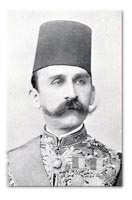
The situation changed briefly in 1892
when the Khedive Tewfik died and was
succeeded by his 18-year-old son, Abbas
Hilmi. Abbas, who reminded people more
of his grandfather, Ismail "the Magnificent,"
Egypt's last independent ruler,
than of his vapid father, was determined
not to be a puppet.
He was soon put in his place. Believing
that he would have the full support of the
Ottoman Sultan and France if it came to a showdown, he attempted to appoint a
new ministry without consulting Cromer.
Cromer threatened to call in British
troops and impose direct rule, and Abbas
resorted to asserting himself in petty
ways, such as complaining that British
officers were not showing sufficient respect
for his rank by wearing long boots
instead of trousers in his presence.
Finally, he went so far as to upbraid
Kitchener for the turn-out of British officered
Egyptian troops, who were
parading in his honour. Kitchener offered
to resign and Cromer, seizing his opportunity, forced the young Khedive to make
a humiliating apology.
Abbas's spirit was broken and from
then on he devoted himself increasingly
to his personal affairs and the enrichment
of his private estates. In 1903 Wilfrid
Scawen Blunt, an anti-imperialist, aristocratic
British poet who keenly supported
Egyptian nationalism, wrote sadly that
he found Abbas, in whom he had once
had high hopes, "grown older and less fat
and gay, with a rather harassed look, like
a man who had been worried and bullied."
Cromer, having won his battle with
"my poor little Khedive," as he disparagingly
called Abbas, tended towards
complacency about the British position
in Egypt. He was so convinced that the
benefits of British rule must be apparent
to any right-minded Egyptian that he
was apt to dismiss anyone who opposed
it as a hooligan or scoundrel whose
opinions were simply not worth taking
seriously. He tolerated a free press
because he did not regard it as important.
He ignored the violent denunciations of
the British occupation which they frequently
contained. His heaviest contempt
was reserved for what he called the
"Gallicised Egyptians," that is those who
had managed to acquire some higher
education in Europe or at the French controlled
law school in Cairo.
Cromer's attitude towards the Egyptians
was typical of that already found
among his British contemporaries in
Egypt. Even in the 1860s, before the
British occupied Egypt, a book on Egypt
was slated by a critic sympathetic to the
country for being filled with statistics but
barely mentioning the Egyptians: "The
people are not real people, only parts of
the scenery [to the author], as to most
Europeans." During the British occupation,
when there were scores of resident
administrators in addition to the visitors
from Britain, the situation hardly
changed. Upper-class Egyptians would
be invited to Residency receptions but
there were scores of English families who
devoted the best years of their lives to the
Egyptian service and saw nothing surprising
in the fact that their servants were
the only Egyptians to have entered their
villas in the European suburbs of Cairo.
The summers were regarded as intolerable
for Englishwomen and children and
they were sent home from May to November;
the men who remained behind
divided their days between their offices
and the Gezira Club. Though the raffish
pleasures and easy-going sexual attitudes
of Cairo and Alexandria attracted tourists
and refugees from Late Victorian and
Edwardian England, this hardly contributed
to mutual comprehension between
the two races.
The Egyptians themselves were despised.
The mass of them were industrious
valley farmers and not the romantic
aristocrats of the desert that attracted
men like T. E. Lawrence (who referred to
the fellahin in one of his letters as "such
worms"). At best the attitude of the
British reflected Cromer's avuncular
affection for the "child-like" peasants.
And they were virtually unanimous in
disliking and despising the new Egyptian
urban intelligentsia.
Cromer's complacency blinded him to
reality. It was perfectly true that these
bright young lawyers and journalists
were often superficial, irresponsible and
over-emotional and, moreover, divorced
by their education from the true feelings
of the mass of their fellow countrymen
who lived in the countryside. Yet they
represented a real and growing opposition
to the British occupation and the
chief reason why they lacked the wisdom
of experience was that Cromer denied
them any share of political power.
This new wave of Egyptian nationalism
found a natural leader in a slender and
passionate youth named Mustafa Kamil
(not to be confused with Turkey's great
nationalist leader, Mustafa Kemal.)
Kamil was one of Cromer's "Gallicised
Egyptians" who had hurled himself into
politics as a schoolboy and founded his
own party, the National Party, in 1894,
when he was only 20. He knew France's
leading pro-Egyptian political and literary
figures. He travelled in Austria and
Germany seeking support for his cause.
In Egypt the Khedive Abbas, defeated
by Cromer, nevertheless still supplied his party with funds.
In speeches and in the Press - in 1900 he
founded his own paper - Mustafa Kamil
denounced the British occupation.
This inevitably provoked Cromer's
accusation of Muslim "fanaticism" and
to counter this Kamil went out of his way
to widen his appeal. Kamil encouraged
both pan-Islamism and the Christian
Copts. He also cultivated his relations
with the Ottoman Sultan, as part of his
drive for outside support.
His charismatic vitality attracted an
immense following among Egyptian
youth, but he was soon to be disillusioned
about the outside support he could
expect for his cause. He came to realize
that Sultan Abdul Hamid might enjoy
intriguing against Cromer, but was not
prepared to risk war with Britain over
Egypt. Similarly, his French friends were
more interested in annoying Britain than
in helping Egypt to achieve independence.
Kamil's affection for France was
ultimately destroyed by the Anglo-French
Entente Cordiale of 1904 which,
among other things, gave Britain a free
hand in Egypt in return for an acknowledgement
of French paramountcy in
Morocco and Tunisia.
This greatly eased Cromer's task. He
chose to ignore Kamil and his National
Party (later, he even omitted to mention
their names in his Modern Egypt, which
he published in retirement) and to give
his cautious approval to a group of
moderates who founded their own party,
the Hizb al-Umma or People's Party.
Yet, ironically, one of Cromer's last
acts was to appoint, as Minister of
Education the party's rising young star,
Saad Zaghlul, who was to become the
champion of unfettered Egyptian in dependence
and Britain's implacable enemy.
Zaghlul's rise was aided when, in 1906,
an event occurred that permanently
embittered Anglo-Egyptian relations. In
June of that year a party of British
officers went out shooting pigeons in the
Delta village of Denshawai. The villagers,
who relied upon the birds for food, set
upon the officers. In the scuffle, one
officer, who became separated from the
others, was so severely beaten up that he
died of sunstroke on his way back,
despite the effort of a friendly Egyptian
fellah to help him. Both men were then
found by a party of British soldiers who,
assuming the fellah had murdered the
Englishman, beat him to death.
The incident had been caused by the
officers' insensitivity and by a misunderstanding
on both sides. But Cromer and
the vast majority of the European communities
saw it as a symptom of the
dangerous xenophobic nationalism
which, fanned by the nationalists, was
sweeping the countryside. The European
Press in Egypt demanded exemplary
punishment, a cry taken up by some
London newspapers.
Their demands were heard by a special
tribunal set up to try the villagers. Of the
52 accused, four were sentenced to death,
two to penal servitude for life, six to
imprisonment for seven years and the
rest to 50 lashes. The sentences of hanging
and flogging were carried out on the
site of the incident - and the villagers
were compelled to watch.
The effect on Egyptian opinion of the
savage punishment of the villagers was
electric. Editors, poets and politicians
combined to denounce the "atrocity" of
Denshawai. Many who had hitherto
hardly been touched by nationalist feelings
were converted overnight. Kamil gained a million followers at a stroke.
When Cromer, his term of office cut
short by declining health, left Cairo the
following year he was watched by silent,
hostile crowds who stood behind the
British troops lining the streets with
fixed bayonets. Despite his economic
achievements, Cromer left behind him a
country made restive by the faults of his
rule: his neglect of education, his increasing
authoritarianism, his dislike of opposition
and, above all, his refusal to allow
Egyptians any real power which indefinitely
prolonged the occupation.
Cromer's successor, Sir Eldon Gorst,
small, intense and bursting with ambition,
would have seemed just the man to
reform British rule if he had not been so
unpopular. His colleagues disliked the
Teutonic earnestness of purpose which he
showed as much on the tennis-court as in
his office. He was mistrusted by Cromer
and detested by Kitchener. To cap it all,
he owed his appointment in part to his
friendship with King Edward VII and
the King's mistress Mrs. George Keppel.
But the newly elected Liberal government
wanted a change of policy in
Egypt and he was politically and personally
ideal for the job. He had already
served in Egypt in the key post of financial
adviser. And he revelled in the power
offered by his position.
He commented gleefully in his journal : .
"Throughout the British Empire (though
Egypt never was formally in the Empire)
there is no place in which the occupant
enjoys greater freedom of action than
that of British Agent and Consul-General
in Egypt. The Consul-General is the de
facto ruler of the country, without being
hampered by a parliament or by a network
of councils like the Viceroy of India
and the interference of the home government
has hitherto been limited to such
matters as are likely to arouse interest or
criticism in the British House of
Commons."
Having decided on sweeping reforms,
Gorst summoned all Anglo-Egyptian
officials to Cairo and informed them that
he intended to promote Egyptians to
positions of greater responsibility. Most
officials were appalled and did nothing to
help Gorst carry through his new policies.
Gorst's task would have been easier if
he had succeeded in gaining the confidence of the Egyptian nationalists,
weakened in 1908 by the death of Kamil,
aged only 34. Gorst's strategy of giving
Egyptians greater authority was based
on restoring the dignity and self-confidence
of the Khedive, extinguished as a
political force years before by Cromer.
Egyptian nationalists suspected, not
without reason, that in promoting and
encouraging the Khedive, Gorst was aiming
to further weaken nationalist forces.
Agitation increased and the press
heaped a crescendo of abuse on Egyptian
ministers, as well as on the English
occupiers. One especially alarming aspect
of the situation was the deterioration of
relations between Egyptian Muslims and
the 10 per cent minority of Christian
Copts. This bitterness intensified when,
in 1908, with Gorst's encouragement, a
new government was formed under an
aristocratic Copt, Boutros Ghali Pasha.
Boutros Ghali was not only a Christian,
but he had also been President of the
Denshawai tribunal. In 1910 he was
assassinated as he was standing outside
his office by a young nationalist, Ibrahim
al-Wardani, and students joyously
chanted the name of his murderer in the
streets of Cairo.
Gorst's liberal experiment was at an
end. His attempt to change Britain's
Egyptian policy was praiseworthy, but
he had had no chance to learn from his
mistakes - in 1911, he died of cancer of
the spine - and Britain's Liberal government,
disturbed by the rising nationalist
feeling in Egypt, decided that a firm hand
was required. The man chosen for the
task was Kitchener.
Lord Kitchener of Khartoum (as he
had now become) was at the height of his
prestige. In 1905, as Commander-in-Chief of the Indian Army, he had
emerged victorious from a blazing row
with the Viceroy, Lord Curzon, on the
question of the Indian Army's submission
to Viceregal control, and Curzon had
resigned in disgust.
His vision of Empire matched his prestige.
He shared Rhodes's dream of an all red
route the length of Africa. He dreamed
of ending Turkey's nominal suzerainty
over Egypt and of creating a new viceroyalty
of Egypt and the Sudan, within
the Empire, with himself as Viceroy.
In pursuit of this vision, he reversed Gorst's liberal policies. Like Cromer, he
had a paternalistic regard for the welfare
of the fellahin, but his style was more open
and flamboyant: with his aura of prestige
he established himself as an archetypal
Oriental potentate, accepting petitions
from the humble and proceeding from
time to time on tours of the countryside
to observe how the peasantry was faring.
He firmly snubbed the "wicked little
Khedive," as he referred to him in his
private letters, and appointed more Englishmen
to senior positions in the administration.
He employed special powers to
suppress the nationalists so that their
leaders were either imprisoned or exiled.
However, he avoided the impression of
being purely coercive. Like Cromer; he
gave some cautious encouragement to
the moderate nationalists of the Umma
Party; he even sponsored a modest
constitutional advance through the creation
of a Legislative Council, some of
whose members were elected (others were
official appointees). Although the Council's
membership was confined almost
exclusively to wealthy landowners, not
even Kitchener could prevent it taking
on a nationalist character - especially
after Saad Zaghlul, who had resigned
from the government, became its first
vice-president.
Then, in 1914, the slowly developing
struggle between Egyptian nationalists and Britain was put in sudden abeyance
by the outbreak of War. Kitchener's
reign was cut short by his appointment as
Secretary for War. Meetings were barred,
the Press muzzled and the fledgling
legislative council closed down.
From the British viewpoint, there were
good strategic reasons for such stringent
controls. Turkey had entered the war on
the side of Germany, and Egypt, still
nominally part of the Ottoman Empire,
was theoretically enemy territory. After
some debate between Whitehall and
Cairo, in which outright annexation of
Egypt was considered, a British Protectorate
over Egypt was declared, replacing
Cromer's "Veiled Protectorate"; the
British Agent was re titled High Commissioner;
and the Turcophile Khedive
Abbas, who was caught by the outbreak
of war on a visit to the Sultan; was
deposed and replaced by his amiable
elderly uncle, Hussein Kamel, who was
given the title of Sultan.
Egypt was not to be formally incorporated
into the British Empire; its
people were subjects of the Egyptian
Sultan and not of King George V. But
Egyptians could be forgiven for failing to
see the difference. Although Egypt was
nominally neutral, martial law was declared
and British and Indian troops
arrived to defend the Suez Canal against
possible Turkish attack. With the launching of the Gallipoli campaign in 1915,
Egypt became a huge military transit and
hospital camp for the Allies. Australians
and New Zealanders (the Anzacs)
thronged the Egyptian bars and brothels.
(The annual incidence of V.D. ran up to
25 per cent in some units.)
 |
|
|
British control was, on the surface,
acceptable to Egyptians. Though the
Turkish Sultan, the Caliph of Islam,
called for all faithful Muslims to join in
a "jehad" or holy war against the Allies,
the Egyptians never responded to the
Sultan's appeal, even when the Turks
reached the Suez Canal. On the contrary,
Egyptian artillery units took part in the
defence of the Canal, and the Egyptian
Labour Corps and Camel Transport Service
between them contributed some
150,000 men to the Allied cause.
Though the British military authorities
were too busy with the conduct of the war
to be aware of it, the national movement
was not dead; it had merely gone underground.
The students in the cities were as
rebellious as ever. The fellahin in the
countryside became increasingly resentful
at the war measures, which included
the requisitioning of their draught animals
- more precious to them than their
children - the confiscation of their firearms
and the reintroduction of forced
labour. Profiteering by landowners, who
grew cotton instead of cereals, inflicted fearful hardship on the towns and led to
an outright famine in 1918.
Yet, even then, at the end of the war,
very few of the British in Egypt were
aware of the country's explosive mood.
It was thus a considerable shock when,
two days after the signing of the Armistice,
Saad Zaghlul, now universally acknowledged
as the unofficial leader of
Egyptian nationalism, presented himself
at the head of a delegation in the office of
Sir Reginald Wingate, the High Commissioner,
to inform him that the Egyptian
people wanted their complete independence
and that he would like to lead
his delegation to London to negotiate
with the British government.
They had good reason for confidence.
Declarations by the Allies, including the
United States, had promised self-determination
to the peoples freed from
Turkish rule. Already the Arabs of
Arabia, whom the Egyptians regarded
as more backward than themselves, were
looking forward to independence and
preparing to send a delegate to the Peace
Conference in Versailles. But British
imperial interests in Egypt were too
great for the government to consider
granting their request.
The Foreign Secretary, A.J. Balfour,
curtly replied that "no useful purpose"
would be served by Zaghlul's visit. He
later relented to say he would receive the Egyptian Prime Minister, Rushdi Pasha,
but not Zaghlul, who had no official
status. But Rashdi could do nothing
without Zaghlul and the massive support
he commanded, so the Egyptian Prime
Minister resigned with his whole cabinet
on March 1, 1919.
Thereafter, Anglo-Egyptian relations
deteriorated rapidly. Zaghlul called upon
the country to protest; the British
authorities in Egypt, making use of
martial law which was still in force,
deported Zaghlul and three of his colleagues
to Malta. In consequence, there
occurred what Egyptians. refer to as the
1919 Revolution.
Beginning with violent student demonstrations
and strikes, protest spread first
to civil servants and to professions and
then - to the astonishment of Anglo-Egyptians,
who believed the fellahin were
impervious to student agitation - to the
countryside. Telegraph-wires were cut,
railway tracks torn up and stations
burned down. Individual Englishmen
were murdered. In the worst incident
seven unarmed soldiers and one civilian
were killed and mutilated by a frenzied
mob on the train from Luxor to Cairo. At
each station along the line, the train
bearing the bodies was greeted with
shouts of joy.
General Sir E. Bulfin, commander of
the Egyptian Expeditionary Force,
mobilised all the troops he had available,
issued stern warnings to Egyptian notables
and government officials and dispatched
mobile columns to every trouble
spot; Planes bombed suspicious gatherings
and armoured cars fired on suspect
groups near roads or railways. Gradually,
the country was sullenly pacified.
News of the events in Egypt was as
unwelcome as it was unexpected to the
Lloyd George government, which was
heavily involved in the affairs of the
Peace Conference in Paris. They decided
to give full military and civil
powers to General Lord Edmund AlIenby,
who in 1917 had taken Jerusalem and then
forced the capitulation of Turkey, to
restore law and order in Egypt.
The result was an odd and welcome reversal
of policy. Despite Allenby's formidable
military bearing - he was known
as the "Bull" - he had strong liberal instincts. On his arrival in Cairo, he
quickly reached the conclusion that many
of the Egyptians' grievances were justified.
He also had a strong belief that the
Egyptians should be allowed to administer
themselves as far as possible. He
persuaded a reluctant British government
to allow the immediate return to
Egypt of Zaghlul and his colleagues.
Egypt went wild with joy, but Allenby's
hopes that the country would settle down
were disappointed. The nationalists continued
their campaign against the Protectorate;
strikes, protests, demonstrations
and occasional assassinations of British
officials continued. In this tense atmosphere
the British government, in December,
1919, sent out a high-powered
Commission of Inquiry under Lord Milner.
Milner had once been an arch-imperialist:
he had already served in Egypt and
written a justification for British intervention
there; and it was he who had
been the most powerful advocate of war
against the Boers in 1899. But now
almost 70, and exhausted by his years in
the War Cabinet, he had mellowed.
After a bleak and hostile visit to Egypt
- the nationalists boycotted him and the
moderates were afraid to offer their cooperation
- Milner reached the same conclusion
as Allenby: the Protectorate
would have to go.
It was not, of course, as simple as that:
Britain had important interests in Egypt,
which was still the vital link with the
Indian Empire and also the key to Africa
in which Britain had recently enlarged
her colonial possessions through the breakup
of Germany's East African Empire.
On Milner's return in March, 1920, he
recommended that both Britain and
Egypt should sign a treaty recognising
Egypt as an independent constitutional
monarchy but - to safeguard British
interests - with its independence qualified
in a number of respects, of which the most
important was the establishment of a
permanent military alliance.
It was hopeless: no Egyptian political
leader would agree to terms which implied
so many limitations to Egypt's sovereignty.
Some moderates might have done
so, but they did not dare take action in the
face of Zaghlul's opposition. On the
British side, many cabinet members, led
by the Secretary of State for the Colonies,
Churchill, strongly opposed accepting
even limited Egyptian independence.
Nearly two years passed in fruitless
discussions while, in Egypt, the strikes December, 1921, Allenby in exasperation
sent Zaghlul into a second exile, this
time to the Seychelles. The agitation died
down, but Allenby knew he had gained
only a temporary respite.
He decided to act: on February 10,
1922, he arrived in London with what
amounted to an ultimatum to Lloyd
George: either the Prime Minister declare
Egypt's independence or accept his resignation
(which would leave him free to
make a strong and influential attack on
the government in the House of Lords).
When the Prime Minister raised objections
at their meeting, Allenby cut him short.
"I have waited five weeks for a decision
and I can't wait any longer." "You
have waited five weeks, Lord Allenby,"
said Lloyd George. "Wait five more
minutes." He then capitulated and accepted
Allenby's proposals.
Britain's unilateral declaration of
Egypt's independence was made on
February 28, 1922. Sultan Fuad, who had
succeeded on the death of his brother,
Hussein, in 1917, became King Fuad I,
with considerable powers provided by a
parliamentary constitution. But independence
was severely qualified, for Britain
reserved rights on four matters: the
security of imperial communications in
Egypt; the defence of Egypt; the protection
of foreign interests and minorities;
and the Sudan. These matters were to be
the subject of bilateral negotiations at a
future date.
In other words, the hated Capitulations,
the military occupation (though it
was officially denied that the continued
presence of British troops implied an
occupation) and British control over the
Sudan were all to be retained. British
officials remained, though their numbers
were to be steadily reduced. And in recognition
of Britain's privileged position in
Egypt, Allenby retained the title of High
Commissioner instead of becoming
Ambassador.
But there was no denying that British
influence had been severely reduced.
Instead of the British Residency being
the only real centre of power in the
country, it had to share it with the
Palace and Zaghlul's party, now known
as the Wafd, after the Arabic for 'delegation' in commemoration of the original
group that Zaghlul had led to see Wingate
in 1918. Their three-cornered struggle
lasted with varying intensity for the next
30 years, providing the dominant theme
in Egyptian history until Nasser's rise to
power in the 1950s.
Zaghlul returned from exile in 1923 to
triumph the following year in Egypt's
first parliamentary election, from which
he emerged as Prime Minister. But
Zaghlul's hopes of reaching a settlement
of the four reserved points with Ramsay
MacDonald's newly elected Labour
government were soon dashed: Labour
was, it turned out, as mindful of imperial
interests as the Tories.
Agitation once again increased, especially
over the vexed question of
British rule in the Sudan. On November
19, Sir Lee Stack, the Sirdar of the
Egyptian Army (who was also by convention
Governor-General of the Sudan),
was murdered as he was driving through
Cairo by a group of Egyptian terrorists.
Allenby's reaction showed how far
Egypt's sovereignty was still limited.
Without awaiting Foreign Office instructions
he issued an ultimatum which included,
apart from the condign punishment
of the criminals, the payment of a
£500,000 fine, the banning of all political
demonstrations, the withdrawal from
the Sudan of all Egyptian officers and
units, an unlimited increase in the irrigated
area in the Sudan (at the expense
of Egypt's share in the Nile waters) and
the withdrawal of all opposition to the
British government's wishes concerning
the protection of foreign interests.
When Zaghlul's government rejected
several terms of the ultimatum, the British
expressed their determination to enforce
them and occupied a customs post to
prove it. Helpless, Zaghlul resigned.
Nothing, however, changed. The dapper
little Lord Lloyd, enthusiastic imperialist
and close friend of Winston Churchill, who
succeeded Allenby and served as High
Commissioner from 1925 to 1929, put his
finger on the anomaly of Britain's role in
Egypt in a letter to a friend. "Our present
position is impossible... We cannot
carry on much longer as we are. We have
magnitude without position; power without
authority; responsibility without control. I must insure that no foreign
power intervenes in education, aviation,
wireless communications, railways or
army. (where all seek to do so) and I must
achieve this without upsetting the parliamentary
regime which we forced upon
the country in the face of the king's
wishes; without weakening the power or
alienating the loyalty of the monarchy
which we set up, and without displaying
the military power which is in fact our
sole remaining effective argument. I must
maintain and respect Egyptian independence
and yet justify our army of
occupation."
It was an impossible situation, rendered
many times more complex by the British
need to fight both King and the Wafd, and
by the struggle between these two. Although
Lloyd was strongly critical of the
system he had inherited from Allenby, he
honestly attempted to make it work to the
extent of putting pressure on King Fuad
to respect the parliamentary constitution.
This the King was unwilling to do.
King Fuad (and his son Farouk, who succeeded him in 1936) saw the Wafd
rather than Britain as his enemy. Whenever
elections were held under the 1923
constitution the Wafd, as the only party
with mass support, always won a sweeping
victory. The King would bide his time
until the Wafd committed some act of
folly, as it invariably did, which enabled
him to suspend or amend the constitution
to rig the elections, send the Wafd into
opposition and rule through some forceful
independent of his own choosing.
Popular pressure would then build up
until he had to restore the constitution
and allow the Wafd to return to power.
In June, 1930, King Fuad once again
succeeded in getting rid of the Wafd,
dissolving Parliament and suspending
the constitution. Five years of quasi-dictatorship
began. Inevitably popular
agitation grew for the restoration of the
constitution and Parliament. In 1936,
just before his death, Fuad gave way.
The Wafd returned to power - and in
an odd reversal of its extreme nationalist
policies, signed the treaty suggested under the terms for independence. Six attempts
to reach a treaty agreement with Britain
had been made during the previous 14
years by various governments and all had
broken down - usually over the Sudanese
question. There were, however, good
reasons for signing. With the chastening
experience of many years out of office,
the Wafd had come to realize the disadvantage
of fighting both the Palace
and the British at the same time. And
they had become thoroughly alarmed at
the rise of Fascism: Mussolini's imperial
ambitions in Africa, against which Egypt
would be virtually defenceless without
Britain as an ally.
The treaty, under which Britain retained a
dominant if diminished influence,
was to run for 20 years; both parties were
committed to negotiating a further
alliance in 1956, when Egypt would have
the right to submit to third-party judgement
the question of whether British
troops were any longer necessary in
Egypt. The British occupation of Egypt
was formally ended, though British troops were to remain in some areas. As Egypt's
self-defence capability improved, they
would be withdrawn gradually to the
Canal Zone and Sinai where their numbers
would be limited to 10,000. And
Britain reserved the right of reoccupation
with the unrestricted use of Egyptian
ports, airports and roads in war-time.
It was, nevertheless, an advance towards
total independence. Egypt gained
control over its own security forces for the
first time since 1882. The British High
Commissioner became an Ambassador.
An Egyptian replaced the British
Inspector-General of the Army and the
country's military intelligence was
Egyptianised. The number of Europeans in the police was to be reduced by 20 per
cent a year, although an Englishman,
Thomas Russell, scourge of narcotics
pedlars, remained head of the Egyptian
police until 1946. Britain sponsored
Egypt's entry into the League of Nations.
The Capitulations were finally removed
and Egypt obtained full rights of jurisdiction
and taxation over all residents.
A new and hopeful period seemed to
have opened. The treaty was popular:
the Prime Minister, Nahas Pasha, and
even Sir Miles Lampson, the British
Ambassador, were cheered in the streets.
Fuad's young successor, Farouk, a handsome,
outgoing 16-year-old, was wildly
popular with his subjects.
This heady mood of optimism did not
last. Farouk, although not unintelligent,
was spoiled and wilful. With astonishing
speed, the golden boy-king declined
morally and physically into a corrupt,
frivolous and premature middle age which
made him an object of ridicule. Then, in 1939, practically all the advantages Egypt
had gained by the treaty were destroyed
by the outbreak of war: once again Egypt,
virtually an ally under the terms of the
1936 treaty, was occupied by a huge
imperial army.
At first, there was no apparent loss of
harmony. But Italy's entry into the war
in June, 1940, transformed the situation.
Many Egyptians both expected and hoped for an Axis victory, not out of
sympathy with Fascism but because they
believed it would finally rid Egypt of the
British. (One such Egyptian was the
young Captain Anwar Sadat, now Egyptian
President, who was caught by British
Intelligence and interned for spying for
the Axis.) Winston Churchill, who had
never shown much sympathy for Egyptian
nationalist feelings, declared it was
intolerable that Cairo should be a "nest
of Hun spies" and gave orders for the
dismissal of the pro-Axis Egyptian Chief
of Staff and the removal of all Egyptian
troops from the front line.
Matters came to a head in February,
1942, when General Rommel was advancing
into Egypt from Libya and his
name was being chanted in the streets of
Cairo. Farouk, who was anyway suspect
for the numerous Italians in his entourage,
was thought to be on the point of appointing
a new Prime Minister with anti-British
and pro-Axis sympathies. On
February 2, 1942, the Abdin (Abdeen) Palace was
surrounded by British tanks and the
towering figure of Sir Miles Lampson
forced his way into the King's presence to
present him with a choice between
abdication and forming a Wafd government
under Nahas. To Lampson's dismay,
because he had hoped to be rid of
Farouk, the King gave way and reluctantly
sent for Nahas. For the rest of the war the Wafd fulfilled Britain's
wishes, although it would not be until 1945 that Egypt finally got around to officially declaring war on Germany.
After the war, the Egyptian government
believed that the country's fulfilment
of its treaty obligations during the
war gave it the right to generous treatment
from Britain. The decision had
anyway been taken to grant independence
to India, removing the chief historical
reason for the continued occupation of
Egypt. In 1946 Britain accepted the
principle of total evacuation, but once
again failed to reach a firm agreement on
terms: Egypt refused to accept British
sovereignty over the Sudan. British
troops remained in the Canal Zone,
80,000 of them, eight times as many as
stipulated by the 1936 treaty, a constant
affront to Egyptian pride.
The nationalists, initially incensed by
Farouk's feeble capitulation and the
Wafd's war-time collaboration with Britain,
now had an additional grievance. In
the Army, an organization formed during
the war by a brilliant young captain,
Gamal Abdel Nasser, plotted the overthrow
of the monarchy.
The regime tottered from crisis to crisis.
In 1948 its ill-trained and ill-equipped
army suffered a humiliating defeat at the
hands of the new state of Israel. In 1950
King Farouk turned in despair to his old
enemies, the Wafd, who, still anxious to
prove their soiled nationalist credentials,
stepped up the anti-British campaign,
denounced the 1936 treaty unilaterally
and launched a sabotage and guerrilla
campaign against the Suez Canal Zone.
In January 1952, after a particularly
severe British act of retaliation against
Ismailia police headquarters (film), which were
being used as a centre for guerrilla
activity, a frenzied Cairo mob burned
the centre of the city, concentrating their
fury on buildings with British and other
foreign associations. It was not until the
evening that either the King or the
government made any move to call in the
army to restore order.
When they did they were prompted by
the real fear that the British might intervene
from the Central Zone. No Egyptian
in authority had forgotten that the riots
in Alexandria had been the chief justification for the British invasion of Egypt 70 years before. A plan had already been
worked out with the British commanding
officer in Suez to intervene to protect the
lives and property of British subjects and
they could have been in the capital within
a few hours. The Egyptian Army's move
to clear the streets of rioters removed the
threat of a new British occupation in the
nick of time.
The King blamed the disaster on the
Wafd and dismissed Nahas. But the
country was now virtually ungovernable.
As a result, in July, 1952, Nasser's
Free Officers were able to overthrow the
monarchy and parliamentary regime with
astonishing ease. The British made no
attempt to intervene. At first, all went
well with the new government. Whatever
Britain's doubts about the ability of
a bunch of young colonels to govern
Egypt, they seemed able to maintain
order and protect foreign interests.
They also showed political sagacity
by announcing their
willingness to separate the Sudan
question from that of the Suez
Canal Zone and the British base - a
move that could have solved Anglo-Egyptian
difficulties at a stroke.
It was also an astute move to oust
Britain from the Sudan, and preserve
Egyptian influence there. Over the years
of Anglo-Egyptian deadlock since 1936,
Britain had acted unilaterally to establish
the Sudan as an independent, pro-British
entity. In 1948 an elected Legislative
Assembly was formed representing
the whole country. When, in 1951, Egypt's
Wafdist government declared Farouk
King of Egypt and Sudan and enacted its
own Sudanese constitution, Britain refused
to recognize the move and proceeded
with plans for Sudanese self-government
under a British governor-general.
The situation was entirely changed by
the Egyptian coup of July, 1952. The new
regime formally accepted the right of the
Sudanese to self-determination and therefore
to the choice of independence. The
Free Officers thought they were calling
Britain's bluff because they honestly believed
that, once they were given a free choice, the majority of Sudanese would
opt for union with Egypt.
Having accepted the principle of self-determination,
both Britain and Egypt
had to run the risk that, at the coming
elections, the Sudanese would choose full
independence. To Britain's dismay, the
elections were won by a coalition of
groups which stood for union with Egypt.
But also, to Egypt's dismay, the Sudanese
nationalist parties at once about-faced
and expressed their desire for complete
independence. In August, 1955, the
Sudanese Parliament passed a resolution
demanding the evacuation of both British
and Egyptian forces from the Sudan. On
January 1, 1956, the flag of the Sudanese
Republic was raised and the 57-year life
of Cromer's curious brainchild, the Anglo-Egyptian
Condominium, came to an end.
Egyptian and British disappointment
over the result of the Sudanese settlement
did not improve relations between the
two countries, but it opened the way
towards an agreement on a British
evacuation of Egypt - the principal goal
of all the Free Officers. Negotiations
were prolonged and difficult because,
although British military opinion had by
now conceded that Egypt was no longer
vital to British or Western defence
strategy (especially since Turkey had
entered N.A.T.O.), they were still anxious
to retain several thousand British troops
to man the installations at the Suez base.
This was the one concession that the
young Colonel Nasser, who was leading
the negotiations for Egypt, would not
make: he would accept civilian technicians,
but not soldiers in uniform. In
return for a complete military evacuation,
he was prepared to agree to the reactivation
of the Suez base in event of an outside
(i.e. Soviet) attack on any Arab state
or Turkey. In the end, a formula was
found whereby the base installations
would be maintained on a seven-year
lease with a cadre of British civilians on
contract to British firms. The final agreement
was signed in Cairo on October 18,
1954. On March 31, 1956, some three
months earlier than was provided for in
the agreement, the last British troops
pulled out of their base in Port Said.
|
|
At the signing of the 1954 agreement, Nasser remarked: "A new
era of friendly relations based on
mutual trust, confidence and
co-operation exists between
Egypt and Britain and the Western
countries... We want to get rid of the
hatred in our hearts and start building
up our relations with Britain on a solid
basis of mutual trust and confidence
which has been lacking for the past 70
years."
It was not to be. The antagonisms engendered
during the negotiations over the
Sudan and the Suez base grew into something
much worse. In 1954, Gamal Abdel
Nasser began to look far beyond Egypt's
borders towards the creation of a neutral
and independent Arab bloc under Egyptian
leadership allied to other nations in
Africa and Asia. The British government,
still inclined to patronise Egypt as a
natural Western satellite, soon came to
regard Nasser's revolutionary regime as
a mortal danger to the remaining British interests in the Arab world.
The Prime Minister, Anthony Eden,
developed an almost pathological hatred
of Nasser whom he regarded as the source
of all Britain's troubles in the Middle
East. When King Hussein of Jordan dismissed
General Glubb, the British commander
of his army, Eden wrongly
assumed Nasser was responsible. He
shouted at Anthony Nutting, Minister of
State at the Foreign Office : "But what's
all this nonsense about isolating Nasser,
of 'neutralising' him, as you call it? I want
him destroyed, can't you understand?"
Both the opportunity and the grounds
were soon to be provided. In 1955 the
Western Powers had not altogether given
up hope of keeping Egypt within their
orbit. Their weapon was two-edged:
economic control which would, it was
assumed, lead to political control.
The U.S. and British governments
began discussions with Egypt to finance
the building of a huge dam on the Nile
south of Aswan. Desperately worried by Egypt's breakneck population growth,
which was not being matched by increased
production or exports, the Free Officers
were pinning their hopes for the future on
the dam and encouraging the public to
do the same.
In February, 1956, a provisional agreement
was announced by which the World
Bank would lend $200,000,000 on condition
that the U.S. and Britain would
between them lend another $70,000,000
and Egypt provide the equivalent of
$900,000,000 in the form of local services
and materials.
The West attached stringent terms to
the loan which Nasser hesitated to accept.
When he finally made up his mind it was
too late. On July 19, the U.S.
Secretary of State, John Foster Dulles,
coldly informed the pro-American Egyptian
Ambassador in Washington that the
U.S. had decided not to give any aid to
the dam because the Egyptian economy
was too unstable for so large a scheme.
The World Bank and Britain at once
withdrew their offers.
To the surprise of the West, Nasser
retaliated. A few days later he told a vast
cheering crowd in Alexandria that the
Suez Canal - "our canal" in his own
forthright words - had been nationalised.
Egypt would build the High Dam with the
revenues from the Canal and if the
imperialist powers did not like it they
could "choke in their rage."
There was apparently no way of stopping
him. Most Egyptians were delighted,
for the Suez Canal Company was widely
hated as a symbol of foreign exploitation.
And according to international law, the
act of nationalisation was impeccable
because Nasser offered full compensation
to the shareholders. This was implicitly
acknowledged by Eden when he dismissed
any discussion of its legality as" quibbles."
At once, Eden began to discuss with his
colleagues means of bringing the strongest
political pressure on Egypt to accept
international control. If this failed, he
was determined to use force. His difficulty was that while many countries, including
Egypt's friends such as India, disliked
the way in which Nasser had nationalised
the Canal Company the great majority including
the United States - were
resolutely opposed to the use of force.
However, Eden, whose hatred of Nasser
had reached a point by which he was no
longer rational, was supported - even
when the invasion was launched - by
most of his colleagues and much of the
British press and public. (Indeed, the
Labour Opposition developed a campaign
against him only when it realized he was
planning a military adventure.) The so called
Suez Group of right-wing Tory
M.P.s who had opposed the 1954 agreement
with Egypt now claimed to have
been justified. As one of them put it: "The
Suez Canal and the area surrounding it
are in some essential sense part of the
United Kingdom." And on the day of the
invasion itself, a newspaper headline
crowed: "It's Great Britain again!"
Eden also had the full support of the
French government, led by the Socialist
Guy Mollet, which had convinced itself
that Egyptian support was keeping the
Algerian Rebellion alive.
By the end of July, British and French
ministers were preparing joint plans for
the invasion of Egypt. Early in August,
Eden announced partial mobilisation; the
proclamation was rushed to the Queen at
Goodwood races where she signed it on the
rump of a racehorse. Meanwhile, Britain
and France pursued their efforts to impose
international control on the Canal, but
since it was reasonably certain that Egypt
would reject internationalisation they
also went ahead with plans for military
intervention. In August Britain invited
the principal Canal users to a conference
in London. A few days before the conference,
Eden, speaking on TV, referred
to Nasser in such insulting terms ("a man
who cannot be trusted to keep an agreement... We all know this is how fascist
governments behave") that, as he must
have expected, Egypt refused to attend.
A majority at the conference endorsed a
U.s. proposal for international control.
This was taken to Cairo by the strongly
pro-Eden Australian Premier, Robert
Menzies, and, to no one's surprise, was
rejected by Nasser.
The next Anglo-French step was to withdraw all their pilots from the Suez
Canal Company in the expectation that
this would slow or stop traffic and provide
an excuse for intervention. The scheme
failed because the Egyptians, by working
overtime and hiring some extra pilots from
sympathetic nations, managed to keep
the Canal running normally and even to
increase traffic.
In September, the Eden government
began to think in terms of collaborating
with Israel in an attack on Egypt. Israel
had its own reasons for wishing to invade.
It had been in a state of war or semi-war
with Arab states since its foundation
eight years before; Arab invaders were
continually mounting raids across the
border from Sinai and Egyptian vessels
had blockaded the Gulf of Aqaba, Israel's
outlet into the Red Sea. France was
already in close contact with Israel and
Britain was now brought in to form a
tripartite anti-Egyptian front. The plan
was sealed at a secret meeting at Sevres
in France on October 22- 24 between the
Israeli Prime Minister, Da vid Ben-Gurion,
and the Foreign Ministers of France and
Great Britain.
Although Eden, was almost past caring
about the appalling risks of taking a
divided nation into war against the advice
of its principal ally, he was conscious of
the threat to British interests in the Arab world if collusion with Israel became
known. He therefore insisted on the
strictest secrecy.
In accordance with the plan, Israel
invaded Sinai on October 29. The next
day Britain and France issued a joint
ultimatum calling on Egypt and Israel to
cease fighting and to withdraw their
forces ten miles from the Canal, failing
which Anglo-French forces would "intervene
with whatever strength may be
necessary to ensure compliance." Israel,
whose forces were nowhere near the Canal
yet, and whose "withdrawal" would thus
entail a massive advance, accepted the
ultimatum; Nasser, who by the terms of
the ultimatum would have to voluntarily
abandon territory he had not yet lost,
rejected it.
On October 31, when the ultimatum
expired, British and French planes began
to bomb Egyptian airfields and radio
stations and within three days almost the
entire Egyptian Air Force, except for the
planes sent to Syria for safety, had been
destroyed on the ground. On November
5, the Anglo-French invasion force which
had been assembled in Cyprus landed
near Port Said and, after capturing the
city, which suffered some heavy damage,
advanced southwards along the Canal.
In retaliation the Egyptians had
blocked the Canal with scores of ships and
the Syrians had blown up the oil pipelines
and pumping-stations on their territory,
thus threatening Western Europe with
the possibility of a serious oil shortage.
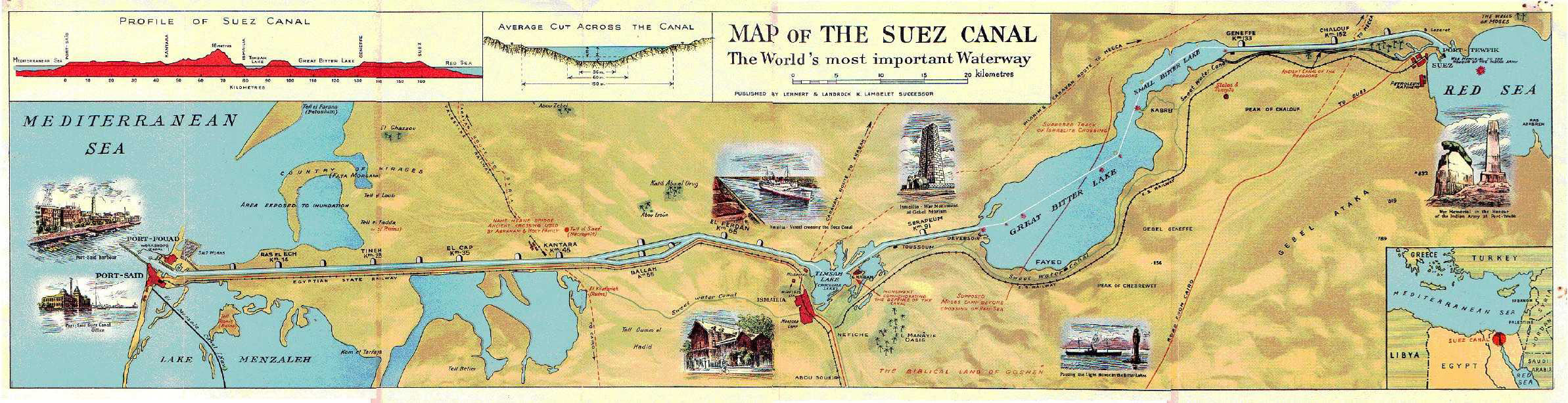
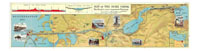
The Three "Musketeers" Move In
Anxious to carry out her part of the
secret agreement with Britain and
France, Israel made a four-pronged
attack on Sinai with airborne and ground
troops on October 29, and by the 30th
had, with French and British aid, inflicted
a heavy defeat on the ill-organized
Egyptian Army.
Assuming the role of spontaneous
peacemakers, Britain and France on that
day issued a joint ultimatum, which, as
part of the conspiracy, had been drawn
up five days before. It demanded that
both belligerents should cease fighting
and that, within 12 hours, the Egyptians
should move ten miles west and the
Israelis ten miles east of the Canal, leaving
the Canal Zone neutral.
Since Egyptian troops were already
fighting the Israelis on Egyptian soil up
to 125 miles east of the Canal, the ultimatum
meant that they were now asked
to retire 135 miles into their own country
while the Israelis moved into it no less
than lIS miles. If both sides did not agree to comply by the end of the time
limit, Anglo-French forces would seize
the Canal. Israel quickly agreed; Egypt
naturally refused, and the Anglo-French
military operations, code-named "Musketeer"
by Supreme Commander General
Sir Charles Keightley, were authorised
at 3 p.m. on October 31. The first strikes
against the Egyptian Air Forte began a
few hours later. R.A.F. and French Air
Force bombers in Malta and Cyprus,
aided by raiders from the Combined
Fleet's five carriers, screamed over Egyptian
airfields, knocking out aircraft on the
ground, blowing huge holes in the runways
and setting hangars aflame.
In 36 hours the enemy air force was
annihilated. Port Said military targets
were next destroyed. By Sunday, November
4, the way was clear for the airborne
landings. On the stage of world politics,
the issues were equally clear-cut: other
nations were almost unanimously incensed
at the blatant cynicism with
which the invasion had been engineered.
Race for the Canal
Britain and France were assailed by an
overnight chorus of loud and world-wide
disapproval. The Russians threatened
them with rockets, members of the U.N.
Security Council called for a ceasefire,
which they twice vetoed.
Even President Eisenhower, on whom
Eden had relied for support, publicly
upbraided Britain. And on November 2
the General Assembly of the U.N. voted
for an immediate ceasefire, with only
Australia and New Zealand upholding
Britain. To make matters worse, Israel,
which had gained vastly, and Egypt,
which had suffered enough, both agreed to end the fighting. Swift action by
Britain and France was now vital if their
declared aim of "separating the combatants"
and seizing the Canal was to
be a success.
They therefore advanced the date of
their airborne assault, even though this
would cause the paratroops to be unsupported
for 24 hours by armoured
units sailing from Malta. At 5 a.m. on
November 5, British troops dropped on
Port Said's Gamil airfield, capturing it
after two hours of fierce fighting. The
French seized two vital bridges and, later,
Port Fuad. The Canal was nearly theirs.
End of an Epoch
November 6, 1956, was to mark the end
of an epoch. In the early hours, British
seaborne reinforcements poured into Port
Said from Malta and the bitter struggle
for the town began. That evening, while
the battle still raged, a column of tanks
and paratroops was roaring south towards
Suez.
But suddenly the political and economic
opposition became decisive. The
pound plummeted throughout the world,
while Arab countries stopped the flow of
oil. Britain lacked dollars to buy American
oil and President Eisenhower refused
American credit unless Britain ordered a
ceasefire by midnight that day and agreed
to quit Egypt completely. Eden had no
choice but to surrender. The units racing
down the Canal road ground to a midnight
halt at El Cap, a quarter of the way
to Suez. Soon, a U.N. Emergency Force
moved in to police the ceasefire and withdrawal. The last fling of Empire had failed.
|