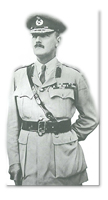
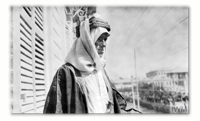
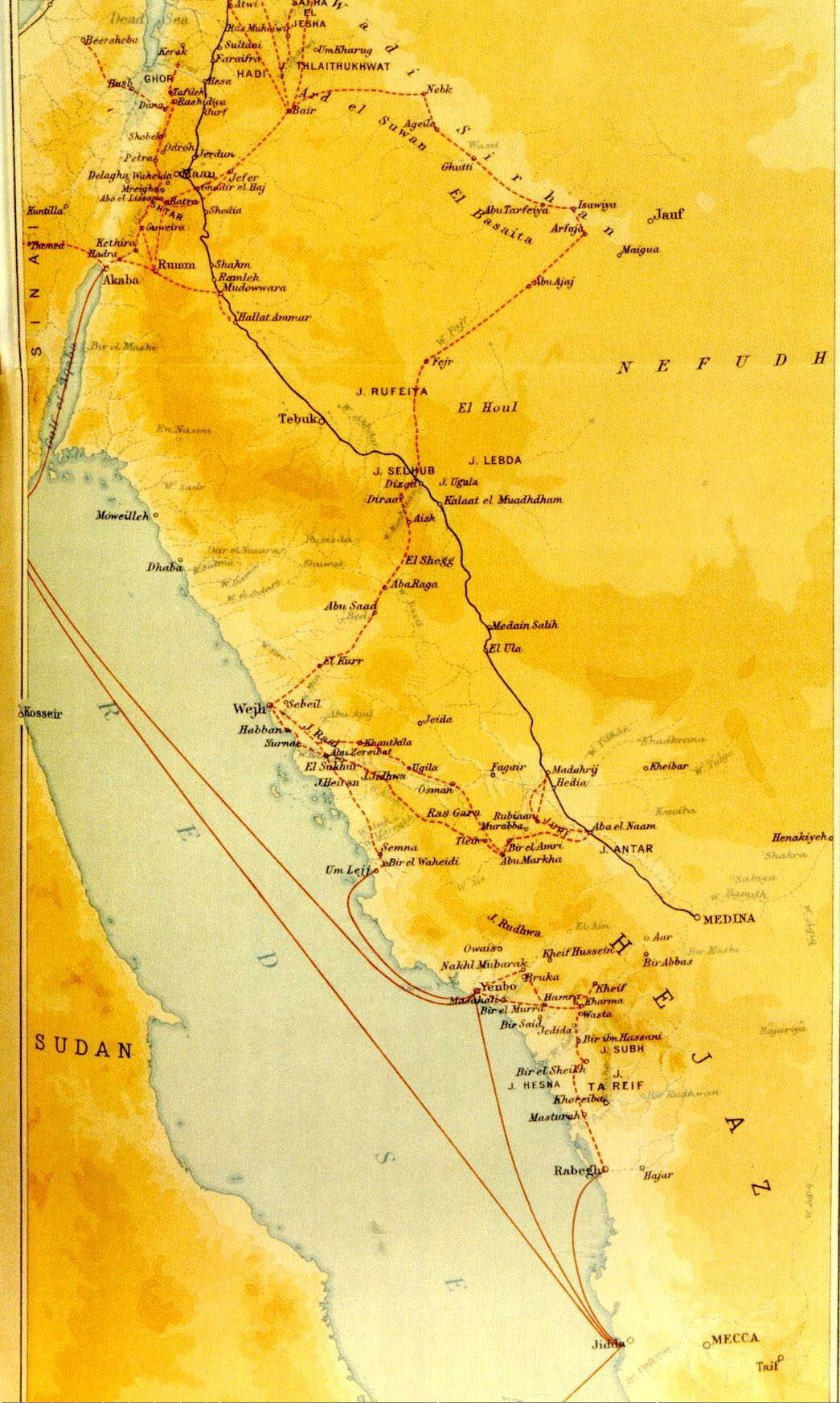
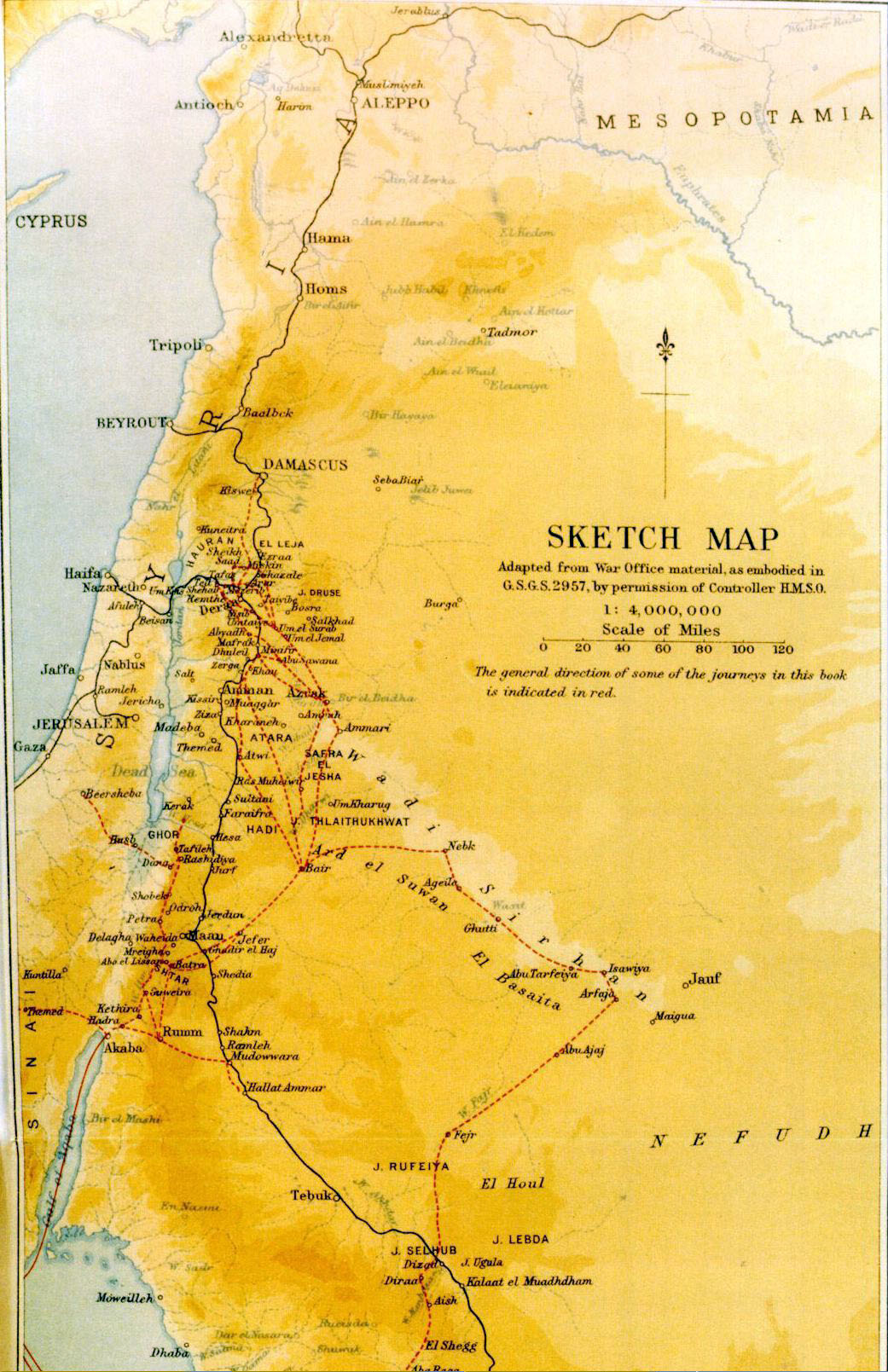
While the massive, mechanised armies of Europe were
bogged down in the mud of the French trenches during
the First World War, a young English captain, T.E.
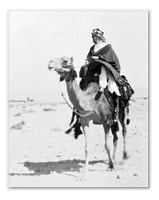
Lawrence, was criss-crossing the deserts of Arabia on
his camel. To the war-weary British, Lawrence rapidly
became a hero - "Lawrence of Arabia" - the man who
seemed a gallant brother to the Arabs as they fought
to gain their freedom from their Turkish overlords.
But Lawrence's motives were by no means so clear-cut
as the legend suggested. He was far less interested in the
freedom of the Arabs than in the future of Britain as a
Middle Eastern power, a fact of which his Arab allies,
the Hashemites, were unaware. After the war, the Arab
territories were cold-bloodedly divided into areas of
British and French interest - and although the British set
up three Hashemites as kings of the Hejaz, Iraq and
Transjordan, only Transjordan, now simply called
Jordan, managed to survive under Hashemite rule.
On May 21, 1935, the East Dorset
Coroner and jury decided that
"Thomas Edward Shaw, an
aircraftsman (retired)," had
died accidentally two days before
of wounds received after crashing
on his motorcycle. The unfortunate motorcyclist
was better known as "Lawrence of
Arabia," a national hero since his exploits
in the First World War.
Famous statesmen and writers who had
been captivated by his mercurial personality
crowded his funeral. Winston
Churchill wept and called him "one of the
greatest beings of our time," prophesying
that, whatever Britain's need, "we shall
never see his like again."
Though Lawrence had deliberately
chosen to live an obscure life in the Army
and Air Force after those heady days in
the Middle East, his legend lived on.
He was the subject of countless school
lectures and scores of books (which are
still coming out today), while his own
account of the Arabian campaign, The Seven Pillars of Wisdom was to become
an acknowledged masterpiece.
In the minds of every English schoolboy
Lawrence was the man who, in the
guise of an Arab sheikh, had led - with
incredible skill and daring - a successful
Arab revolt against Germany's ally,
Turkey, and so helped to win the First
World War. But those Arabs who remembered
him at all did so at best with
puzzled irritation and at worst with
angry resentment. The real story of
Lawrence was much more complex than
the legend - and much more sordid.
The reasons why a young blue-eyed
Englishman had led his wild Bedouin
allies against the Turks are complex: for
one thing, this pro-Arab activity was a
complete reversal of Britain's policy
towards Turkey for, throughout the 19th
Century, Britain had been Turkey's
staunchest ally.
Britain had been interested in the
Middle East since the time when India
had become part - indeed, the central part - of the British Empire, for the area
straddled that traditionally touchy lifeline
of Empire, the overland route to
India. With the opening of the Suez
Canal in 1869 and the establishment of
a quick sea route to India, it became even
more important that affairs in the Middle
East stayed stable.
Since the early 16th Century all the
Balkans and most of the Arab lands excluding
only Morocco and the more
remote parts of the Arabian peninsula had
been part of the Empire of the Ottoman
Turks. But, by the 1840s, the Empire
was in decay. Turkey was, in the Tsar of
Russia's words, "the sick man of Europe,"
and the vultures were gathering round
to feed off the corpse. It now became vital
for Britain to protect the route to India
from French, Russian or any other imperial
interference. To this end, in a
series of treaties during the 19th Century,
Britain bolstered up Turkey, supporting
her against the territorial claims of the
other great powers. It suited Britain
better to have a weak Turkish Empire in
the area rather than strong rivals.
But, in the late 19th Century, Britain's
traditional relationship with Turkey
started to change. The rising power of
imperial Germany, eager for allies, held
out the hand of friendship to Abdul
Hamid II, Sultan of Turkey. Germany's
ambitions received an unexpected boost
when Britain, horrified by the brutal
massacre by the Turks of their Christian
Armenian subjects in 1896, headed Russia
and France in an attempt to force reforms
on the Sultan. When that happened,
the German Kaiser's hand seemed well
worth grasping. Abdul Hamid invited
Germany to help train the Ottoman
army and to build a railway eastwards
from Constantinople to Baghdad. The
forces that would soon lead to open Arab
revolt were gathering.
Abdul Hamid was a traditional oriental
despot, who ruled his Empire with a
blend of intrigue and intimidation. Corps
of spies and agents provocateurs, rumoured
to total at least 30,000, roamed among
his 22 million imperial subjects, half of
whom were Arabs, the potentially rebellious
inhabitants of present-day Syria,
Lebanon, Jordan, Israel, Iraq and western
Arabia (including the immensely important
Muslim holy cities of Mecca and Medina, in the province of the Hejaz).
The Sultan also exercised a much looser
authority over Yemen and central Arabia.
One of his methods of keeping his Arab
subjects contented was to build a railway
from Damascus to the Hejaz to assist
Muslims in making the Pilgrimage to
Mecca. The fact that the railway also
allowed Ottoman troops to be moved
swiftly into Arabia in case of need was
less widely appreciated.
The Sultan was ruthless in dealing with
opposition, but there were certain people
who were too important simply to "disappear."
One of these was Sheikh Hussein
Ibn Ali, a prominent member of the
House of Beni Hashem, the noblest of
Arab families, who traced their descent
in the male line from the Prophet's
daughter, Fatima. Indeed, the Hashemites
were theologically much better
claimants to the Caliphate, the spiritual
headship of Islam, than the Sultan himself.
The Sultan kept this strongly independent
character with his wife and
four sons under careful watch in Constantinople
from 1893 to 1908.
In 1908 an elite group of army officers
(the "Young Turks") seized power, forcing
the Sultan to accept constitutional
government. They then decided to appoint
Hussein to be the Grand Sharif of
Mecca and Keeper of the Holy Places of
Islam. By long tradition, the Hashemites
were entitled to this position of immense
spiritual significance in the Islamic world.
It was a fateful decision for the future
of the Ottoman Empire and, indeed, the
future of the Middle East as a whole,
for this was the man who was to forge the
link between the British and the Hashemites.
That alliance led to Lawrence's
leadership of the Arab Revolt and ultimately
to the creation of three Arab
Hashemite kingdoms, or "Anglo-Arab
monarchies" as they were called.
Although it was not immediately apparent,
it was their misfortune to be
founded under Britain's aegis at a time
when the power of the British Empire
was in decline. As Britain's creatures and
clients they were highly vulnerable to
the new forces at work in the Arab world
and of the three only one (Jordan) has
perilously survived through a combination
of special circumstances and the
pertinacity of its Hashemite rulers.
As soon as Hussein arrived back in
Mecca, he began to show his independence
by reviving the Grand Sharif's prerogatives
which previous holders of the office
had allowed to lapse, asserting himself
against the local Turkish governor and
restoring the hegemony of the Sharifate
over the tribes of the Hejaz.
In the spring of 1914, the Young Turks
were regretting his appointment and
had secretly decided that he must be
deposed. It was then that the Sharif's
second son, the 30-year-old Amir Abdullah,
called upon Lord Kitchener in Cairo
cautiously to sound out Britain's reaction
in the event of an open breach between
Arabs and Turks.
But as the first step towards a relationship
that was to have such a
momentous result, the meeting itself was
rather farcical. Abdullah certainly did not
want to commit himself to Britain at this
stage, so, hoping merely to make his
interest known on a social rather than a
political level, he decided to call ostentatiously
on Kitchener at a time when the
overlord of Egypt should not have been
at home. But he was. The two men warily
discussed their battle scars, and little else.
Kitchener, too, did not want to be
tied down. The British government's
policy was still to preserve the Ottoman
Empire. Although war with Germany
was generally expected, it was by no
means certain that Turkey would be the
Kaiser's ally, and it was of the greatest
importance to Britain that war with
Turkey should be avoided - India contained
70 million Muslim subjects who
still regarded the Ottoman Sultan as the
Caliph, or Ruler of the Faithful, and no
one could be sure if, in the event of war
with Turkey, they would fight against the
Sultan-Caliph on behalf of his Christian
Majesty King George V.
A new factor had also to be considered
- oil. This had first been discovered in
large quantities in southern Persia in
1908 and its potential importance was
already realized. From 1904 onwards,
Britain's First Sea Lord, Admiral Sir
John Fisher, had been busy converting
the British fleet from the use of coal to
oil for power. Although Persia was not
part of the Ottoman Empire, it was known
that Mesopotamia was also likely to be
rich in oil and a rather surprising syndicate
of British and German interests
had secured a concession to exploit all
the oil within the Empire's borders.
In this uncertain situation, the wary
friendship between Abdullah and Kitchener
prospered. Abdullah came to
Cairo for a second time and this witty and
cultivated Arab prince extended his
British contact by establishing a close
rapport with Kitchener's Oriental Secretary
and confidant, the urbane and ultra-civilized
Ronald Storrs. The two men
spent hours together, playing chess and
quoting Arab poetry.
War was approaching, and the significance
of the Grand Sharif's overtures
through his son became increasingly
apparent. On one occasion, Abdullah
asked Storrs if Britain would present the
Sharif, his father, with "a dozen or even
half a dozen machine-guns" for defence
against the Turks.
In August, Britain, France and Russia
were finally at war with Germany and
Austria. In November, Turkey joined
the Central Powers.
Immediately, the Grand Sharif found
himself in a very delicate situation. He
was beginning to cherish the ideal of an
independent Hashemite Empire, uniting
the whole of the Middle East. Now war
had been declared he could gain his
ambition in one of two ways. Either he
could stand with Turkey and gain the
rewards of loyalty or he could throw in
his hand with the British and use their
help to mount a full-scale rebellion.
The decision had to be made when the
puppet Sultan-Caliph who had succeeded
Abdul Hamid issued a call to all the
faithful for a "jehad", or holy war,
against the infidel. The potential effect
on Muslims in India, French North Africa
or the Russian Empire was incalculable.
But, to be really effective, the Grand
Sharif of the holiest city of the Muslim
world must issue the call from Mecca
itself. The Sharif kept stalling, sending
messages to the Sultan that he was praying
for success in the war against the infidel
("May God lay them low"), but he was
sure His Sublime Majesty would understand
that the time was not propitious,
as the British might attack the people
of the Hejaz and bombard them into
rebellion against the Ottoman Empire.
While messages were travelling between the Sharif and the Sultan the
British were beginning to realize that
they desperately needed the Sharif's
help. Though there were other, more
martial potentates in the Arab peninsula,
he had the advantage of his spiritual
strength. Of Hussein's sons, Abdullah
was in favour of throwing in the Hashemite
lot with the British, though his
third son, Feisal, urged caution.
Kitchener had been recalled to London
to join the War Cabinet in 1914 but he
sanctioned an initial response to Sharif
Hussein's overtures. Clandestine negotiations
through secret emissaries took place
between Ronald Storrs, Colonel C.F. Clayton, director of Military Intelligence
in Cairo, Sir Reginald Wingate, Governor-General
of the Sudan, and the Sharif in
Mecca. Then, in January, 1915, Sir Henry
McMahon, a senior Indian civil servant,
arrived to assume the post of High Commissioner
for Egypt (which Britain had
finally declared a British protectorate)
and he took charge of the negotiations.
In the same month Sharif Hussein
received another secret emissary - this time from the Arab nationalist societies
in Syria and Iraq. Concern for security
was so great that when the messenger
whispered into the ear of the Sharif, the
Sharif stared unresponsively out of the
window. But the message was clear: the
Arabs of Syria would take part in a
British-backed revolt against the Turks
and accept Sharif Hussein as "spokesman
of the Arabs" provided he could extract
suitable terms from the British.
The vital question now was what these
terms would be, and this was to be the
subject of hard bargaining between Hussein
and the British which took the form
of a prolonged correspondence between
the Sharif and McMahon.
At the outbreak of war all Kitchener
had offered in a cable to Abdullah was:
"If the Arab nation assists England in
this war England will guarantee that no
intervention takes place in Arabia and
will give Arabs every assistance against
external foreign aggression." But Hussein
and the Arab nationalists of Syria and
Iraq wanted much more than this.
In his first letter Hussein proposed that
Britain should back an area of Arab
independence embracing the whole of
what is now Syria, Lebanon, Jordan,
Iraq and the entire Arabian peninsula
with the exception of Aden - a British
colony. In the ensuing correspondence, the Sharif made a few reluctant and
imprecise concessions: he accepted that
Britain's treaties with certain Arabian
chiefs should remain and agreed to a
temporary British military occupation
of Iraq (where British and Indian troops
had already landed at Basra and were
fighting the Turks). He neither accepted
nor refused but postponed his decision
on a British demand that parts of Syria
"lying to the west of the districts of
Damascus, Homs, Hama and Aleppo"
be excepted from the proposed area of
Arab independence.
The failure to clarify all these points
- especially the last - was a major cause
of future trouble. British statesmen (including
those involved) and historians
have disputed ever since whether the
exception of western Syria was meant to
include Palestine.
The problem was made worse by the
fact that the style of both McMahon's and
Hussein's letters was exceptionally vague.
(In McMahon's case they read like a
Gilbert and Sullivan parody of The
Arabian Nights. One began: "To the
excellent and well-born Sayid, the descendant
of Sharifs, the Crown of the
Proud, Scion of Mohammed's Tree and
Branch of the Kuraishite trunk, him of
the Exalted Presence and of the Lofty
Rank... the lodestar of the Faithful and
the cynosure of all devout Believers... "
down to "may his Blessing descend upon
the people in their multitudes.")
But while the wily Sharif thought he
would make his own terms with the British
since they were clearly desperate for
his help, he did not realize that the British
had a much deeper motive for wanting to
start the revolt than simply defeating
the Turkish Sultan: Britain was looking
to her own future in the Middle East.
To this end. she was secretly negotiating
with France on the future of the
Ottoman Empire after its defeat even
while McMahon was corresponding with
Hussein. The result was the notorious
Sykes-Picot Agreement (named after the
British and French negotiators), concluded
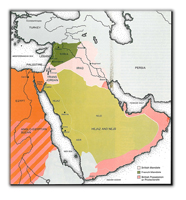
in the spring of 1916. This effectively
divided the Arab provinces of the
Ottoman Empire outside the Arabian
peninsula into areas of future British and
French control or influence.
The Russian Tsarist government was a
minor party to the Sykes-Picot agreement
and when, after the October, 1917,
Revolution, the Bolsheviks hastened to
expose this "imperialist plot" the British
were embarrassed, the Arabs dismayed
and the Turks delighted. It so happened
that November 1917, saw the publication
of the famous Balfour Declaration, whereby
the British government declared its
support for the establishment of a National
Home for the Jewish people in Palestine.
This greatly increased the alarm and
suspicions of the Arabs because, although
the Declaration stated that "nothing
shall be done which may prejudice the
civil and religious rights of existing non-Jewish
communities in Palestine" (i.e.
the Arabs, who formed about 93 per cent
of the population), they already had more
than an inkling that the real aim of the
Zionists was to turn Palestine into a new
land of Israel with a Jewish majority.
However, all this still lay in the future.
On June 10, 1916, the still unsuspecting Sharif finally launched the Arab Revolt
by symbolically firing a rifle at the
Turkish barracks in Mecca. First Mecca
and then Jedda on the coast fell to the
insurgents, but the Turkish garrison in
Medina continued to hold out against the
Sharif's ill-trained and ill-equipped
troops. Though the Arabs fought boldly
against lightly armed garrisons, they
often ran away from artillery. After one
such retreat, the Arabs explained that
they had "withdrawn to make ourselves
some coffee."
In October, 1916, Ronald Storrs arrived
in Jedda from Cairo to see what could be
done to pull the Revolt together. He was
accompanied by a slim, blond and very
untidy young temporary captain in the
intelligence service - T. E. Lawrence.
Lawrence was one of five illegitimate
sons of an Anglo-Irish baronet and a
governess. The baronet had employed the
governess to mind his legitimate children
and had then run away with her and set
up another home. At school Lawrence
showed outstanding intelligence and was
sent to Oxford, where he came under the
influence of the tall, black-bearded D. G.
Hogarth, author, don and archaeologist.
But Hogarth was more than a brilliant
academic: he was also a political intelligence
agent specializing in the Middle
East and a powerful behind-the-scenes
member of the British Establishment.
He was strongly influenced by the ideas
of the "think-tank" of Edwardian Imperialism,
Lord Milner's Round Table,
which was the name of both a periodical
and a study group. Hogarth chose Lawrence
as a young man capable of disseminating
these somewhat impractical
ideas for imperial federation. His deep
interest in Lawrence is shown in a
detailed report he wrote on his pupil,
ending: "He should go far; but he may
be driving lonely furrows where at present
few expect him to plough."
With Hogarth's approval Lawrence
spent the immediate pre-war years travelling
in the Middle East, studying the
Arabs and their language as well as
military tactics and medieval history,
and on occasions carrying out some part-time
spying on the Turks and Germans.
During these years Lawrence gained a
detailed knowledge of, although, contrary
to the legend, no particular affection for, the Arabs and an abiding hatred of the
Turks and the French, who were Britain's
biggest rivals in the Middle East. (Hogarth
and the Round Table members
were also deeply anti-French.)
When war broke out in 1914 Lawrence's
special knowledge of the Middle East was
clearly going to be useful, and Hogarth
used his influence to get his 26-year-old
protege into Military Intelligence. Lawrence
was posted to Cairo, where he
recruited agents and, although only a
captain in rank, conducted several highly
independent intelligence operations
against the Turks. In January, 1916,
Colonel Clayton set up his small but
influential Arab Bureau in Cairo with a
staff (to which Hogarth was recruited) of
intelligence and diplomatic officers who
became responsible for the British involvement
in the Arab Revolt. Lawrence
succeeded in attaching himself to the
Bureau and he went to Jedda with Ronald
Storrs to report on the state of progress
of the Revolt.
Lawrence's British colleagues and
superiors were either captivated by his
dynamic and impishly independent personality
or infuriated by his arrogance
and indifference to authority. No one
remained neutral towards him. His emotional
make-up was highly complex and
remains mysterious even today, in a
large part due to the fact that he was a
compulsive liar and it is impossible to
take anything he said or wrote at face
value. But from the conflicting mass of
evidence emerges a character shy and
self-advertising at the same time, who
punished his body both by driving it to
the limits of its endurance and, on occasions,
more directly by the administration
of repeated beatings. Nevertheless, in
spite of his tormenting self-doubts, he
was an astute judge of character and an
indefatigable asset to British operations.
When this as yet obscure young captain
arrived in Jedda, he soon summed up
the Sharif's family In The Seven Pillars
of Wisdom as:
"The first, the Sharif of Mecca we knew to
be aged. I found Abdullah [the second
son] too clever, Ali [the first son] too
clean, Zeid [the fourth son] too cool.
Then I rode up-country to Feisal [the
third son] and found in him the leader
with the necessary fire."
Feisal had a splendid presence and was
more sophisticated, in a Western sense,
if less intelligent than Abdullah, who
remained at heart a Bedouin chieftain.
At Lawrence's first meeting with Hussein's
family, he clashed with Abdullah.
When Lawrence discussed the Turkish
positions, Abdullah exclaimed a little
irritably to Storrs, "Is this man God, to
know everything?" There can be no
doubt that Feisal, who had been won
over to wholehearted support of a revolt
against Turkey by the brutal Turkish
repression of the Arabs in Syria, was
chosen by Lawrence as the ideal instrument
for maintaining British control
over the Arab national movement and,
ultimately, for achieving Lawrence's personal
objective of an Arab "brown
dominion" within the British Empire.
For his part, Feisal trusted Lawrence
entirely, in the firm belief that he would
help the Arabs achieve complete independence
under Hashemite rule.
Lawrence attached himself to Feisal,
and for a while the relationship was an
open and honest one. But soon Lawrence
learned, through the Arab Bureau, of the
Foreign Office's plans to carve up Syria
and Iraq between Britain and France
after the war.
Hogarth and Lawrence were appalled but
not because they believed in the Arab
right to independence: the two imperialists
simply wanted the hated French to
have no share in the Arab world. Consequently,
they set out to undermine the
Sykes-Picot agreement. Although ultimately
they failed, Lawrence did manage
to keep the terms of the agreement from
Feisal until he was totally dependent on
Britain and unable to withdraw from the
British-backed uprising.
Lawrence soon became the acknowledged
leader of the Arab Revolt and also,
much to his satisfaction, succeeded in
over-riding the views of his French counterpart
in the Hejaz, Colonel Edouard
Bremond, with whom he was on particularly bad terms, on the conduct of the
war against the Turks.
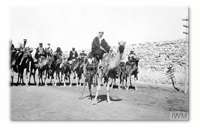
By mastering irregular guerrilla tactics,
wearing Arab dress and learning to
ride camels superbly, Lawrence turned
himself into a Bedouin warrior. An interesting
sidelight on Lawrence's personality
is shown.in a manual for political officers
which he 'wrote in August, ·I9I7. In this,
he implies that he wore Arab dress, not
because he loved the Arab way of life,
but because it was the best way to
"handle" the Arabs. "If you can wear
Arab kit when with the tribes you will
acquire their trust and intimacy to
a degree impossible in uniform. It is,
however, dangerous and difficult."
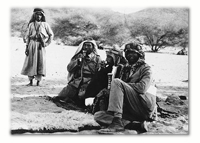
With Auda "the Hawk," a famous
tribal leader, he captured the important
town of Aqaba in July, 1917. Afterwards,
in a series of daring raids he pursued his
attacks on Turkish supply lines, especially
the Hejaz railway.
It was from this period that the Lawrence
legend derived. On the Arab side
there can be no doubt of the devotion of
his Bedouin followers to "al-Orens," as
they called him. They admired his courage,
devotion and skill as a guerrilla leader.
But they were few in number and are now all long
dead. For the Arabs, the short-lived
Lawrence myth was lost in the squalid
betrayal of the post-war settlement.
For the British, on the other hand, the
myth flourished for much longer. At a
time when the British, French and Germans
were monotonously slaughtering
each other in the mud of Flanders, the
romantic, individualistic character of
Lawrence's desert guerrilla campaign
had an irresistible appeal. It was easy
for the British public, encouraged by able
propagandists such as the American
journalist, Lowell Thomas, who depicted
Lawrence as a blue-eyed Robin Hood of
the desert, to believe that he had led the
Arabs virtually single-handed to victory.
King George V was caught up in the
enthusiasm and asked for a private
showing of Thomas's lecture and lantern slide
show, Other British officers played
vitally important roles in the Arab Revolt
but Lawrence was the only name that
anyone remembered.
In military terms, the Arab Revolt
immobilized some 30,000 Turkish
troops along the Hejaz railway,
prevented a link-up between the
Turkish forces in Arabia and the
Germans in East Africa and generally
helped to weaken the Turkish armies. But
the central responsibility for defeating
the Turks lay with Britain's General Sir Edmund Allenby. Known as "the Bull,"
he was a military administrator and
strategist of-genius who, in the autumn of
1917, launched a successful offensive from
Sinai, sweeping up into Palestine to
occupy Jerusalem in December, 1917.
Allenby's advance was delayed by the
severe 1917-18 winter and stubborn
Turkish resistance, but in the following
summer he advanced, with Feisal and
Lawrence on his right flank, to victory,
taking Damascus on October 1, and Beirut
on the 8th. The British were doing well,
too, in Iraq. The Anglo-Indian force had
advanced from Basra and, after an initial
disaster in 1916, when 8,000 of them surrendered
to the Turks at Kut, had gone on
under General Maude to capture Baghdad
in March, 1917. By the end of 1918 virtually
all of what is now Iraq was in British
hands. On October 30, 1918, Turkey
signed the Mudros armistice and the war
in the Middle East came to an end.
The Allied forces and the Arabs made a
triumphant entry into Damascus, capital
of Syria. The Arabs of Syria, although
subdued by Turkish repression and decimated
by famine, went wild with enthusiasm
at their liberation and the prospect
of independence.
But the leaders of the Arabs already
had good reason for doubts about the
future. Two years before, in November,
1916, Sharif Hussein had proclaimed
himself King of the Arab lands. Britain and France, however, recognized him
only as King of the Hejaz and he had had
to be content with that. Then, at the end
of 1917, came the Balfour Declaration
stating Britain's views on the future of
the Jews in Palestine and the revelations
about the Sykes-Picot agreement. Even
though the Zionist leader, Chaim Weizmann,
had assured Hussein that the Jews
did not aim to set up their own government
in Palestine and British representatives
told him that Sykes-Picot had now
been superseded, Hussein remained
doubtful - and with good reason.
Britain also tried to calm the fears of
the Arabs with a series of well-publicised
policy declarations (including one in
conjunction with the French) made before
the war ended. All these said, in
effect, that the Allies fully supported the
famous principles of "self-determination"
and "consent of the governed" which had
been enunciated by the American President,
Woodrow Wilson, and had so
raised the expectation of all subject
peoples. In reality, Britain and France
had already agreed to divide between
them all Turkey's former Arab provinces
that were of political interest to them
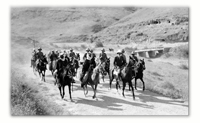
During his two years of desert warfare, Lawrence
became a folk hero to the British. A nation sickened
by the slaughter of the French trenches seized
on the romantic picture of "al-Orens" (as his Arab
followers called him), galloping at the head of
his Bedouin troops in their revolt against their
Turkish overlords. Few, least of all the Arabs,
were aware that he was far more interested
in gaining British dependencies than
freedom for the Arabs. But whatever his
motives, no one questioned his military
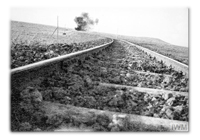
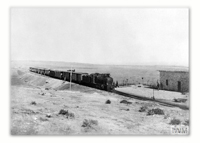
skill: he swooped on Turkish troop trains
supplying the southern territories
along the Hejaz railway, organized an attack on
the Turks' Red Sea port of Aqaba and marched
triumphantly into the city of Damascus.
In a letter to a fellow officer describing one of his daring raids
on a Turkish train, Lawrence vividly captures the excitement
he felt fighting in the desert. The train, he wrote, "had two
locomotives and we gutted one with an electric mine. This
rather jumbled up the trucks, which were full of Turks shooting
at us. We had a Lewis and flung bullets through the sides.
So they hopped out and took cover behind the embankment
and shot at us between the wheels, at 50 yards. Then we tried
a Stokes gun, and two beautiful shots dropped right in the
middle of them. They couldn't stand that (12 died on the spot)
and bolted away to the East across a 100-yard belt of open
sand into some scrub. Unfortunately for them, the Lewis
covered the open stretch.
"The Turks then nearly cut us off as we looted the train, and
I lost some baggage, and nearly myself. My loot is a superfine
red Baluch prayer-rug. I hope this sounds the fun it is. The
only pity is the sweat to work them up and the wild scramble
while it lasts. It's the most Buffalo-Billy sort of performance,
and the only people who do it well are the Bedouin."
The Military Strategist
Lawrence's most dramatic military achievement was his
attack on the vital town of Aqaba in July, 1917. This was
the last port the Turks held on the Red Sea and its loss meant
that the Arab army could join up with the imperial army in
Egypt to complete Turkey's defeat.
With the independent and fierce old desert chief Auda, 33
camel-men armed with rifles, and saddle-bags full of gold,
Lawrence set out to march 200 miles north from Wejd on the
Red Sea over the most arid desert in the world.
The gold and Auda's reputation attracted some 500 local
tribesmen and the band attacked the pass commanding the
route to Aqaba on July 2. The outcome was both superb and
comic: in a wild camel charge at the enemy, Lawrence accidentally
shot his mount and was knocked out as the beast fell.
When he came to, the battle was over, with 460 Turks dead or
captured for the loss of two Arabs. The almost undefended
town fell easily. Lawrence returned to Cairo in triumph, the
war against the Turk in Arabia nearly over.
After the British under General Allenby had launched a
brilliantly successful offensive from Sinai, with Lawrence and
his Arabs sweeping up the right flank, they occupied Jerusalem
in December, 1917. From there Allenby planned his assault
on Damascus, to end 400 years of Ottoman domination over
the Arabs. Nine months later, on September 30, the final push
brought the allied troops to the gates of Damascus.
Now Lawrence hoped to realize a long-standing political
ambition: to make Feisal the king of Syria under British protection,
thus "biffing the French out of all hope of Syria."
Ignoring the fact that the Australians had already arrived, he
arranged for the Arabs to march in triumph into the city and
ensured that an Arab was governing there.
But Lawrence's and Feisal's hopes were rapidly dashed.
Allenby summoned Feisal to the Victoria Hotel and informed
him - through a discomfited Lawrence acting as interpreter - that
Syria was to be a French protectorate and Feisal was to
have no real power. Lawrence's attempt at king-making had
failed. Soon he left for England, a broken man.
When the war ended, the
whole of Syria and Iraq
were described as "Occupied
Enemy Territory" and administered
under military law
pending a peace settlement. The area was
occupied by British troops with a small
French force on the Syrian coast and
Feisal's army in the interior. In Palestine
there was a British military administration,
on the Syrian coast a French provisional
government. Although the main
cities of Syria and Transjordan were
governed by an Arab administration
under Feisal, there was a significant
attachment of British and French officers.
Iraq was treated as a single unit under
one administration with a British civil
commissioner at its head. This was the
cool and careful Sir Percy Cox who had
many years experience in the Persian
Gulf. He was assisted as Oriental Secretary
by one of the most remarkable
Englishwomen of the century, Gertrude
Bell. Tall and gaunt, with an addiction
to Parisian hats, Gertrude Bell had already
earned her reputation as an intrepid
traveller and oriental scholar. She knew
as much as, if not more than, Lawrence
about Arab tribal politics and she shared
his dream of establishing a Hashemite
Arab state under British patronage (which
would exclude the French).
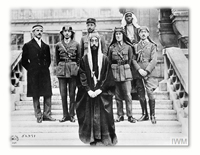
The Paris Peace Conference which,
among other things, was to decide the
future of the Ottoman Empire, opened in
January, 1919. Feisal, with Lawrence
as his adviser, went as spokesman for the
Arabs, but he was in a weak and difficult
position. Snubbed and cold-shouldered
by the French, who never relaxed their
hostility towards the Hashemites, he was
more than ever dependent on British
support. On French insistence he attended
the conference as representative only of
the Hejaz and not of his dream empire.
In fact, the important decisions about
the future of the Arab lands had already
been taken without his knowledge as the
British and French premiers, Lloyd
George and Clemenceau, had come to an
understanding on the revision of the
Sykes-Picot agreement. Militarily, Britain
was much stronger than France in the
Middle East, but the area had to be seen
in a world context in which France was
still Britain's principal ally despite growing
friction between them.
Lloyd George and Clemenceau had
agreed that Palestine and Iraq would be
under British administration while the
French would have Syria, Lebanon and a
proportionate share in Iraqi oil. The
British government still hoped that the
French would be willing to co-operate
with Feisal's government in Damascus,
but there was nothing much it could do
if they would not.
Lawrence had not despaired of "biffing
the French out of all hope of Syria" as
he had written in a now famous letter
earlier in the war. In January, 1919, he
had coaxed a dubious Feisal into an agreement
with the Zionist leader Weizmann
on Zionist-Arab co-operation in Palestine.
Though it seemed satisfactory at the time,
it was largely meaningless because of the
Zionists' real intentions and Feisal's
doubts about them.
Lawrence had conceived a half-baked
scheme whereby, with the help of Zionist
money, Feisal could be made financially,
and therefore politically, independent of
the French. In a letter to a colleague at
the time Lawrence sketched out a remarkable
vision of the future: "The
British Empire has been increased by this
war in Africa, and in Australasia: and in
Asia we have taken on Persia, Mesopotamia,
Arabia, and half of Syria. We will
crash with all these new houses, unless we
can find tenants for some of them. Therefore
we need Zionist and Arab Cooperation.
Australia won't like brown
citizens of the Empire - but it's coming
anyhow. They are 5,000,000 and the
Browns about 300,000,000. " (Lawrence
was looking forward to the day when
India and the Arabs would have dominion
status.) To Lord Curzon, Lord President
of the Council, Lawrence wrote, "My own
ambition is that the Arabs should be our
first brown dominion, and not our last
brown colony."
Lawrence's dream may have been
imperialist but it was far from illiberal
at a time when those with non-white
skins were still considered to be incapable
of self-government. But the dream was
not realized for a number of reasons:
determined French opposition, the ultimate
impossibility of co-operation between
Zionists and Arabs who had their
own aims in view, and finally the military
incompetence of the Hashemites who
Lawrence hoped would lead the Arabs
into the British Empire.
As King of the Hejaz, Hussein was the
only independent Hashemite monarch to
have emerged from the war. He still
enjoyed the prestige of the Keeper of the
Holy Places but his kingdom was desperately
poor and financially dependent on
Britain. Moreover, he was no match in the
field for the rising new warrior, Abdul
Aziz Ibn Saud, the new power in central
Arabia. In December, 1915, Ibn Saud had
signed a treaty with the British government
which gave Britain a large measure
of control over his policy in return for a
monthly subsidy and recognition of the
internal independence of the Nejd. Ibn Saud enjoyed the support of the government
of India which, although under the
ultimate control of Whitehall, held its own
views about the future of the Middle East.
It tended to regard both the Arabian
peninsula and Mesopotamia (Iraq) as its
special provinces and, in common with
the 70 million Muslims of India, had no
sympathy with King Hussein's pretensions
as a religious and political leader.
Thus there existed the extraordinary
situation of two arms of the British
government in direct conflict with each
other. The Foreign Office continued to
support the Hashemites while the India
Office favoured Ibn Saud's plans to take
over the Hejaz.
In May, 1919, Ibn Saud attacked and
nearly annihilated a force led by the
Amir Abdullah which had been sent to
deal with him. Only British pressure prevented
him from going on to seize the
Hejaz from Hussein. For this he had to
wait another five years.
Meanwhile, Feisal was trying to consolidate
his role in Syria which was even
more vulnerable than that of his father
in the Hejaz. In May, 1919, he returned
from Paris to Damascus and elections
were held in those parts of Syria under his
control. The National Congress which
resulted proceeded to pass vigorous resolutions
declaring Syria (including Palestine)
an independent Arab state, repudiating
both the Sykes-Picot Agreement and
the Balfour Declaration.
But none of this was very realistic,
and when Feisal returned to Europe in
the autumn of 1919 he was forced to
compromise in order to try to save what
was left of Arab hopes of independence.
Urged on by Lloyd George, he reached
an agreement with Clemenceau by which
he accepted the French occupation of the
entire coastal area of Lebanon and Syria.
This did not please his followers; on
March 8, 1920, the Syrian National Congress
passed a resolution proclaiming
Feisal King of Syria (including Palestine
and Lebanon). At the same time a meeting
of Iraqi leaders passed a similar
resolution concerning Iraq and chose
Abdullah as their first monarch.
The Allies reacted swiftly. The Supreme
Council of the League of Nations (equivalent
of the United Nations Security
Council) met at San Remo and announced
its decisions on May 5. Britain was to
have the mandates for Palestine and Iraq,
and France a joint mandate to administer
Syria and Lebanon.
Feisal now ruled what was perhaps the
shakiest kingdom in history. The French
made little secret of their intention of
establishing direct control over the whole
of the Syrian interior as well as the coast
and were seeking only an excuse to
occupy Damascus. Enraged by the San
Remo decisions, young Syrian Arab
officers were only too ready to provide
the French with their pretext by attacking
their "border" posts between the
coastal region and the interior and the
confused and irresolute Feisal was unable
to restrain them.
On July 14 General Gouraud, the
French commander in Beirut, issued an
ultimatum which demanded an unqualified
acceptance of the mandate and a
French military occupation of Aleppo and
the other main towns of central Syria.
Feisal, urged by Lord Curzon to avoid
hostilities with the French at all costs,
actually accepted the ultimatum. But it
was no use. General Gouraud's terrifying
Senegalese and Moroccan Arab troops
advanced and occupied Damascus.
Feisal's forces fought back bravely but
could do little against the French tanks
and artillery. Feisal himself was "invited"
by the French to leave Syria. The
British government, genuinely dismayed
by what had happened, could nevertheless only express sympathy and wash its
hands. It did invite Feisal to London
where he arrived, a dignified but pathetic
figure, in December, 1920.
Unlike the French, Britain did not
have to use force to establish her Arab
mandates because her troops were already
in occupation. But she was facing
severe trouble in both of them. In Palestine
the first incidents in the Arab-Jewish
conflict occurred in 1920 and in
Iraq Britain faced full-scale Arab
rebellion against this occupation.
British officials in Iraq were divided
between those, like Gertrude Bell, who
favoured indirect British control through
Arab institutions and an Arab (preferably
Hashemite) Amir and others, like the
redoubtable Acting Civil Commissioner,
Colonel A. T. Wilson, an arch-imperialist
who believed in direct colonial rule which
would make Iraq rival the Indian Empire
as the brightest jewel in the British
imperial crown.
Wilson's ideas were in line with the
imperialists in the British cabinet who
had argued during the war that Britain
should do everything to obtain "a continuity
of territory or of control both in
East Africa and between Egypt and
India." Such men even considered "Indianizing"
Iraq by settling thousands of
Indians in the country.
Eventually, it was Gertrude Bell's
views which prevailed, but not before
Wilson's repressive measures had helped
to provoke an uprising of the tribes of
central Iraq which was only put down at
the cost of 10,000 casualties and £40
million - more than three times the sum
Britain had spent on subsidizing the
Arab Revolt.
In view of the generally unsatisfactory
situation in Britain's semi-colonial Arab
Empire, Lloyd George decided on a fresh
approach. In order to put an end to the
disastrous rivalry in the Middle East
between Lord Curzon's Foreign Office and
Edwin Montagu's India Office, he decided
to put the whole problem into the
hands of the young Winston Churchill's
Colonial Office.
One of Churchill's first actions was to
persuade Lawrence to join his newly
Created Middle East Department as
adviser on Arab Affairs. After a series of
urgent discussions in London, in which the exiled Feisal was involved, Churchill
called a conference in Cairo in March,
1921, to endorse his decisions. Lawrence
said later: "The decisions of the Cairo
Conference were prepared by us in London,
over dinner tables at the Ship
Restaurant in Whitehall."
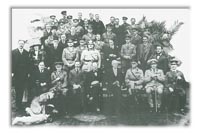
The conference was attended by all the
senior officials in Britain's new Arab
"empire" - Sir Percy Cox and Gertrude
Bell from Iraq, and the newly appointed
High Commissioner for Palestine, Sir
Herbert Samuel. On an amicable trip
during the conference it is recorded that
Churchill fell off his camel and Lawrence
roared with laughter.
It had already been arranged between
Churchill, Lawrence, Cox and Bell that
Feisal should be made King of Iraq.
Brushing aside Lloyd George's doubts
about the reaction of the anti-Hashemite
French towards the sudden promotion
of the man they had recently expelled
from the throne of Syria, Churchill
suggested that Iraqi public opinion
should be prepared well in advance to
give Feisal a good welcome.
Churchill had, in fact, another more
immediate problem. In November, 1920,
the Amir Abdullah had arrived in Maan
(in what was to become Transjordan) at
the head of a motley army of tribesmen
and retainers and announced his intention
- possibly spurious and certainly unrealistic
- of marching on Damascus to
avenge his brother's expulsion.
His presence on the East Bank of the
river Jordan was not unjustified. This
dry, unpromising territory, inhabited
largely by Bedouin, had, in Ottoman
times, been virtually independent under
its tribal rulers and during Feisal's brief
reign in Damascus it came nominally
under his authority. Moreover, although
the French were demanding that Britain
expel Abdullah, the British felt some
obligation towards the Sharif Hussein's
second son, who now appeared to have
no hope of acquiring an Arab throne, let
alone an empire.
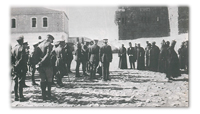
Churchill, accompanied by Lawrence,
went up from Cairo to Jerusalem and
summoned Abdullah to meet him. Abdullah,
like a good oriental salesman, began
by naming what he knew was an impossible
price: that Transjordan should be
incorporated into Palestine as a single
Arab state with himself as king. When
Churchill turned this impossible scheme
down, he suggested that Transjordan
should be joined to Iraq.
Finally, he accepted Churchill's proposal
that he should "temporarily" become
ruler of the independent Amirate of
Transjordan, with an annual British
subsidy and British advisers, on the understanding that Britain would try to persuade the French to restore an Arab
administration in Damascus with Abdullah
at its head. Abdullah knew very well
that there was no chance of this, but a
reasonably secure amirate was worth
several hypothetical kingdoms.
The temporary arrangement, therefore,
became permanent and Transjordan was
incorporated into the Palestine mandate,
under the High Commissioner in Jerusalem
with the proviso that the Mandatory
(i.e. Britain) could exclude it from the
area of Jewish settlement. This was done
and for nearly 30 years Transjordan
remained a poor but relatively peaceful
desert Arab state under British guidance
and protection.
There remained the problem of ensuring
that Feisal was accepted as King of
Iraq by a large majority in a national
plebiscite. Gertrude Bell and Sir Percy
Cox gave all their considerable energy to
the task. (Some members of the British
administration, such as H. St. John
Philby, famous Arabian explorer and
father of Kim Philby, the Soviet agent,
doubted the wisdom of imposing Hashemite
rule on Iraq and favoured a republic.
Philby was overruled and resigned.)
Feisal went first to Mecca from London
and made a carefully staged triumphant
arrival in Baghdad in June. A series of
meetings of tribal leaders was held
throughout the country. Gertrude Bell
was usually present to give support. At
one moment Feisal faltered in a speech
and gave her a beseeching look of inquiry
to which she responded with an encouraging
nod. At another, when a tribal leader
remarked with tactless honesty that he
was ready to swear allegiance to Feisal
because he was acceptable to the British,
Gertrude saved the day by clasping her
hands as a symbol of British-Arab friendship
in equality.
Feisal's most serious rival in Iraq,
Sayid Talib, was invited to tea with
Gertrude Bell and Lady Cox. As he left,
he was whisked into an armoured car and
shipped off for a prolonged stay in
Ceylon. Finally, Feisal was elected King
by a 96.8 per cent majority. Tribal
leaders had recognized that he was Britain's
choice - and Britain had the power.
On April 23, 1921, Feisal I was proclaimed
King of Iraq and Gertrude could write to
her father: "We have had a terrific week
but we've got our King crowned."
With Abdullah and Feisal settled in
Amman and Baghdad, their aged and by
now bitterly resentful father still presented
a problem. Lawrence was dispatched
to Jedda to persuade the old man
to accept the accomplished fact that
Syria, Lebanon and Palestine were lost
to the rule of his family.
Hussein's stubborn refusal to sign the
treaty which was offered him drove Lawrence
into a fury. He wrote home describing
the King of the Hejaz as "conceited to
a degree, greedy and stupid."
Hussein never did sign and in 1924 the
matter was settled when Ibn Saud, freed
from his promise not to attack Iraq,
Kuwait or the Hejaz by the ending of the
annual British subsidy, overran Mecca
with his fierce Wahhabi troops. Hussein
abdicated in favour of the ineffectual
Amir Ali, who withdrew to Jedda. The
old Sharif retired to a bitter exile in
Cyprus, taking with him what remained
of his gold in petrol tins. In 1930, at the
age of 75, he suffered a stroke and was
allowed to move to Amman where he
died a year later.
In December, 1925, Ibn Saud overran
the rest of the Hejaz and in the following
year was recognized by the Great Powers
as King of the Hejaz, with the Soviet
Union leading the way.
Only two British-sponsored Hashemite
states therefore emerged from the postwar
"settlement" and its aftermath - the
Kingdom of Iraq and the Amirate of
Transjordan. In The Seven Pillars of
Wisdom, Lawrence wrote: "Mr. Winston
Churchill was entrusted by our harassed
Cabinet with the settlement of the Middle
East; and in a few weeks, at his conference
in Cairo, he made straight all the
tangle, finding solutions fulfilling (I think)
our promises in letter and spirit (where
humanly possible) without sacrificing
any interest of our Empire or any
interest of the people concerned. So
we were quit of the war-time Eastern
adventure, with clean hands, but
three years too late to earn the gratitude
which peoples, if not states,
can pay."
Lawrence's admiration for Churchill
was doubtless sincere and
indeed warmly reciprocated but it is difficult to believe that he suffered no
pangs of conscience when he wrote these
words, despite the significant qualifications
of "(I think)" and" (where humanly
possible)". Whatever the reasons, Britain
had not fulfilled either the letter or the
spirit of the promises which inspired the
Arabs to revolt against the Turks.
But what of the interests of the British
Empire, none of which, according to
Lawrence, had been sacrificed? He had
fought hard to "biff the French out of
Syria" and had failed. The brown dominion
of which he had dreamed had not
come into existence. Yet it could be
claimed that for some 30 to 40 years after
the First World War Britain held the
position of paramount power in the Middle
East. The eastern Arab world (that is
excluding French North Africa and Italian
Libya) was not part of the British Empire but it was emphatically part, and a very
important part, of the imperial system.
British troops in Palestine and Egypt
guarded the life-line of the Empire. One
M.P. was to remark as late as 1956 that:
"The Suez Canal and the area surround~
ing it are in some essential sense part of
the United Kingdom." Many Englishmen
would have gone further and included
the Red Sea and Aden.
In Iraq, once the views of those who
favoured the creation of a permanent link
with India had been decisively rejected,
Britain's primary interest was oil. Lord
Curzon's statement that "the Allies in
World War I floated to victory on a wave
of oil" was prophetic, if exaggerated, and
through her special position in Iraq
Britain was able to secure a concession
covering virtually the whole country for
British oil interests.
Later, political and commercial pressures
obliged Britain to allow several
American and one French company a
share in the development of Iraq's oil
resources, but the Iraq Petroleum Company
remained under British control and
was always regarded by the Iraqis as
the major instrument of British power and
influence in their country. Its existence
made it easier for Britain to relax the outward
forms of its political control which
were repugnant to Iraqi nationalists.
A series of Anglo-Iraqi Treaties in the
1920s... which were always opposed by the
nationalists because they did not go far
enough towards removing the limits to
Iraq's independence - culminated in one
of 1930 by which Iraq became a sovereign
member of the League of Nations two
years later.
Yet, to a certain degree, Iraq still remained
tied to the British Empire. Under
the 1930 Treaty Britain retained Air
Force bases in Iraq who was obliged to
regard herself as Britain's ally in the
event of war. (In the Second World War,
Britain actually overthrew an Iraqi
nationalist revolt, which was seeking help
from the Axis powers, and restored the
Hashemite monarchy.) It was not until
the Iraqi Hashemites were finally destroyed
in the bloody revolution of 1958
that Iraq ceased to be regarded in the
Arab world as a British satellite.
Unlike Iraq, Transjordan was a wholly
artificial British creation. But despite
this, and although its population was
composed largely of quarrelsome Bedouin
tribesmen, it was easier to fashion it into
the semblance of a unified nation with
which Britain was able for a time to
establish a fairly harmonious relationship.
Two outstanding Anglo-Arab administrators,
Sir Henry Cox and Sir Alec
Kirkbride, were given the chance, as
Abdullah remarked in his own memoirs
"to do good to the Transjordanians, even
against their will."
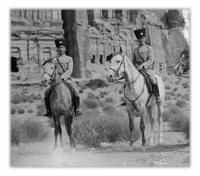
The most notable British achievement
in Transjordan and the partial fulfilment
of Lawrence's dreams was the creation of
the Arab Legion. This was the Transjordanian
army named by Abdullah after
the regulars who fought with Feisal in the
Arab Revolt.
It was the work first of Colonel F.G.
Peake, a former commander of the
Egyptian Camel Corps, and later of
General J.B. Glubb, or Glubb Pasha as
he was always known.
Peake concentrated on training the
villagers to defend themselves; Glubb was
mainly concerned with the Bedouin from
whom he formed a desert patrol as an
arm of the Arab Legion. Between them they fairly easily pacified Transjordan
internally and, with greater difficulty,
protected its southern and eastern borders
against the forays of Ibn Saud's Wahhabi
warriors who, on one occasion, advanced
in large numbers in a swirl of dust towards
Amman only to be repelled by two
aircraft and four armoured cars.
As in Iraq, but at a more leisurely
pace, Britain transferred its mandatory
powers to Transjordan. The 1928 treaty
recognized Transjordan's independence,
although Britain retained control over
finance, foreign affairs, jurisdiction over
foreigners and "freedom of conscience."
In 1939 Britain agreed to the conversion
of the Legislative Council into a cabinet
with ministers responsible to the Amir.
In 1946 Transjordan became fully independent
and, following the Arab-Israeli
war and Abdullah's annexation of the
West Bank - the part of Palestine which
remained in Arab hands - he was proclaimed
King of the Hashemite Kingdom
of Jordan - the only Hashemite monarchy
which survives precariously to this day under
Abdullah's descendants.
Even after the declaration of Transjordan's
independence the country remained
under British tutelage. Lacking
any resources of its own, Transjordan
depended heavily on British subsidies especially
for the army, which continued
to be trained and commanded by British
officers until Glubb's summary dismissal
in February, 1956, by the young King
Hussein, who deeply resented his paternalist
attitude. With the termination of the
Anglo-Jordanian Treaty (including the
British subsidy) in the same year, the
United States replaced Britain as Jordan's
chief outside protector and supporter.
Elsewhere in the Arab world the United
States was taking over Britain's semi-imperial
role, although its style and
methods were different. In the 1930s
American interests acquired the concession
to exploit Saudi Arabia's oil
resources which were to prove to be some
of the richest in the world. Oil was discovered
in 1937, but production was held
up by the Second World War, and it was
Britain who provided King Ibn Saud with
an annual subsidy to help him in his
severe financial straits.
The American oil companies became
alarmed that Britain might increase her
political hold over Saudi Arabia to a
point that would endanger their concession
and, with support from the U.S.
government, provided the old king with
loans to see him through the war. The
United States won the rather curious
competition with Britain to pay Ibn
Saud the most money fairly easily both
because it was richer and because oil
revenues increased rapidly again after
the end of the war.
King Feisal II Visits London
In 1945 Britain, with her huge military
bases in Suez and Palestine, was still
seemingly the paramount power in the
Middle East. In that year she was largely
responsible for forcing France to grant
independence to Syria and Lebanon (an
action which Charles de Gaulle neither
forgot nor forgave) and the Arab League
was established under her auspices. Thirteen
years later, after the Suez fiasco of
1956 and the Iraqi Revolution of 1958,
Britain's Middle East hegemony was
little more than a memory except on the
fringes of Arabia - in the booming port of
Aden, the barren hills of the Aden
Protectorate and in the Persian Gulf,
where the British Resident was still to
play a pro-consular role from his headquarters
in Bahrain for another decade.
Many factors contributed to the extinction
of British power: the post-war
exhaustion which caused Britain to hand
over the Cold War command in the Middle
East sector to the United States; the
disastrous failure to find any solution
to the Arab-Jewish problem in Palestine, and its abandonment on the doorstep of
the United Nations; and, above all, the
granting of independence to the Indian
sub-continent which removed the very
foundation of Britain's interest in the
Middle East. Britain's brief Arabian
adventure was over.
It is often said that an instinctive
bond exists between Britain and the
Arabs. If this were true, the attempt to
incorporate them within the British
imperial system was natural, if belated.
But the proposition hardly stands up to
examination.
Certainly, there were individual Englishmen
who distinguished themselves as
explorers, scholars, soldiers or, more
recently, as administrators in the Arab
world. Apart from Lawrence, there were
men like Doughty, Philby, Cox, Kirkbride,
Ingrams, Glubb and a score of others
who have played a role in the modern history
of the Arab nation even if there are
few Arabs who care to remember them
today. There were, too, some fearless and
formidable English ladies in a line that
stretches from Lady Rester Stanhope,
William Pitt's niece who became the
uncrowned Queen of Palmyra, through
Gertrude Bell to the
traveller Freya Stark.
Some of these Englishmen, but by no
means all, were genuinely devoted to the
Arabs. It is easy to believe Glubb when
he writes of the time he was serving as a
young officer in Iraq: "I made up my
mind to resign my commission in the
British Army and devote my life to the
Arabs. My decision was largely emotional.
I loved them."
But almost invariably the aspect of the
Arabs these Englishmen fell in love with
was the dying civilization of the nomadic
desert tribes. They hated its destruction
by the overpowering influence of Western
urban values. Undoubtedly, the new
forces had their uglier aspects (although
these Englishmen exaggerated them as
much as they romanticized the virtues of
the desert), but no 20th-Century nation
could ignore them. The new Arab political
elite was formed more by its attitude to
the riches that lay under the desert than
the romance of the desert itself. Unless
Britain could compete with America and
Russia on an economic level, then her
Arab pseudo-Empire was doomed. And
modern Britain could not compete.
Abdullah Hussein travels to Cairo for secret negotiations with Lord Kitchener
October 29th 1914
Ottoman Empire declares war on
Allied powers
1915-16
Lawrence at Military Intelligence Dept, Cairo
January - July 1916
General Murray Advances through Sinai
February 1916
Sykes-Picot Agreement
May 1916
Turks block military supplies to Hejaz
5 June 1916
Arabs Attack Turks in Medina
10 June 1916
Sherif Hussein Proclaims Arab Revolt
16 June 1916
Jeddah Captured by Arabs with help from Royal Navy
30 June 1916
British Military Supplies begin to arrive at Jeddah
July 1916
Arab Forces Capture Rabegh and Yanbu
9 July 1916
Turkish Garrison in Mecca Surrenders
September 1916
Hussein takes title ‘King of the Arabs’ although later changed to 'King of the Hejaz'.
22 September 1916
Turkish Garrison in Ta'if Surrenders
October 1916
Lawrence Arrives at Jeddah as Liaison Officer to the Arab Revolt
November 1916
Colonel Joyce moves to Rabegh with 450 Egyptian Troops
December 1916
Lawrence is appointed as official adviser to Sheikh Feisal.
December 1916
Turkish Offensive to Rabegh Fails due to Arab Resistance and Supply Issues
8/9 January 1917
Battle of Magruntein: Turkish troops defeated in Sinai by British forces.
17 January 1917
Wejh Captured by Arab Forces with Royal Navy Support
February 1917
Lieutenant H. Garland destroys a moving train on the Hejaz Railway
26 March 1917
British defeated at First Battle of Gaza
30 March 1917
Lawrence leads
400 Arabs to station at Aba el
Na’am, north of Medina. The
station and rolling stock are
damaged. A mine destroys a locomotive
and around 30 Turkish troops are taken
prisoner. The line is cut for three days.
17–19 April 1917
Second Battle of Gaza also unsuccessful. General Murray replaced by
General Sir Edmund Allenby.
6 July 1917
Lawrence and
Arab tribesmen Capture Aqaba
6 - 16 July 1917
Colonel Joyce, Colonel Newcombe and
a party of Sharifian regulars embark
on a series of highly successful railway
raids to the north and south of al ’Ula
and also on Sahl al Matran. On 6 July
alone, they detonate over 500 charges
on the line.
26 September 1917
Lawrence and Capitaine Pisani of the French mission embark on a railway
raid with a party of around 80 Bedouin
6 October 1917
Lawrence and Capitaine Pisani destroy a train and
a bridge near Akabat el Hajazia
12 October 1917
Colonel Joyce captures the ancient
Crusader castle at Shawbak, which
commands the road northwards
into Palestine.
21 October 1917
Turkish force is repelled by
soldiers of the Arab Regular Army
at Wadi Musa, near Petra.
31 October 1917
Third Battle of Gaza. The British Army
turns the Turkish flank at Beersheba.
Lawrence leads a diversionary raid into
Syria in an unsuccessful attempt to
wreck the vital railway bridge over
the Yarmuk at Tell ash-Shehab.
October - November 1917
Turkish forces in Medina engage in series of sweeps to west to drive
Arab forces away from the town.
2 November, 1917
Balfour Declaration
November, 1917
Train ambushed north of al ’Ula and found to be carrying large quantity
of gold and conciliatory letter from the
Turks to Sharif Hussein
20 November, 1917
Lawrence is captured, tortured and
raped at Deraa.
9 December, 1917
General Allenby enters Jerusalem. Lawrence
is present at official parade.
December, 1917
Colonel Joyce explains
Sykes–Picot Agreement to Sharif
Hussein
December, 1917
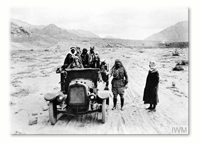
Lawrence and Joyce embark on
long-range reconnaissance towards
railway station at Mudawwarah, using
Rolls-Royce armoured cars
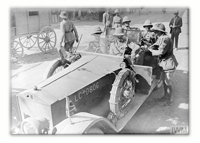
1 January, 1918
Lawrence and Joyce use light artillery
mounted on Talbot cars to attack
Turkish posts north of Mudawwarah
3 January, 1918
1,000 Arabs led by Sharif Nasir and
Nuri as-Sa’id capture strategic well
at Abu al-Lissan. They then embark
on a large raid towards Ma’an
25 January, 1918
With a party of around 600 tribesmen,
Lawrence defeats a Turkish column
of 1,000 men at Tafila, a town to the
south-east of the Dead Sea. The Arab
force captured over 200 prisoners and
also mountain guns in what was the
most significant Arab victory over
conventional troops in the war.
Lawrence was later awarded a DSO
for his part in this action.
March, 1918
Lieutenant-Colonel Alan Dawney
replaces Joyce as head of Operation
Hedgehog
26–31 March, 1918
General Allenby leads an attack
against Amman.
12 April, 1918
Nuri as-Sa’id captures
Ghadir el Haj
13 April, 1918
Maulud Bey occupies Jabal Simnah,
to the west of Ma’an using regular
Sharifian troops. Further assaults on
Ma’an during the days that follow.
17 April, 1918
A contingent of the Arab Regular Army
and also Arab tribesmen begin a final
major assault on Ma’an. The town does
not fall but the railway line south of
Ma’an is cut and is not repaired for the
remainder of the war. A lengthy siege
then ensues.
30 April - 3 May, 1918
General Allenby leads a second attack on Amman.
May, 1918
A series of raids takes place against
the Hejaz Railway and 25 bridges are
destroyed. This is part of a wider campaign in support of General
Allenby’s operations.
4 June, 1918
Feisal and Chaim Weizmann,
the Zionist leader, meet at Waheida to
discuss the future of Palestine and also
Arab claims to nationhood
8 August, 1918
300 men of the Imperial
Camel Corps commanded by Major
Buxton and T. E. Lawrence attack
and capture the railway station at
Mudawwarah with RAF support
16 September - 1 October, 1918
Feisal coordinates
with Allenby’s planned Megiddo
offensive. A contingent of around
1,000 men including 450 Arab regulars,
Gurkhas, Egyptian troops and French
artillery carry out a series of raids on the
line to the north and south of Deraa.
19 September, 1918
Allenby’s Megiddo offensive begins.
Arab attacks in and around Deraa. Despite being harassed
by bombing raids from German and
Turkish aircraft, the Arab Army
continues to destroy bridges on the
lines north and south of Deraa.
23 September, 1918
Turkish garrison at Ma’an vacates
the town, having been under siege since
April, and surrenders to British forces
27 September, 1918
Turkish force destroys the village
of Tafas and kills the majority of its
inhabitants in an act of reprisal. This
Turkish force is later destroyed by
elements of the Arab Army under
Nuri as-Sa’id and Lawrence
28 September, 1918
British 4th Cavalry Division under
General Barrow and an advance party
of the Arab army arrive in Deraa at the
same time. Barrow finds tribesmen
killing the wounded on a Turkish
hospital train in the station.
1 October, 1918
Leading elements of the Arab Army,
the 5th Cavalry Division and the
Australian Mounted Division enter
Damascus. Thereafter, the Arab Army
continues to parallel the British
advance northwards.
26 October, 1918
When the British Army enters Aleppo,
it finds an Arab force already there.
29 October, 1918
British and regular troops of Arab
Army arrive at Muslimiya Junction,
north of Aleppo. This crucial railway
junction controls the Turkish rail link
to the Mesopotamian front.
31 October, 1918
Ottoman Empire Surrenders
January 1919
Having held out for another two months,
Fakhri Pasha, the Ottoman commander
of Medina, finally surrenders.
July 1919
Lawrence and Pisani accompany Feisal
to the Paris Peace Conference. In July
1919, Feisal is forced to leave Syria
on the orders of the new French
administration.
1921
A Middle East settlement is arrived at
during the Cairo Conference. Under
the terms of the British mandate, Feisal
is to become king of Iraq (former
Mesopotamia) in 1921