|

For 300 years Arabia and the Persian Gulf served as
a vital link between Britain and imperial India. But
from 1908, when the first major oil strike was made
in Persia, Britain had an additional and
growing interest to protect in the region. It was to
bring her into bitter conflict with Arab nationalism
and involve her in bloodshed as well as profit.
On the morning of November 30,
1971, Iranian gunboats landed
two companies of soldiers on
three tiny Arab islands in the
Persian Gulf off the Trucial
Coast of Oman. They met a mixed reception.
On the biggest island, called Abu
Musa, where a few hundred transient
fisherfolk scraped a precarious living, the
soldiers were officially welcomed by the
local Arab police commander, and within
hours they were sitting down to as substantial
a feast as the island's modest
resources of fish and scrawny chickens
could provide.
On the smallest island, a rocky protuberance
called the Lesser Tunb, their
arrival was neither welcomed nor opposed,
for the excellent reason that there was no
one there. Save for a teeming population
of snakes, the Lesser Tunb was uninhabited,
and the Iranians, having made
a token landfall, departed as quickly as
they had come. On the third island however,
called the Greater Tunb, where 80 or 100 people lived in the utmost indigence,
a crackle of rifle-fire sounded from the local police post, and before the
Iranian soldiers could raise their flag in
safety, three of their own number and
one Arab policeman were shot dead.
Intrinsically, there was nothing in
these tiny islands to justify any international
incident, even on such a petty
scale as this; but for many months before
the Iranian landings, the island had been
the focus of a complex wrangle about historic
rights and sovereignty between
their ruling Arab sheikhs, the Shah of
Iran, and Her Britannic Majesty's government,
which, for reasons by then obscure
to most people, had once undertaken to
protect the Arab claim. By 1971 that
protection had been withdrawn and the
Shah had exercised the right of force
majeure against the sheikhs without fear
of British opposition.
On the day after the Iranian landings,
Britain's senior diplomatic representative
in the Gulf was threatened by a hostile
Arab crowd, and in protest against what
they said was a British betrayal of the
Arab cause, Iraq broke off diplomatic
relations with Britain and Libya nationalized the local assets of the British Petroleum
Company. With these small episodes
150 years of the Pax Britannica in the
Gulf were ended and the remaining relics
of Britain's empire in the Middle East
slid into history. Almost without knowing
it, the world had said good-bye to the
last, scattered outposts of the Raj.
The story of Britain's involvement in
the Middle East falls into two main parts,
broken by the First World War. The 300
years preceding 1914 were ones of rising
British power, when the colonial administration
in India, concerned to defend its
trading route to Britain, was brought
gradually to exercise more and more influence
in Arabia and the Persian Gulf.
After 1914, British investment in Middle
Eastern oil led the British government
into conflict with the awakened Arab
nationalism of the 20th Century.
The first part of the story goes back to
the early 17th Century, when Iran, under
its older name of Persia, was the mistress
of the Gulf and her emperors claimed
control of several parts of the Arab shore.
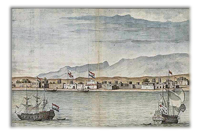
In 1619 one of those emperors, the great
Shah Abbas, granted the British East
India Company a monopoly of his country's
silk trade and allowed its factors to
settle at the Persian port of Bandar
Abbas. For 150 years the Company survived
there, a sturdy offshoot of its
Bombay headquarters, gradually squeezing
out its French, Dutch and Portuguese
rivals and extending its commercial tentacles
northwards to Basra to dominate
the entire Persian coast.
But while the Company prospered the
empire of the Shahs declined. By the
second half of the 18th Century, Persia
was sinking into chaos, and threats to the
East India Company's supremacy in the
Gulf were appearing from all directions.
From the east the Afghans had invaded
Persia and disrupted its internal trade.
Across the Gulf the coastal Arabs had
destroyed the last Persian footholds, and
an upsurge of Arabian fanaticism, inspired
by the Wahhabi Muslims of the interior,
was beginning to strengthen their tribal
organization and reinvigorate their traditional
piracy at sea.
In the north the expanding empire of
Russia was pressing upon the fragile
barrier of the Ottoman Turks, as well as
upon the decayed administration of the Shahs, in a first intimation of that Tsarist
threat to India which so obsessed the
19th-Century Raj. Further west, in the
Mediterranean, the French were also
active, probing the Ottoman hold on the
Levant in the hope of reopening the old
overland route from Europe to India.
The British response to these activities
was cautious, but consistent. In the late
18th Century and throughout the 19th,
Britain's primary imperial concern was
to protect her trade-routes to the East,
especially to India. And so over 150 years
she was led into a steady and, as she
believed, defensive extension of imperial
control from the Persian mainland to the
Arabian shore of the Gulf and thence, by
degrees, round the whole Arabian coast
until, by 1914, a cordon sanitaire covered
the approaches to India all the way from
Teheran to Suez.
The first British move was inspired by
the local threats of Persian instability and
Arab pirate raids. In 1763, the East India
Company transferred its Gulf headquarters
from Bandar Abbas to the more
secure port of Bushire, further up the Gulf. There a British official, called the
Resident, was installed with an Indian
guard. The East India Company was
guaranteed a monopoly on the export of
woollens into Persia and the Persian ruler
promised that no other European nation
would be allowed to establish a competing
trading station. Here was the origin of
Britain's presence throughout the region.
The next British moves were a response
to foreign intervention - Napoleon's
Egyptian campaign to force a way through
the Muslim barrier between East and
West and outflank the British sea-route
to India. Even before Nelson had destroyed
the French fleet at Aboukir in
1799, forcing Napoleon to withdraw from
Egypt, the British officials in India had
acted on their own account, without
instructions from London, to seal off the
French roads to the East.
In 1798 naval units from the Bombay
Marine seized the little island of Perim at
the mouth of the Red Sea, the first British
occupation of any Middle Eastern territory.
In the same year, at the exit from
the Persian Gulf, representatives of the East India Company signed a treaty of
friendship with the powerful Sultan of
Muscat, the first British treaty with an
Arabian ruler.
The pattern of British activity in this
region thus established in the closing
years of the 18th Century was to persist
virtually up to the time of Britain's withdrawal.
The pattern had two main
features. In the first place, the "British"
presence was Indian in origin, control and
style. On the western side of the Muslim
barrier the British government in London
assumed the responsibilities of empire,
juggling with the intricacies of the Eastern
Question to ensure British supremacy in
Cairo and Constantinople and reaching
its diplomatic arm far into Central Asia.
But east of Suez the British in India
were in command; and before the Indian
Empire vanished they had spread the
influences, priorities and titles of the Raj
everywhere from Baghdad to Aden.
(When the activities of the British government
and the Indian administration
overlapped, as they did in Persia and
Mesopotamia, there was ill-disguised rivalry between them. For a time in the
I9th Century, indeed, there were rival
British and Indian legations in Teheran,
until it was agreed to split Persia in half
and for their respective consuls to share
a diplomatic compound in the capital.)
In the second place, British control
was maritime, not territorial - a girdle of
sea power round the eastern extremities
of the Arab world. Where territorial control
of some kind was deemed essential,
it was achieved by the traditional British
method of indirect influence, rather than
direct rule. In the West, the British
government secured the same result by
supporting the Ottoman Empire against
Britain's European rivals and by making
the Royal Navy mistress of the
Mediterranean.
In the East, the Indian administration
simply extended its system of protective
overlordships from the native states of
the sub-continent itself to the petty
coastal rulers of Arabia and the Gulf.
Apart from the maintenance 'of a territorial
sphere ' of influence in southern
Persia, nothing more was required so long
as the defence of India and Britain's
seaborne trade remained the centre of
imperial policy. Arabia was, anyway, a
notoriously hostile land; and although a
few explorers, like John Lewis Burckhardt
and Richard Burton, or William Palgrave
and Lieutenant James Wellsted, braved
its dangers from time to time out of scientific
curiosity or a love of adventure, few
British travellers in the Arabian interior
envisaged - and none found - any means
of turning curiosity and adventure to material advantage. "Here is a dead
land," wrote one of the greatest of them,
Charles Doughty, in his classic 19th Century
work, Travels in Arabia Deserta, "whence,
if he die not, [the traveller] shall bring
home nothing but a perpetual weariness
in his bones."
It was not the function of the Raj to
seek entanglement in such unrewarding
regions, nor to extend the Pax Britannica
to its warring tribes. As long as the surrounding
seas were free and other powers
were kept at arm's length from India, the
imperial duty was done. Only in one place,
around the port of Aden, a paltry 75
square miles, did the British assume the
responsibility of colonial rule in these
Middle Eastern extensions of the Raj.
Elsewhere, they took some 40 or 50 independent
principalities into a variety of
treaty relationships that made them what
Lord Curzon called "loyal feudatories."
The treaties embraced many a curious
agreement, containing numerous degrees
of subordination to British power and
many different kinds of British obligation
in return. But nowhere was the subordination total. Everyone of the treaties
confirmed the local ruler in some measure
of independence by restricting Britain's
right to interfere in the principality's
internal affairs. The first treaty, that
signed with' the Sultan of Muscat in 1798,
included no formal 'British suzerainty of
any kind. The Sultan was generally
regarded as Arabia's most powerful ruler.
He had overseas possessions in
and East Africa, his navy possessed 75
ships of the line, and his agents traded as far afield as the Great Lakes of Africa and
the China Sea.
His alliance with the British was, therefore,
nominally a meeting of equals; and
although the equality soon became more
fiction than fact - especially when the
Royal Navy began to suppress his African
trade in slaves - it was never formally
gainsaid on paper. By every test of international
law he and his successors remained
independent rulers, a fact that
was to cause many a British official to
grind his teeth in later years.
Lesser Arabian rulers accepted some
degree of vassalage. In the Gulf this
merely took the form, at first, of undertakings
to desist from piracy. By the end
of the 18th Century, under the growing
influence of the Wahhabis, Arab piracy
had become the scourge of the Persian
shore and for the next 50 years its suppression
was the main preoccupation of
the Bushire Residency.
Repeated punitive raids on what came
to be known as the "pirate coast" of
Oman had no effect and the bold operations
of the Qawasim tribe, in particular,
mounted from the little port of Ras
al-Khaima, remained a tiresome irritant
to British traders. Then, in 1835, a new
Bushire Resident, Captain Samuel Rennell,
replaced the iron hand with the velvet glove. Apart from piracy and fishing, he noted, the only resources the Arabs
had were the Gulf's ancient pearling
grounds. If pearling were more profitable,
he reasoned, the Arabs might be less
inclined to plunder.
Captain Rennell therefore induced the
Arab sheikhs to accept a maritime truce
among themselves for the duration of
each annual pearling season. As the years
went by and profits rose, the truces were
extended - from a season to a year, from
a year to ten years, and finally, in 1853, to
perpetuity. By the Treaty of Maritime
Peace signed in that year the sheikhs
accepted "a peaceful maritime truce...
between ourselves and between our successors
respectively for evermore." Thus
the pirate coast became the Trucial
Coast and the waters of the Gulf were,
finally, at peace.
The Pax Britannica had arrived, but it
was at the invidious cost of making
Britain arbiter of all local disputes. To
maintain the peace Britain had to defend
each sheikh from attack by his neighbours,
and to make the peace palatable to the
sheikhs in the first place, she had to
acknowledge their sovereignty in places
around the Gulf where, a century or two
before, the Persians had claimed control.
In those concessions lay the seeds of trouble when the Empire bowed out of the
Gulf 120 years later.
The truce was strictly maritime. Inland,
the Arabs continued to squabble with
what a British political agent of the day
described as "that mania for fighting
that possesses the Arab mind." British
agents held by the rule that events on the
mainland were not their concern. Anti-slavery
agreements, for example, were
imposed along with the truce at sea as part
of the world-wide campaign against the
slave-trade; but it was the traffic in slaves,
not the institution of slavery, that Britain
and the Royal Navy sought to end.
True, British agents secured the right
to manumit any slaves who applied to
them for freedom. And as late as the 1960s
they were still occasionally called upon to
do so. But to attack the problem frontally
by requiring the release of all Arabian
slaves would have involved the Raj in a
degree of territorial control that it was
unwilling, and probably unable, to
exercise at that time.
Even the defence of India required no
more than a negative British influence
on the Arabian shore. In the final quarter
of the 19th Century, when the possibility
of Russian invasion seemed increasingly
strong, and successive Vice-regal governments
in Delhi trembled for their estate,
the British response was to sign another
series of agreements with the Gulf rulers
giving Britain control of their foreign
relations. Rival powers were thus formally
barred from the Gulf, from Kuwait to
Muscat, without Britain's being committed
to any greater physical presence.
These defensive arrangements were
not, to be sure, secured without some
blood-and-thunder- though more thunder
than blood. When, in 1899, Curzon, as
Viceroy, sent the Resident from Bushire
to Kuwait to negotiate the first British
treaty with the Kuwaiti Sheikh, he
painted an alarming picture of the threat
to Empire that might result if other powers
got there first and used the sheikhdom
as the eastern terminus of a railway from
Europe. "Are we prepared to surrender
control of the Persian Gulf and divide that
of the Indian Ocean?" he asked. "Are we
prepared to make the construction of the
Euphrates Valley Railroad or some kindred
scheme an impossibility of England
and an ultimate certainty for Russia? Is
Baghdad to become a new Russian capital
in the south? Lastly, are we content to
see a naval squadron battering Bombay?"
Rather, he would "impeach the British
minister who was guilty of acquiescing in
such a surrender as a traitor to his
country."
A few years later, the Russians had the
temerity to send the cruiser Askold on a
tour of the Gulf (greatly impressing the
inhabitants, who believed its five funnels
to be a sign of great strength) and Britain's
Foreign Secretary, Lord Lansdowne, asserted
British supremacy with the warning
that the establishment of a naval base
in the Gulf by any other power would be
resisted "with all the means at our disposal."
By then the imperial administration
in India had made Britain the sole
overlord of the Gulf from top to bottom.
In the rest of Arabia, meanwhile, the
British presence had grown in a similar
fashion. At the mouth of the Red Sea the
waterless inhospitality of Perim island soon forced the British to look to the
near-by mainland for a base. Their choice
fell naturally on the superb anchorage at
Aden, one of the finest harbours between
London and Bombay, and perfectly endowed,
therefore, to serve in addition as
a coaling station for the East India Company's
first 19th-Century steamships.
Aden had once been known as the prosperous
"eye of the Yemen," a natural
port of call on the Red Sea route to the
East and the outlet for the fertile Yemen
mountains, 100 miles to the north. But
after the Turks had conquered the interior
in the 16th Century and Europe's merchants
had discovered the Cape route to
India, Aden had declined into nothing
more than a pirate village preying on
Indian Ocean traffic.
Then, in the 1830s, an army from
Muhammad Ali's Egypt invaded the
Yemen and threatened to capture Aden.
The British decided to act. Local pirates
provided a pretext by holding the passengers
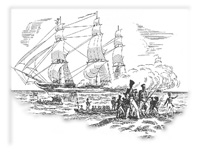
and crew of a British ship to ransom, and in 1839 Captain Stafford Haines
of the Indian Navy landed from Bombay
with 700 men and a couple of Royal Naval
sloops in support. At a cost of only 15
casualties he annexed Aden to the Bombay
Presidency, the first imperial acquisition
of Queen Victoria's reign and one
destined to carry some flavour of the Victorian
Age far into the 20th Century.
Haines, who was appointed political
agent in the territory, had a vision of
restoring Aden to its former commercial
glory. And after the Red Sea route to
Europe was reopened in 1869, with the
inauguration of the Suez Canal, Aden's
trade did, indeed, increase. Indian merchants
moved in to exploit the new commerce.
Indian clerks manned the offices
of the new shipping agents, and behind
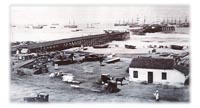
the headland known as Steamer Point,
where the P. & O. vessels took on coal, a
whole new Anglo-Indian town arose, full
of the characteristic wooden bungalows
and box-wallahs of the Raj.
But to the Indian officials Aden was
primarily a military outpost, as Perim had
been. They therefore rejected the possibilities of commercial co-operation with
the Yemen and chose instead to strengthen
the defensive barriers between Aden and
the interior by extending exclusive treaties
of British protection to all the principal rulers of the South Arabian coast.
Not all the sheikhs received the British
overtures, and many lesser tribal rulers
were ignored (a fact that was to cause
trouble for the British in later years, when
favours offered to the treaty sheikhs
stirred the others to rebellion). But, one
way or another, by the end of the century
some 30 ill-defined tribal states between
the Red Sea and the Sultan of Muscat's
territory in Dhofar had been recognized
by Britain, thus creating that curious
strip of pink on the old schoolroom maps
of Empire known as the Aden
Protectorate.
What little more was needed to complete
the British cordon round the approaches to India was accomplished in the
First World War, with the collapse of the
Ottoman Empire. The sheikhdom of
Qatar, in the Gulf, was brought under
British protection when the last Turkish
garrison withdrew in 1916. Sherif Hussein
of Mecca, the leader of the Arab Revolt
against Turkish rule, became Britain's
ally, and his rival, the young Abdul Aziz
ibn Saud, ruler of the eastern Arabian
province of Nejd and descendant of the
Wahhabis, secured a treaty of British
protection in return for his help against
the Turks. When the Mesopotamian
Valley was formally included in the British
sphere of interest as a post-war League of
Nations mandate, the Empire appeared
supreme from the Caspian to Cairo.
Yet it was an Empire, not of occupation
or administration, but of influence and
custom - and these remained respectively
as maritime and Indian as ever. For all
the proliferation of treaties, the internal
life of Arabia's sheikhdoms and sultanates
remained untouched. Frontiers were unmarked
and tribes were still at war, much
as they had been since the days of
Abraham. In Persia, neither the eclipse
of the Shahs nor the menace of Russia
had induced the British to change their
indirect authority for direct rule. They
had stuck to the principles implicit in the
terms of the East India Company's early settlement at Bushire: the protection of
British trade and the extension of India's
imperial defences.
The Company's Resident in Bushire
had long since gone, but in his place there
was the Indian administration's Resident
for the Gulf. In Aden Britain's chief official was also a Resident appointed by
the Viceroy. The Resident's staff was
recruited from the Indian Army, or even
the Indian "civil." Indian soldiers provided
ceremonial guards at British legations
and consulates in Baghdad, Teheran,
Isfahan and Muscat, as well as at the
Residencies in Bushire and Aden. Indian
Army engineers built their characteristic
administrative compounds, Indian merchants
ran the trade, Indian rupees were
the standard currency and Indian words
and customs laid a veneer of Indian
culture upon both the Arab and Persian
worlds.
The Anglo-Indian curry lunch was an
accepted Sunday ritual. Every laundryman
was a dhobi, every watchman a
chowkidar, and every household servant
answered to the Anglo-Indian cry of
"Bearer!" Three or four thousand miles of
Middle Eastern territory - a crescent
around the heartland of Arabia - lay
securely under the shadow of the Raj.
Yet in that post-war moment of
apparently unchallenged supremacy, the
Raj, in truth, had already passed its peak
and in both its Arab and its Persian outposts
new revolutionary forces were
emerging that would eventually destroy
the whole imperial structure. They were
those 20th Century twins of Middle
Eastern politics - nationalism and oil.
In all the long history of Britain's
special connection with the Middle East
there was never a more momentous document
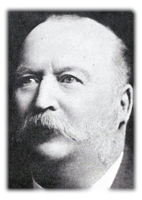
than that to which the Shah of
Persia put his name on May 21, 1901, at
the request of an Englishman called
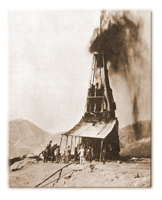
William Knox D'Arcy. It was the first oil
concession agreement of the 20th Century,
bestowing upon D'Arcy "a special and
exclusive privilege to search for, obtain,
exploit, render suitable for trade, carry
away and sell natural gas, petroleum,
asphalt and ozerite throughout the whole
extent of the Persian Empire for a term
of sixty years."
Although its terms were to be revised,
denounced, broken and restored many
times by many different signatories long
before its 60 years were up, it was the
foundation of one of the biggest economic
operations the world had ever seen and its
results inspired political changes more
radical than any the Middle East had
known for centuries.
At first, the deal seemed unrewarding. Seven
years elapsed before D'Arcy got
any returns, and his directors had actually
sent a cable cancelling further exploration
when the news arrived in London in
1908 of an oil strike at Masjid i-Suleiman
in southern Persia. In the next year the
Anglo-Persian Oil Company was formed
with a capital of £2 millIon supplied by a
group of British and Dutch financiers.
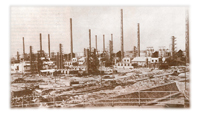
D'Arcy was bought out and work began
on the first Middle Eastern oil refinery at
Abadan, in the Gulf.
The strike could not have come at a
better time. On the eve of the First World War
the Royal Navy was just completing
its conversion from coal- to oil-fired ships
and Winston Churchill at the Admiralty
persuaded the government to safeguard
the Navy's future by acquiring a majority
holding in the new oil company. Sixty
years later, when Anglo-Persian had become
the British Petroleum Company,
that holding provided a revolutionary
Arab government in Libya with the excuse
to confiscate B.P.'s assets, in response
to Britain's final alleged "betrayal" of the Arabs in the Gulf. But at the time, the
government's purchase seemed to be a
matter of common prudence, on a par with
Disraeli's shrewd purchase in 1875 of
shares in the Suez Canal.
The discovery prompted other countries
to seek oil concessions in the area;
and in 1914 Anglo-Persian joined with
Royal Dutch Shell and a German company to prospect for oil in northern Mesopotamia
- the origins of the modern Iraq
Petroleum Company. At the same time,
the British hurried to plug possible loopholes
in their screen around the Gulf by
signing yet another series of agreements
with all the Arab states, from Bahrain and
Kuwait to the Trucial Coast and Muscat,
giving Britain the exclusive right to oil
concessions in their territories. They were
the first indication that Britain would
soon switch her policy from maritime
containment in the interests of India to
territorial engagement for economic gain.
The Empire was forced to come to
terms with another new and challenging
phenomenon encouraged by the First
World War - nationalism. In India itself
when the war was over, the independence
movement began to shake the
confidence of the Raj, and in the Middle
East the collapse of the Ottoman Empire
and the success of the Arab Revolt had
started the same fires burning. In Persia,
the military coup d'etat of Reza Shah, a
former colonel in the Russian Cossack
Regiment, suggested as early as 1921 that
the days of simple acquiescence in British
policy were ending.
In Arabia, five years later, ibn Saud
asserted his independence by overrunning
his old Hashemite rival, Sherif Hussein,
and proclaiming himself King of the
Nejd, Hejaz and its Dependencies. In the
Yemen, too, a new Arab ruler, the Imam
Yahya, emerged in the wake of Turkish
withdrawal to try to subjugate or suborn
the sheikhs of the Aden Protectorate in
the hope of restoring the medieval unity
of his kingdom.
Like the search for oil, these new rumblings
from the Arabian interior forced
the British to look to the land in earnest.
To leave frontiers unmarked and tribes at
war in regions nominally under British
protection or control was to place both
the new oil concessions and imperial
authority in jeopardy. So the Indian administration was drawn into the interior
at last, in realms far removed from its
own, to extend and defend its traditional
sphere of interest more rigorously than
ever before.
From Iraq to Aden diplomatic negotiations
with new Arab leaders went hand-in-hand with the pacification of unruly
tribesmen and the first attempts at
frontier making. The bumbling biplanes
of the Royal Air Force dropped bombs on
rebellious villagers in Kurdistan, while
Indian officials trekked into the Yemeni
mountains to talk to the new Imam.
Soldiers, surveyors and administrators
followed them and a new wave of explorers
penetrated parts of Arabia rarely, if ever,
seen before by Europeans. St. John
Philby went to the unknown interior of
the new Saudi kingdom, Bertram Thomas
traversed the fearsome desert in the south,
known as the Empty Quarter, and Freya
Stark entered the secret valley of the
Hadhramaut.
By the mid 1930s the modern map of
Arabia was taking shape and a fitful sort
of peace was falling upon some of its
ancient tribal squabbles. In the Hadhramaut,
where Freya Stark was marooned
among warring factions in 1935, a young political officer, Harold Ingrams, was
able, only a year or two later, to settle
1,000 years of quarrels almost single-handed.
In three years of lonely travel
and tribal negotiation between 1936 and
1939, Ingrams obtained the signatures of
over 1,300 local chieftains to a general
truce that became known, deservedly, as
"Ingrams' Peace."
At the same time, he signed a new series
of treaties with the five major rulers of
the area, promising them further British
help and protection if they, in return,
would accept the advice of the Governor
of Aden in matters concerning the welfare
and development of their territories. His
achievement was significant in two
respects. First, because the new treaties
were the first to give Britain any right to
interfere in the purely internal affairs of
Arabia and, secondly, because they
marked a transfer from the Indian
administration's influence to the authority
of Whitehall.
Increasingly preoccupied by the independence
struggle at home, Indian officials
no longer had the energy or the interest
to spare for the Arabian outposts of their
empire. In 1937, the Colonial Office in
London assumed responsibility for the Aden Protectorate and made Aden itself
a fully-fledged Crown Colony, with the
intention of pursuing a "forward policy"
of colonial development and defence to
safeguard Britain's interests.
But the time was already later than it
seemed. The ink was scarcely dry on the
last of Ingrams' treaties when the Second
World War began. Most of Arabia's frontiers
were still uncharted or disputed,
many of its biggest oil-fields were undiscovered
or unexploited, and most of its
tribal life was unaffected by the demands
and opportunities of the modern world.
For the next ten years the war and its
aftermath prevented any rapid change,
and when the post-war demand for oil and
the renewed challenge of Arab nationalism
forced Britain to intervene more
decisively in Arabian affairs, it was too
late for any so-called "forward policy" to
be effective. The rest of the Empire by
then was crumbling and British power was
in eclipse.
Imperial development in the Gulf was
even more tardy. Not until the Raj withdrew
from India in 1947 was the Resident's
post transferred from the Viceroy's
staff to that of the Foreign Office in
Whitehall and his headquarters moved from the decaying little town of Bushire,
on the Persian shore, to the thriving oil
sheikhdom of Bahrain on the Arab side of
the Gulf. On the Trucial Coast the neighbouring
sheikhdoms of Abu Dhabi and
Dubai were still at war as late as 1949,
firing antique cannon-balls at each other
across the sands quite unhindered by the
maritime truce their ancestors had signed
100 years before.
Not for another three years after that
did the British manage to extend the
truce from the sea to the land and establish
the Trucial States of Oman in something
like their final form, when they
recognized the little sheikhdom of
Fujairah as the seventh and last of the
states in the Trucial system and, at the
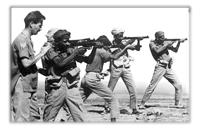
same time, created a local Arab force
known as the Trucial Oman Levies later changed to Trucial Oman Scouts to
keep the peace along the coast.
Once again the motive forces were oil
and nationalism, for by then the oil prospectors
had arrived in Trucial Oman
requiring both protection for their lives
against the local tribesmen and defence
of their concessions against the threat of
external Arab conquest. The Scouts provided
both. What they lacked in military
weight they made good by the symbolic
fact of their presence. With their British
officers, romantically wrapped in the
flowing head-gear of the desert as they
led their camel trains across the great
Arabian sand-dunes, they served notice
that the frontier which Britain was ready
to defend had moved from the Gulf coast
into the Arabian interior.
They were, in short, the last agents of
the Pax Britannica, and in that capacity
they had to prove themselves almost at
once, when Saudi Arabia decided to enforce
a claim to parts of Oman and the
sultanate of Muscat by moving its own
police force into a remote oasis by the
name of Buraimi.
The Saudi claim was based ostensibly
on the history of Wahhabi influence on
the coast, against which the British had
fought 150 years before. But its real basis
was the search for more oil and its support
this time came from far afield, as nationalists
throughout the Arab world took up the cause of revolutionary struggle against
British imperialism. The Scouts finally
threw the Saudis out in 1955, in a bloodless
coup de main, but the Buraimi
dispute passed into the anti-imperialist
calendar, and the memory of it lingered
in the Middle East even after the Empire
had departed from the Gulf for ever.
Thus, in a consistent pattern of challenge
and response, the Empire began to
assert itself all round Arabia in the first
decade after the war. The demands of oil
and strategy, the provision of advice and
social welfare, the need for economic
development, and the extension of law
and order - in one combination or another
all these drew the British on towards new
horizons and new responsibilities. Yet, in
spite of it all, these territories in which
Britain now sank the last of her imperial
energies, remained in limbo. At heart, the
Arabian sheikhdoms which the British
were trying to protect were still the same
lawless places whose "mania for fighting"
had been so striking a century before.
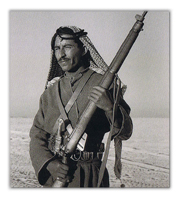
Few of their inhabitants were ever
seen without a rifle, a dagger and a
bandolier full of bullets. Slavery was still
endemic to most of them; poverty and
isolation seemed inbred. Even in those
states where oil discoveries had begun to confer vast riches, the follies of the local
ruling families, unused to such wealth,
were legendary. Girls were imported en
masse from Beirut for their harems and
gold watches and jewelled bracelets were
showered upon casual visitors while their
own people looked on in mingled wonder
and resentment.
In Qatar the ruler was reputed to throw
away his Cadillacs when the ash-trays
were full, and in Abu Dhabi, where the
Sheikh was paid a handsome sum just for
the prospecting rights in his territory, the
ruler's bizarre behaviour was a permanent
headache to his British protectors. His
money was paid at his own request in
brand-new Indian rupee notes - still the
official currency of the Gulf at that time
- which he carried off in one of his
capacious underskirts to the strong-room
of his little mud-walled palace. There he
counted every note himself, thrust them
into old tea-chests and petrol-tins and
locked them out of sight and mind.
His people grumbled, his officials went
unpaid, and once, when his policemen
were on the verge of rebellion, he opened
a tea-chest to find the money to pay them,
only to discover that weevils had eaten
half his concession allowance.
In vain did the British Resident in
Bahrain send his agents to remonstrate
with such men. The new world was not
their world and the treaties which their
ancestors had signed with the Raj had
never required them to listen to British
reproaches about the way they should
run their own affairs. And so an imperial
system constructed for the first half of
the 19th Century shambled on uncertainly
into the second half of the 20th - an increasingly embarrassing example of British
responsibility without power. Of
course, it could not last. As the 1950s
opened, events elsewhere were sweeping
Arabia and the Gulf into the mainstream
of international politics and forcing the
British Empire into one of the last of its
many rearguard actions.
In the years of imperial withdrawal
which followed the Second World War,
few men so nettled the pride of Britain as
Dr. Mohammed Mossadeq, Prime Minister
of Iran. Tearful, contumacious, hysterical
and stubborn, he seemed pre-eminently
the sort of man to whom the Empire of
old would have given short shrift; and
when he nationalized the Anglo-Iranian
Oil Company in 1951, it was widely
assumed that the dispatch of a gunboat,
in the good old-fashioned way, would
soon bring him to heel.
But though the cruiser: H.M.S. Mauritius,
stood by off Abadan with orders to
land Marines if necessary, Anglo-Iranian
stayed nationalized and Dr. Mossadeq
remained in office. The Marines were
never landed, the cruiser was withdrawn,
and three years later, when the crisis was
resolved, Britain's exclusive interest in
Persian oil had been reduced to a small
joint shareholding with a number of
American companies and Iran had set up
its own national oil company, pointing
the way eventually to greater independence
for all the Middle Eastern oil countries.
The Mossadeq affair was a blow from
which British prestige in the region never
recovered. Iran, it is true, suffered from
a commercial blockade of her oil exports,
and Dr. Mossadeq ultimately lost his job.
But he had called the British bluff in the
Gulf, and what had once seemed an
imposing structure of imperial power was
revealed as a rickety facade. In retrospect,
this outcome seems to have been
inevitable. The withdrawal from India
and the abandonment of Palestine had
already signalled the approaching end of
Empire elsewhere and, although post-war nationalism had made only a fitful
impact upon the British-protected fringes
of Arabia and the Gulf before the Mossadeq
crisis, the competition of the new
super-powers was being increasingly felt
in those areas.
In Saudi Arabia the Americans had
secured an oil monopoly before the war,
and ibn Saud had slid from the protection
of the Raj into the more capacious arms
of Washington. American oil-advisers and
the American State Department gave
open support to the Saudis in the
Buraimi dispute and discreetly penetrated
all Britain's commercial strongholds
around the Gulf. American companies
shared the vast new fields of Kuwait
equally with the British and participated,
through the Iraq Petroleum Company
and its subsidiaries, in all the other Arab
oil operations from Mosul to the Trucial
sheikhdoms.
During the war the United States had
taken over Britain's traditional military
and political influence in Iran, as a result
of the great American drive to get war-supplies into Russia through the Persian
back door. When Mossadeq destroyed the
British oil monopoly there, the Americans
moved in to take over the commercial
leadership as well.
The Soviet Union was equally active.
At the end of the war it had sought fo
perpetuate its wartime administration of
northern Iran by setting up a satellite
People's Republic in Azerbaijan. When
American pressure frustrated that intention
the Russians turned to the subtler
and more rewarding tactic of encouraging
incipient nationalist movements throughout
the Middle East. Mossadeq himself
was spurred on by Russia's Communist
allies in Iran; and growing Arab bitterness
over the creation of Israel, accompanied
by accusations of British and
American betrayal, offered Moscow many
new revolutionary friends.
In the aftermath of the Mossadeq affair,
these new rivalries and alliances of the
Cold War became increasingly entangled
with ancient tribal jealousies and national
resentments in Arabia and the Gulf. By
then the proven oil deposits around the
Gulf amounted to two-thirds of the Free
World's resources and, although Britain's
share of them had dwindled to only half
that of the United States, the profits from
British operations there had become vital
to Britain's balance of payments and the
preservation of the world-wide sterling
area. Strategy and finance, therefore,
prompted a hard line.
As Sir Anthony Eden wrote of a meeting
with Nikita Khrushchev in April, 1956,
"I thought we must be absolutely blunt
about the oil, because we would fight for
it." Six months later he did just that,
after Gamal Abdel Nasser nationalized
the Suez Canal. One of the justifications
for the Anglo-French attack on Egypt,
Eden said, was the fear that, if Nasser
"got away" with nationalizing the Canal,
he might thereafter get his hands on Arab
oil and, with Russian approval, strangle
Britain's livelihood.
Even more than the Mossadeq affair,
the Suez campaign revealed the futility of
Britain's imperial posture in a post-imperial
world. The Canal was blocked,
the trans-desert pipelines from Iraq to
the Mediterranean were blown up, Saudi Arabia
refused to pump oil for British
(or French) tankers, and there were riots
in Bahrain and explosions in Kuwait. For
months Britain was forced to endure
petrol rationing and the flight from sterling approached the level of a national
disaster. When the final cost was reckoned,
it included the destruction of nearly all
remaining trust between Britain and the
Arab world and the abandonment of most
of the military bases that had once been
established there.
Yet, still the British government was
unwilling to reverse its imperial policies
altogether. The protection of Gulf oil was
now as much an obsession in Whitehall
as the defence of India had been in Delhi
a century earlier, and the troops and aircraft
that pulled out of Egypt, Jordan
and Iraq were concentrated afresh upon
the last remaining British strongholds in
the Arabian peninsula.
Aden, for so long little more than India's
furthest outpost, became Britain's largest
overseas military base. The naval units in
the Gulf were strengthened, troops were
trained in the Oman Desert, and the
belated "forward policy" of the 1930s
became an urgent drive for military
security, economic development and
political reform. But the British were
running further than ever behind the
clock and, paradoxically, the more they
tried to catch up, the more they caused
events to accelerate out of their control.
In its new role Aden Colony grew
wealthy and the Indian shopkeepers and
Arab landlords of Steamer Point gladly
joined the treaty sheikhs of the Protectorate
in planning a Federation of
South Arabia that would unite the town
and the tribes to secure the British base and
British patronage - indefinitely. But
the same wealth encouraged a new influx
of Arab workers, who made a natural
seedbed for revolutionary anti-British
nationalist sentiment.
Outsiders jumped quickly on to the
nationalist bandwagon, rolling euphorically
onwards now in the post-Suez atmosphere
of Arab triumph and British
defeat. In the Yemen, the Imam Ahmed,
the son of Yahya who had challenged
British rule in Aden 40 years before, increased
his raids on the Protectorate
frontier and appealed to the United
Nations for. support. From Cairo the
Egyptian radio's Voice of the Arabs maintained
a steady stream of anti-imperialist
invective, while both the Soviet Union
and China took their first, cautious
steps into the treacherous quicksands of the Arabian peninsula 's politics.
By 1957, as a result of Yemeni agreements
signed in Moscow and Peking, Russian
rifles were in use against the British
on the Protectorate border and Russian
and Chinese technicians had arrived to
build new ports and roads for the Yemeni
kingdom. As a result, the ancient tribal
skirmishes of the Protectorate soon engaged
more British troops and acquired
ominous international overtones.
Further east, the pace of change also
quickened. In Muscat the Buraimi dispute
spilled over into the remote mountains of
the Oman interior, where an historic conflict
between the Sultan, on the coast, and
the tribal and religious leaders of the
mountains was inflamed by Saudi money,
Egyptian propaganda and the arrival of
the now ubiquitous oil-prospectors.
When Wilfred Thesiger, last of the
great British explorers of Arabia, arrived
on foot, in 1948, at the gates of Nizwa, in
Central Oman, he was the first European
to see the place since Lieutenant Wellsted
of the Bombay Marines more than a century
before, and he was promptly sent
packing by the local chieftains who feared
that he might have come on behalf of the
oil companies to steal their land, their
wealth and their women.
But within a year or two the oil-men
were there, anyway, rumbling down from
Buraimi in ungainly Albion lorries to set
up permanent camp on the edge of the
Empty Quarter. The local chieftains
scented money and with Saudi and
Egyptian help they tried to throw off the
Sultan's rule and make their own deal
with the oil companies. Once more the
British went in, to protect their oil
interests and to honour old obligations
to the Sultan.
Three times between 1955 and 1959
small British forces joined the Sultan' s
men in subduing the Oman rebellion. Like
the Aden skirmishes and the Buraimi
affair these minuscule sorties were added
to the growing catalogue of imperialist
crimes in the folk-lore of Arab nationalism
and became annual features on the
anti-colonialist agenda at the United
Nations.
By now it was a nice question whether
the British presence did not create more
trouble than it suppressed. Had the British actually ruled the territories they
protected and brought the full weight of
enlightened colonial policy to bear upon
them, their military actions might have
appeared more defensible. But, stuck
with the 19th Century treaty system,
they seemed more and more to be defending
the indefensible, propping up a host
of outdated sheikhs and sultans whom
the 20th Century ought (according to the then
fashionably liberal view) long ago to have
swept away.
British efforts to change the old tribal
ways were restricted largely to diplomatic
persuasion and were often rejected with
contempt. The Sultan of Muscat, for
example, a proud and penny-pinching
little man who conceived of practically
any change as the devil's work, turned his back on what he considered Britain's
half-baked notions of political and social
reform. His kingdom, in consequence,
remained the most remote and backward
in Arabia even after British troops had
gone to his rescue.
Even where the British were able to
induce the local rulers to adapt their style
of government to new circumstances,
their success sometimes inspired another
sort of trouble. In Kuwait, a wise ruler,
Sheikh Abdullah as-Sabah, was persuaded
to create a model welfare state for all his
citizens and to negotiate his independence
from Britain by 1961. No sooner
had he done so, than a new revolutionary
government in Iraq, under General Abdul
Karim Kassem, claimed Kuwait as part
of Iraqi territory and advanced its tanks and soldiers towards the sheikhdom.
Abdullah as-Sabah turned to the British
for aid and reluctantly the threadbare
forces of a vanishing Empire were dragged
into yet another gunboat action; The
commando carrier, H.M.S. Bulwark,
landed Marines in July to serve notice on
General Kassem that Kuwait and British
oil were not for the taking.
It was in Aden that the British presence
seemed most obviously self-defeating.
Ostensibly established to defend the Gulf
oil-fields, the post-Suez base in Aden had
to devote most of its energies to protecting
itself from unrest in the Colony and
tribal dissidence in the Protectorate, conditions
inspired partly by the very
existence of the base. By 1962 it seemed
that only desperate measures could succeed;
and in September of that year they
were duly taken when the colonial government
bulldozed through the Aden legislature
a Bill to unite Colony and Protectorate
in the mutually protective
Federation of South Arabia.
But once again the British were too
late. The next day a group of military rebels in the Yemen overthrew the Imam's
regime, proclaimed the birth of the Yemen
Arab Republic, and begged for Egyptian
help. Within weeks, tens of thousands of
Egyptian troops had arrived and both the
Yemen and South Arabia were plunged
into a multi-sided civil war. In the Yemen,
the Egyptians and Republicans, with
Russian and Chinese support, were locked
in battle with tribal supporters of the old
Imamate - who in turn were sustained by
money and arms from the Saudis, proclaiming
a holy war against Communism
and Nasserism on the sacred soil of Arabia.
In the south, the British and the Protectorate sheikhs sought alliance with
the Saudis and the Yemeni royalists,
while the Republicans and their allies
helped the Aden nationalists and the
dissident tribes to close the British base
and destroy the Federation.
In the end, practically every party to
the conflict was a loser. The Saudi regime
was shaken and the Yemeni royal family
was eclipsed. The Egyptians suffered five
years of humiliation and exhaustion in
vain attempts to subdue the hardy mountain
tribes; and after Egypt's catastrophic
defeat in the Six Day War with Israel in
1967, Nasser was compelled to withdraw
all his forces from the Yemen and abandon
his republican proteges to the perils of
compromise with their enemies. The
South Arabian Federation; too, was
destroyed and the British were forced to
evacuate Aden.
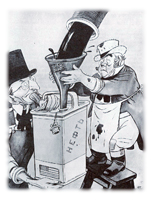
 |
|
|
By the end of 1967 it was all over. The
British forces had suffered some 60 killed
and 700 wounded in the hardest antiterrorist
campaigning since Malaya and
the indignity of their final departure
ranked with the retreat from Palestine.
There were no friendly 'ceremonies of
independence here, only bitterness and
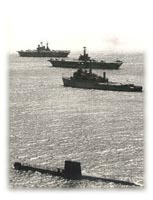
the taste of failure. The last British High
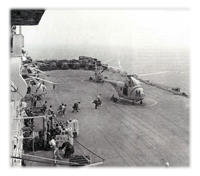
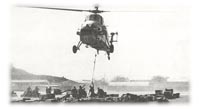
Commissioner had to be lifted out by helicopter under armed guard to a naval carrier standing well offshore, He left behind the first avowedly Marxist state to take the place of Empire, the People's Democratic Republic of South Yemen, and a city racked by fear and poverty that had come to resemble a ghost town. "Gone Away - No Milk, No
Papers," was the message left by a soldier
on the wall of Aden's empty prison.
The British had, indeed, gone
from Aden - but so had tens of
thousands of other people, for
with imperial collapse there
seemed no future for them. The
early commercial vision of Captain Stafford
Haines had never been realized.
Rather, from first to last, through 130
years of British rule, Aden had remained
primarily as the British officials in India
first conceived it - a military base for the
protection of their interests east of Suez.
Once the base was closed, its life ebbed away again into the surrounding sands.
Soon there was little left to remind anyone
of the British occupation save the
peeling verandahs of the government
offices, erected long before by the engineers
of the Indian Army, and an ancient motor
bus at Steamer Point, labelled "Ali
Baba's Mobile Fish and Chip Shop."
Like a golfer scrambling nervously
from one bunker to another, the British
extricated themselves from the perilous
trap of Aden only to fall ignominiously
into another in the Persian Gulf. To replace
the Aden base they created a vast
new army camp in the little Trucial state
of Sharjah and justified a general increase
in their military forces in the Gulf by the
now ritual reference to the need to protect
the Free World's oil supplies.
By 1968 the Soviet Union had greatly
strengthened her influence in Iraq and
was maintaining a regular naval squadron
in the Indian Ocean. Her vessels visited
Arabian ports, like Aden and Kuwait,
with a boldness that must have made
Lord Curzon tumin his grave. China, too,
had sent military and technical advisers
into the new Marxist state of South
Yemen. And in the Sultan of Muscat's
southernmost province of Dhofar old
tribal quarrels had acquired a menacing
ideological slant in the flourishing rebellion
of a revolutionary organization called
the Popular Front for the Liberation of
Oman and the Occupied Arabian Gulf.
To withdraw before such threats seemed
unthinkable to the British government of
the day, especially when the Americans,
in contrast to their earlier attitude to the
British presence in the Gulf, were privately
urging them to stay. Accordingly,
towards the end of 1968, the Labour
Prime Minister, Harold Wilson, sent a
ministerial emissary to reassure the Gulf
states, from Iran to Abu Dhabi, that his
government would continue to exercise
Britain's traditional overlordship in the
interests of all.
Alas for such plans, they lay ruined
within six weeks. Britain was faced with
one of its recurring post-war financial
crises. The pound was devalued. And Mr.
Wilson announced that the cost of maintaining
world-wide military bases had
become too great and that the British
presence in the Gulf - along with that in
Singapore and Malaysia - would have to
go by the end of 1971. This revelation of
the Empire's bankruptcy set the alarm bells
ringing throughout the Gulf and
raised strident criticism at home.
The Sheikh of Abu Dhabi, by now the
lucky owner of vast oil-fields and one of
the richest men in the world, offered to
pay for the British troops himself. The
Conservative Opposition in Parliament
promised that they would revoke the
decision when they were returned to
power. But the Prime Minister's announcement
proved to be self-fulfilling. Once
made it could not be unmade. For the
next three years the only real question to
be answered was just how big a mess the
British would leave behind.
In the end, it was not nearly as bad as
many people had feared, despite the fact
that Britain's withdrawal exposed once
more many Gulf conflicts both old and
new. The very news of Britain's impending
departure led to fresh unrest by the
insurgents. In Dhofar, the revolutionaries
stiffened their campaign against
the ageing Sultan. In the Gulf, the nine
little sheikhdoms still under British protection
- Bahrain, Qatar and the seven
Trucial states of Oman - joined together in the defensive Union of Arab Emirates,
but soon fell to quarrelling.
Saudi Arabia let it be known that the
Buraimi issue was still open, Kuwait professed
satisfaction but nervously sought
diplomatic reinsurance from both Iraq
and Iran. The Iraqis - with discreet
Soviet support - made plain their determination
to encourage revolutionary cells
throughout the Gulf, and the Shah of Iran
made even plainer his insistence that Iran
should call all the local tunes.
To resolve all these differences within
three years and leave the Gulf in a tolerable
state of peace was a race against time
and history. Luckily, the oil money was
now plentiful nearly everywhere and
bought off much potential discontent:
the traditional Gulf rulers were persuaded
to modify their former extravagances in
the interests of their citizens. Only the
Sultan of Muscat remained unmoved by
rebellion, British advice, or the opportunities
provided by his own new oil
revenues, which had been piling up in his
treasury, unspent, for several years.
But in the summer of 1970, little more
than a year before the British left the
Gulf, he was overthrown by his son in a
palace coup. As the gates of his kingdom
were opened to the modern world at last,
the Dhofar rebellion began to look less
threatening. It was the Shah of Iran's
attitude that proved the greatest difficulty. As ruler of the most populous and
powerful of the Gulf states, he believed
his destiny to be to regain for Iran the
supremacy enjoyed by the Persian Empire
in the Gulf before the East India Company arrived.
He therefore restated Iran's
historical claims to Bahrain, where Persia
had once been in command, as well as to
the three small islands at the mouth of
the Gulf with which this story began.
For two centuries the British had
regarded these as Arab possessions. Bahrain
had its own Arab ruler; the islands
were shared between the little Trucial
sheikhdoms of Sharjah and Ras al Khaima;
all three were members of the
new Union of Arab Emirates to which
Britain now proposed to bequeath her
remaining influence in the Gulf; and for
more than a century they had all been
under British protection and would remain
so until the British finally departed. How,
then, was Britain to avoid a clash with
either the Shah of Iran or the Arabs - or,
in default of British intervention, between
them - which might threaten the stability
of the entire Gulf?
The answer was, in effect, a judgement
of Solomon. The biggest of the Shah of
Iran's claims proved negotiable. On
British advice, both he and the ruler of
Bahrain accepted the formality of a
United Nations inquiry into the allegiance
of Bahrain's people which resulted, as
everyone had expected, in the conclusion
that they wished to remain under Arab
rule. The Shah of Iran conceded that
case and Bahrain cut its tenuous links
with the other sheikhdoms in the Union
of Arab Emirates, renounced British protection, and declared itself fully independent
in August, 1971. A few weeks
later Qatar followed Bahrain's example.
Only the seven Trucial states and the
three little islands that belonged to them
were left then to bedevil Britain's departure.
Here the Shah of Iran was
determined to extract a fair exchange for
Bahrain. The islands must be his. They
were of no value to the Arabs, except for
the chance that oil might one day be
found beneath their surrounding waters
- and he offered handsome compensation
against that possibility.
On the other hand, because they stood
astride the exit from the Gulf, their repossession
by Iran was not only historically
fitting, but also strategically vital,
as a guarantee that they would never be
used by hostile forces to blockade Iran's
oil exports. If they were not repossessed
by agreement, they would be taken by
force. Under heavy British pressure, the
Sheikh of Sharjah, who claimed the
largest island of Abu Musa, accepted a
large Iranian pension and agreed to share
his sovereignty on the island with the
Shah. Thus it was that when the first
Iranian soldiers landed there they were
greeted ceremonially with an Arab feast.
The ruler of Ras al-Khaima, Sheikh
Saqr, was made of different stuff. A
crusty and wall-eyed gentleman, and a
direct descendant of the fiercest pirates
of the Gulf, he was the incumbent of the
two tiny islands of Tunb which lay nearest
to the Iranian shore - and he steadfastly
refused to make any deal whatever. In
vain did the British remind him that,
since they had already given notice of
their departure, they could no longer
pretend to defend his claim. That, he
replied grandly, must be on their conscience:
his was clear. Better be bought
out than pushed out, repeated the British
wearily. Nobler to be pushed out than
bought out, was his stubborn answer.
And pushed out he was, with that fatal
little exchange of fire on the Greater Tunb
which announced that the last relic of the
Pax Britannica in the Gulf had ended. By
tacit agreement between the Shah of Iran
and Britain, however, the day chosen for
the Iranian landings on the Tunbs and
Abu Musa, November 30, 1971, was one
day before Britain's withdrawal from the
Gulf became absolute.
Thus it was the British, bound by their old treaties for another 24 hours, who
were made the scapegoat for this blow to
Arab pride. It was the last small service
of the Raj in the Gulf to accept the blame
for the inevitable. Sheikh Saqr duly
accused Britain of betraying him, the
Libyans seized the assets of British
Petroleum in reprisal, Iraq broke off
diplomatic relations with London and
Teheran, and a few small mobs demonstrated
in the towns of Trucial Oman.
Honour was satisfied. On the next day
the British Resident flew down from Bahrain
to the Trucial Coast for a final farewell
tour by car and helicopter of the last
appendages of his once-proud estate. To
each ruler in his sheikhdom the Resident
went in turn, with a flowery Arabic
speech in one pocket and a formal declaration
of British withdrawal in the other.
A deskful of exclusive treaties and agreements,
many half-forgotten and a few
literally lost, were thrown into the wastebasket
of history at each stop.
With the Sheikh of Abu
Dhabi there was no hitch.
He had put his qualms about
Britain's departure behind
him and now, secure in his
great wealth and conscious of his new
dignity as President-elect of the United
Arab Emirates, he accepted the Resident's
message with equanimity and sent him
on his way with an Islamic blessing.
In Dubai the ruler had been more
critical to the end, preferring the British
to stay; but since he, too, was now a
wealthy man and Vice-President of the
new Union, he accepted the inevitable
with a wry joke and turned back swiftly
to his account-books. In Sharjah a crowd
of 300 people greeted the Resident in the
ruler's council chamber and appeared
heartened when he congratulated them on
their ruler's good sense in coming to
terms with their great neighbour, Iran.
(They were not to know that a few weeks
later the ruler would be murdered by his
cousin as a traitor - but as that sort of
thing had been traditional on the Trucial
Coast for many centuries, they would
probably not have been much disturbed
if they had known.)
In the sheikhdom of Ajman the aged
ruler rose from his prayers to receive the
Englishman, saying that what must be
done must be done - it was the will of Allah. In Umm al-Qawain, there was a
brief and equally resigned ceremony with
the Sheikh and his son. In Ras al-Khaima,
as was only to be expected, there were a
few difficult moments when Sheikh Saqr
made a speech about British perfidy and
a crowd shouted outside his palace for the
Resident's blood. But the Sheikh was an
honourable man as well as an obstinate
one; and when he faced the crowd and
demanded their traditional courtesy towards
a guest they fell back shamefacedly
and let the ruler lead the Resident, hand-in-hand, towards his car.
It was after dark when the Resident
returned to the little town of Dubai for
the last act. There, in a small suburban
villa, he was to meet the seventh of the
Trucial rulers, Sheikh Muhammad of
Fujairah, known to nearly every Briton
in the Gulf by the affectionate name of
"Fudge." He was an amiable, but elderly,
gentleman of notoriously fallible memory,
who had once suggested that the best way
for the British to deal with his independence
problems was to enrol his little
state and its inhabitants in the Greater London Council.
In recent years he had spent most of
his time amid the modern urban comforts
of Dubai in preference to the more
spartan environment of his own rocky
territory, far away on the shores of the
Gulf of Oman. As the British car arrived
he was nodding, half-asleep, and when the
Resident began his speech it was soon
apparent that Fudge had forgotten what
the meeting was about. He had never
agreed that his British friends should
leave, he protested. He had never in his
life desired such a thing.
With mingled puzzlement and politeness
he therefore declined to accept the
document of withdrawal. Patiently, Her
Majesty's representative reminded him of
the unwelcome facts of life, of the announcements
and discussions and agreements
of the last three years about what
must now replace the arrangements of the
past century and a half. Mumbling his
sorrow and bewilderment, the old man at
last gave in. The final instrument of
British renunciation was signed, the last
Arabic blessings offered and returned, and
the Resident stepped out into the darkness
again, freed of all his historical
burdens. He had worked himself, as well
as the British Empire, out of a job.
|