

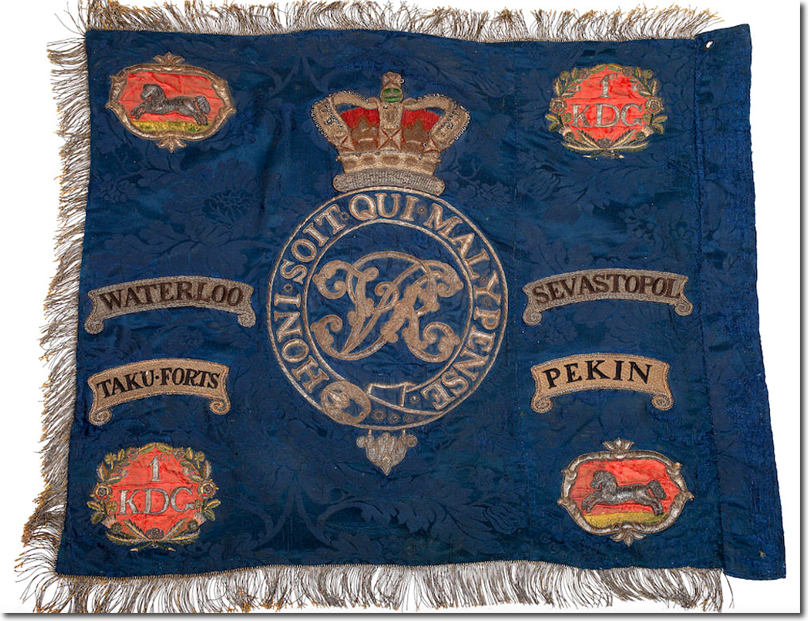
This Victorian Standard is most likely to date from 1856. The battle honour SEVASTOPOL is placed centrally on one side of the Garter, opposite WATERLOO. The regiment returned home from the Crimea in August 1856 and went first into billets at Farnham, but by the end of October were in Exeter. ‘Where’, the regimental history says, ‘they heard that the regiment was to bear on its Standard the battle honour of Sevastopol.’ They left Exeter in June 1857 to go to Aldershot to prepare for service in India. They did not return to Britain until 1866. So the only opportunity for the regiment to receive this Standard was at Exeter in the autumn of 1856. The battle honours for TAKU FORTS and PEKIN were awarded on 4 Nov 1861 and placed below the original two honours on the Standard some time after that.
In 1844 the Standards of Dragoon Guards were ordered to be square ended. Guidons were no longer permitted. They were still allowed more than one Standard, the principal one being called the Royal Standard, on crimson damask, and the second Standard called the Regimental Standard, on blue damask. The battle honours were, from 1844, to be displayed on the Regimental Standard only. Prior to 1855 the Colonels of the regiments were expected to provide the Standards but after that date Standards were to be requisitioned, via the Inspector of Regimental Colours, and subject to royal approval, from the War Office.
In 1858 regiments were ordered to reduce the number of Standards to one only. So from 1858 the Regimental Standard became obsolete. The KDG were in India at the time and, after receiving the battle honours for their hard service in China, seemed determined to defy the order and continue to parade with both the crimson Royal Standard and the blue Regimental Standard. This was probably the mischievous stubbornness of the commanding officer Colonel Thomas Pattle, because when the regiment received a new Standard on 31 May 1868 at Aldershot, the old ones were presented to him on his retirement.
The photo below shows the other side of the double-damask flag. The battle honours have switched sides, and the Horse and 1 KDG compartments have changed over, with the White Horse galloping in the other direction so that it always faced away from the staff. This specimen is without the staff pole which is a pity because in 1858 the spearhead was ordered to be replaced by the Royal Crest, a gilt lion standing on the crown. Would this ‘rogue’ Standard have defied the order to remove the spearhead?


