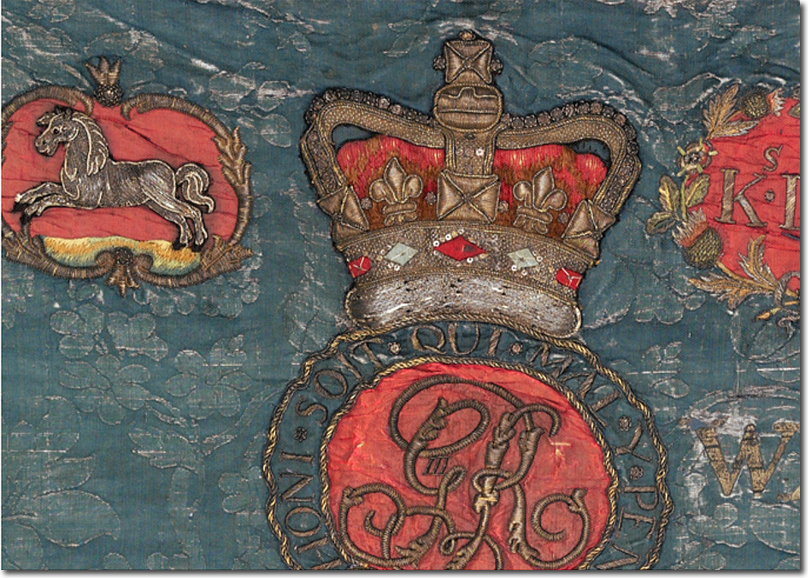
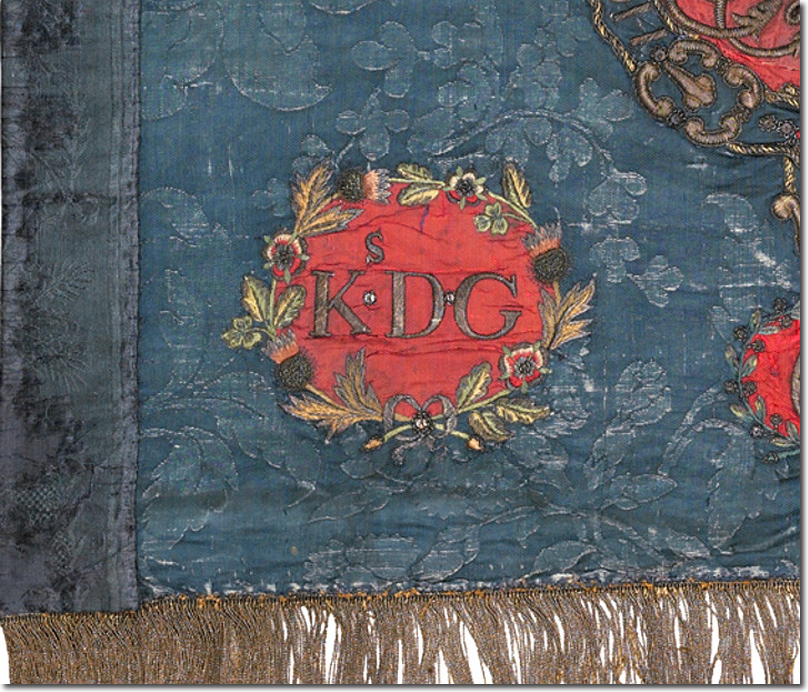
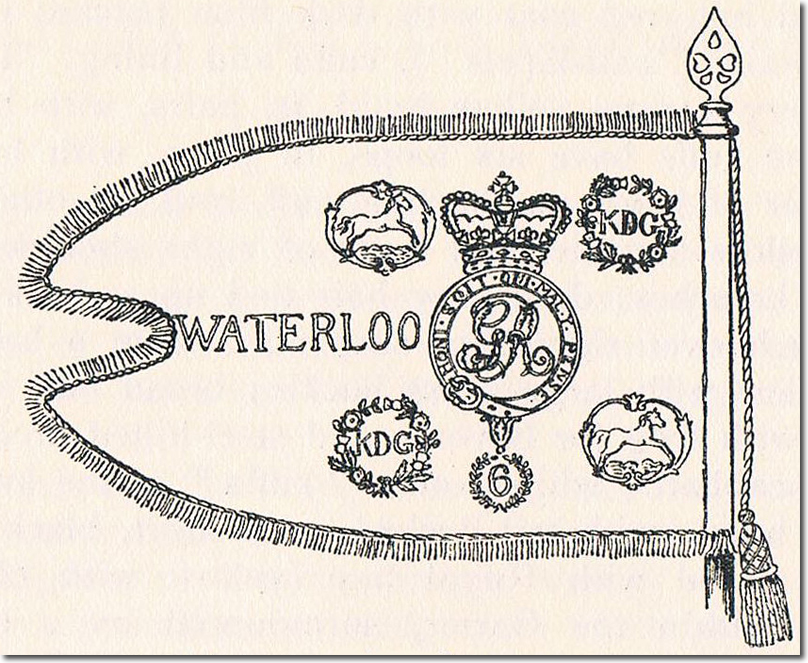
This Guidon first came to light c1920 according to Rev Percy Sumner writing in the SAHR journal in 1934 who said it ‘was offered for sale some years ago, and a small photograph of it appeared in the Connoisseur’. He made a drawing of the side flying left which is shown below. It is of blue damask with gold fringe, having the regimental badge of George III’s cypher on a red ground inside the Garter and Hanoverian Crown above. The White Horse on a red ground in the 1st and 4th corners, and ‘Ks.D.G’ on a red ground inside a Union wreath in the 2nd and 3rd corners. The numeral 6 is on a circular red ground with a wreath around it. All these have been embroidered on both sides. The battle honour WATERLOO has been painted on between the badge and the slit of the swallow tail, on both sides of the Guidon (the battle honour was awarded on 23 Nov 1815). The photo is taken from ageofrevolution.org which incorrectly says that the guidon was carried at Waterloo on 18 June 1815. The regiment had long since ceased to carry Standards or Guidons on active service.
According to Michael Mann’s history of the KDG and Queen’s Bays, on 20 Jan 1815 the KDG received 5 new standards and belts, the gift of the late Lord Heathfield. The old standards had to be returned to Lord Heathfield’s executors. Perhaps an extra guidon had to be added later as this one is for the sixth squadron. The French Revolutionary and Napoleonic wars with France had seen an increase in the cavalry towards the end of the 18th century and the first two decades of the 19th. Normally a regiment would have two Standards/Guidons but the KDG for many years had three, rising to six in 1815. Their strength was 12 Troops, and a Guidon served a squadron of two Troops.
The extra images below show details of the Guidon as well as Sumner’s drawing of the other side. The flag is made up of two pieces of damask put together so that separate embroidery could be carried out showing a slightly different design on each side. If Sumner has drawn it correctly, the White Horse, now galloping to the right, is no longer in the topmost position nearest to the lance pole as one would expect. The drawing also includes the spearhead, cord and tassel.