

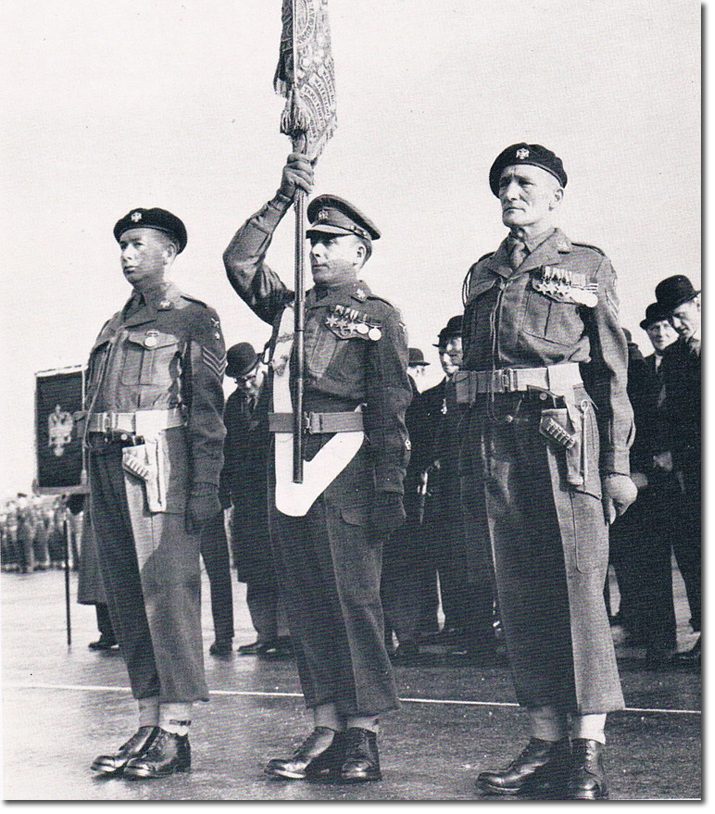
The regiment returned from Malaya in November 1958 and went from Southampton to Perham Down, Tidworth to prepare for amalgamation with the Queen’s Bays on 1 Jan 1959. They held their final parade there on 20 Nov 1958. This photo was taken on that date and shows the guidon party consisting of a warrant officer as guidon bearer, having a metal crown badge on his forearms, and an escort of two sergeants. They wear the khaki battledress that had developed since WW2. The WO wears a khaki forage cap but the sergeants have blue berets. The cap badges are the Hapsburg eagle badges which had been restored to the KGD in 1938, and similar collar badges. After amalgamation the 1st QDG retained the cap badge but replaced the collar badges with Queen’s Bays badges.
The WO and the sergeant nearest the camera are veterans of WW2, wearing a fine show of medals. The other sergeant joined the army after the war and wears a General Service Medal (1918 -1962) with a clasp for MALAYA. The ribbon was purple with a central green stripe. He and the WO have visible cloth badges at the top of the sleeve with crossed kukri knives. A photo of an officer and trooper serving in Malaya show them wearing similar badges on each sleeve. Detachments of the regiment were dispersed around the Malay Peninsula in 1957-8, and one detachment of 10 Ferret scout cars was formed to act as the Gurkha Division Escort Troop, staying at Seremban. The badge may have been for this detachment only, however, the whole regiment worked in support of the Gurkha Division so it may be a divisional formation sign.
Battledress was introduced in 1938 but the post-war version was smartened up so that a shirt and tie was worn with permanently folded back lapels. There were two patch pockets on the chest and the cuffs were buttoned. The pocket on the trouser leg was originally for a field dressing and can be seen on these uniforms. Webbing gaiters were worn with black hobnailed boots. The gaiters and webbing belt had to be cleaned with pale khaki blanco for each parade. The sergeants wear a holster for a Webley revolver and six spare rounds. A khaki lanyard linked the butt of the pistol to the neck.
Towards the end of the War the KDG instituted the award of a Troop leader’s badge for sergeants who had commanded a Troop with distinction. It consisted of the Austrian eagle collar badge worn on a background of red cloth above the chevron. Another regimental distinction from wartime was the patch of yellow cloth beneath the officers’ metal rank badges on the battledress. This persisted for some years after the War.

