

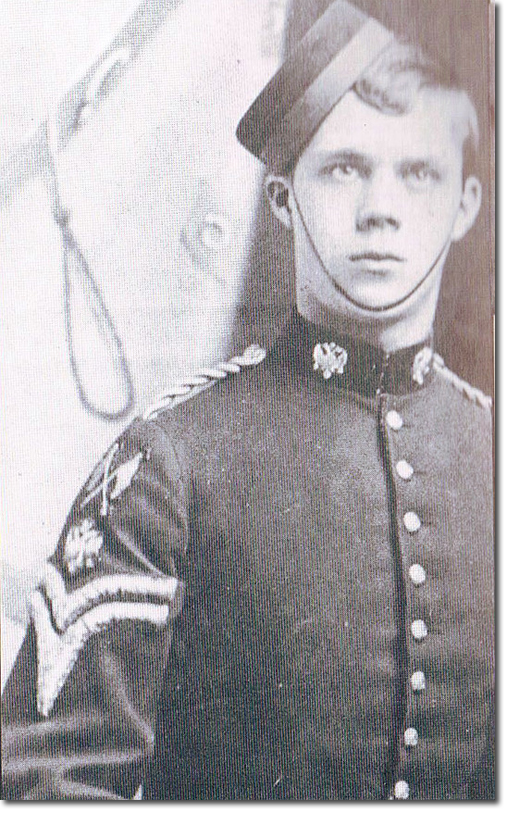
The stable jacket was waist length, scarlet cloth with blue velvet cuffs and collar, which has brass eagle badges. NCO gold lace chevrons in undress were quilted, with the point of the lower chevron extended. This was not the case with chevrons on the dress tunic which were flat gold lace. The badge above the stripes is an embroidered version of the Hapsburg double-headed eagle, adopted as the regimental badge when HIM Franz Josef was appointed Colonel-in-Chief in March 1896.
Up until 1896 the NCOs of the King’s Dragoon Guards did not wear a regimental arm badge as some other cavalry regiments had done. The first metal version of this badge was authorised in 1899 and worn by NCOs thereafter. But officers wore gold and silver wire embroidered badges on their collars from 1896, and NCOs had an embroidered version although it is not clear if it was officer quality. This was worn on the stable jacket from 1896 until c1904, however, this item of dress was discontinued officially in 1898.
Above the eagle badge is a signallers badge of crossed signal flags. On his shoulder are gold twisted shoulder cords. These are seen in photos of other NCOs of the KDG and might be assumed to be of yellow worsted cord. But photographs of the 19th century show yellow as dark. The blue pill box cap he wears has a yellow cloth cap band that seems dark. Normally, gold only appeared on the uniforms of warrant officers but here is a corporal with gold shoulder cords. This suggests that the rank-and-file also had gold shoulder cords on their stable jackets despite the fact that they had ordinary cloth shoulder straps on their dress uniform.

