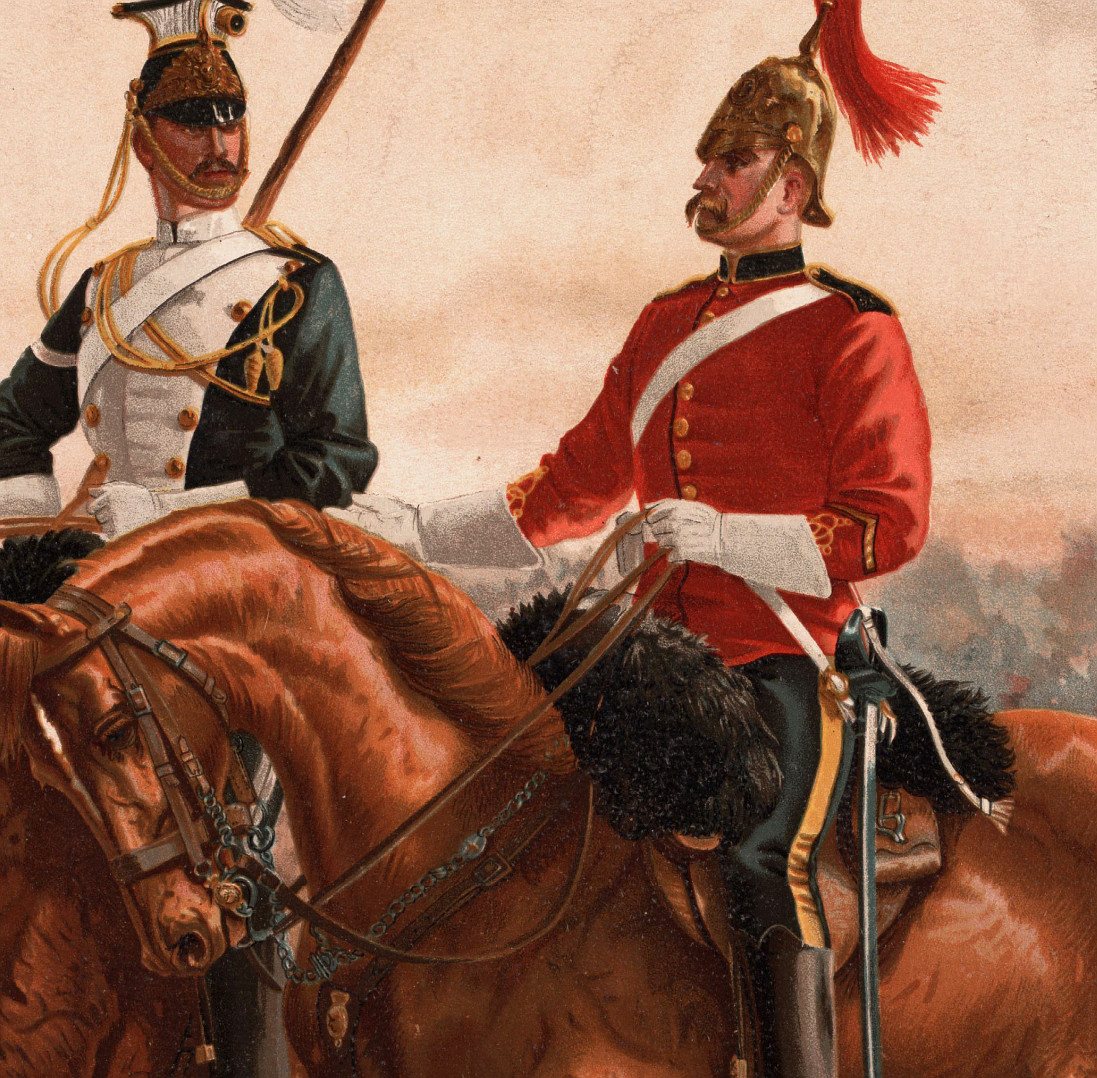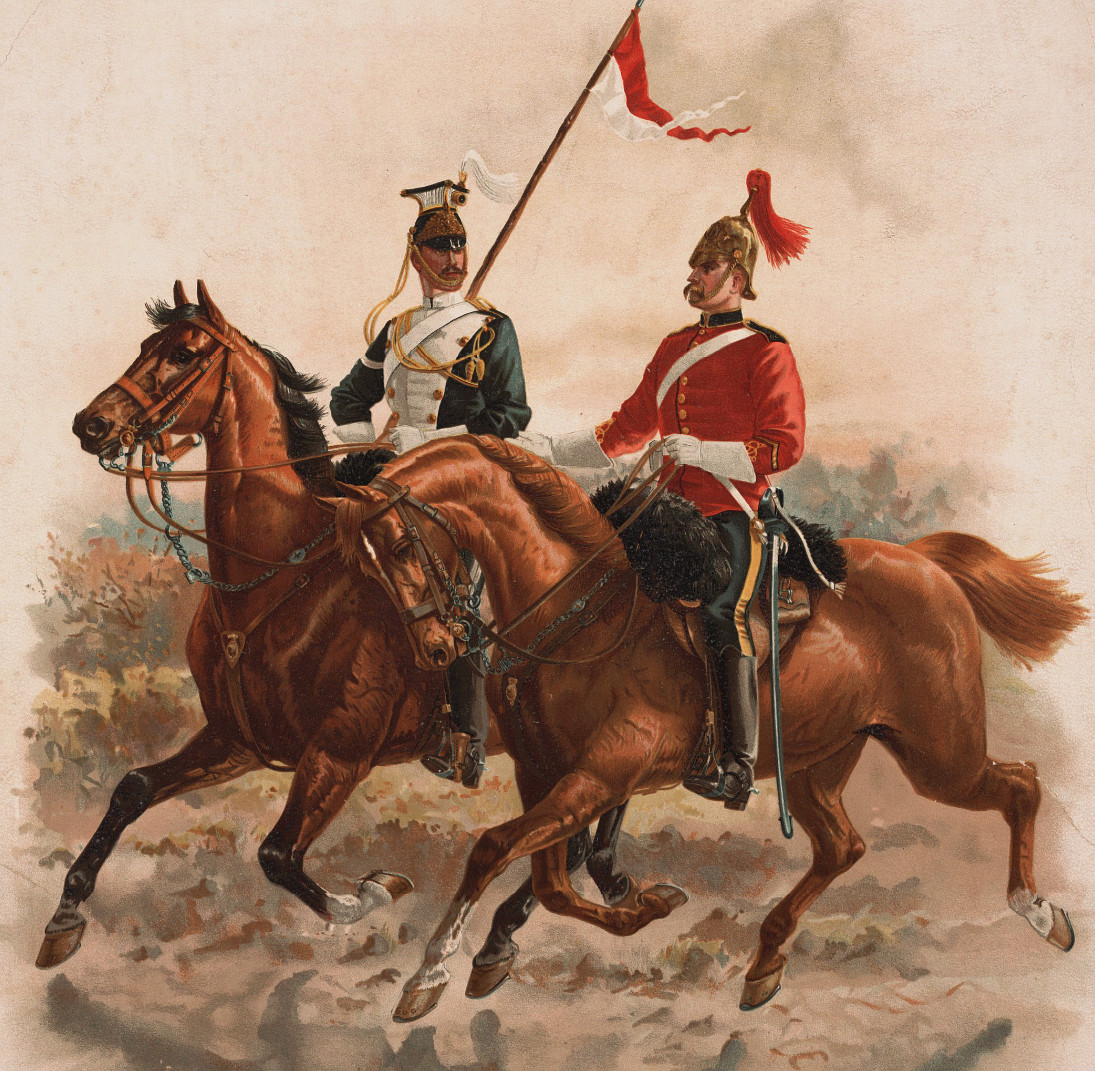
One of Harry Payne’s best military paintings produced as a chromolithograph in 1892 depicts a trooper of the King’s Dragoon Guards cantering beside a 17th Lancer. The dragoon guard tunic is scarlet with blue velvet collar cuffs, shoulder straps and edging down the front. Close inspection of the shoulder strap reveals 1 D G or K D G embroidered in yellow (see below). Collar badges were not worn until after 1896 when Franz Josef was appointed Colonel-in-Chief and the Austro-Hungarian double-headed eagle was adopted as the regimental badge. The collar and shoulder strap are edged in yellow piping. The same yellow braid forms Austrian knots on each sleeve.
The private has a single good conduct stripe on his left forearm. This is shown as gold lace on a blue backing. He has a white pouch-belt on his left shoulder; this was discontinued in 1902. His white waist-belt has a snake clasp, and white sword slings are attached. Officers slung their swords from a concealed waist-belt but other ranks continued with the slings worn outside the tunic. His sword is attached to the slings by two fixed rings either side of the mouth of the scabbard. In 1891 the cavalry were ordered to attach the scabbard to the saddle when mounted.