

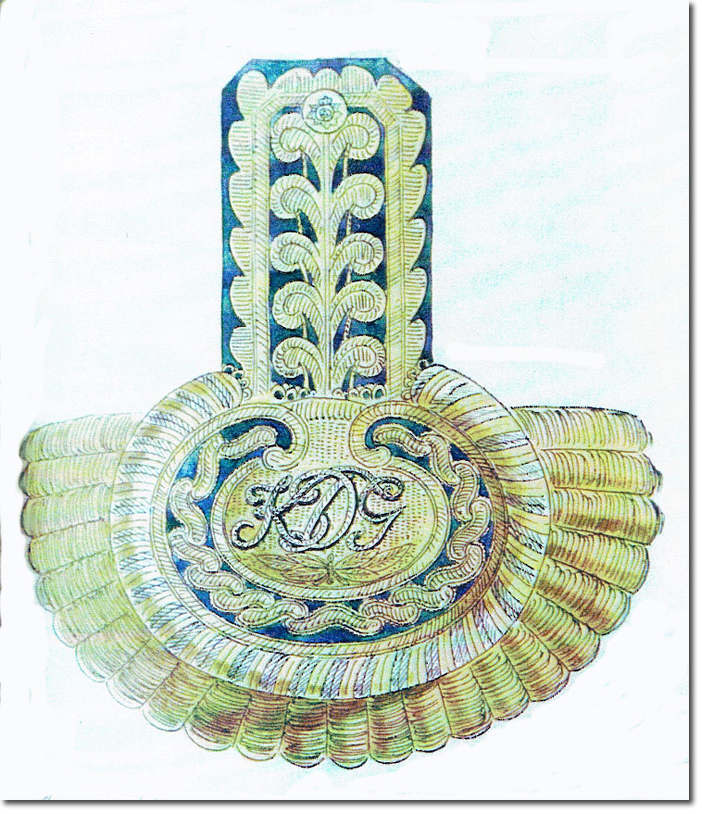
This coloured drawing by B T A Griffiths was included in P W Reynolds’ notebooks. It was drawn c1930 from an actual epaulette in the possession of someone referred to as JKF of Newport, Monmouthshire. This epaulette was worn on the right shoulder of the dress uniform. It is embroidered in gold and silver on blue velvet. The button has the garter star and crown with KDG in the centre in Old English type. The caption written by Griffiths says,
‘The fringe is fastened down (boxed) to a stiffened crescent covered with red silk & edged with crimson velvet. The under part of the strap is covered with red leather. A brass ‘tongue’ working on a hinge at [the point where the crescent meets the strap] and a blued steel spring, to which the button is attached, forms the fixing apparatus. The whole of the crescent and fringe lifts up about 1 inch to allow the arm to be raised, and is controlled by a piece of red velvet ribbon fastened to a red silk cushion in the centre of the crescent. The word “Right” and the name “Andrews, Pall Mall” is on the [indistinct] and the letters “JSSS” are stamped on the red leather of the strap.’
The JSSS must be an officer of the KDG named James Stirling Stirling-Stuart of Castle Milk, Lanarkshire, who joined as a cornet on 17 June 1842, lieutenant 3 May 1844, captain 3 Oct 1848. He left the regiment as a captain in 1852. If ‘JSSS’ is this officer then the epaulette dates somewhere between 1842 and 1852. The 1846 Dress Regulations provide a description of the epaulette:
‘gold bullion, boxed, with strap and crescent embroidered in gold, on velvet in the Dragoon Guards, and on cloth in the Heavy Dragoons, of the colour of the regimental facings. The regimental badge of each regiment embroidered in silver within the crescent.’
The lettering KDG is embroidered in silver on a gold ground and the crescent is bound with alternating gold and silver doubled thread. There are no rank badges which suggests that this is the epaulette of a captain. The lowest rank to have a badge was major, with a star of the Order of the Bath. The whole item is a beautiful piece of the officers’ uniform and must have involved a prodigious amount of work. What a shame that this work remained out of sight when it was being worn, especially by a tall officer.

