

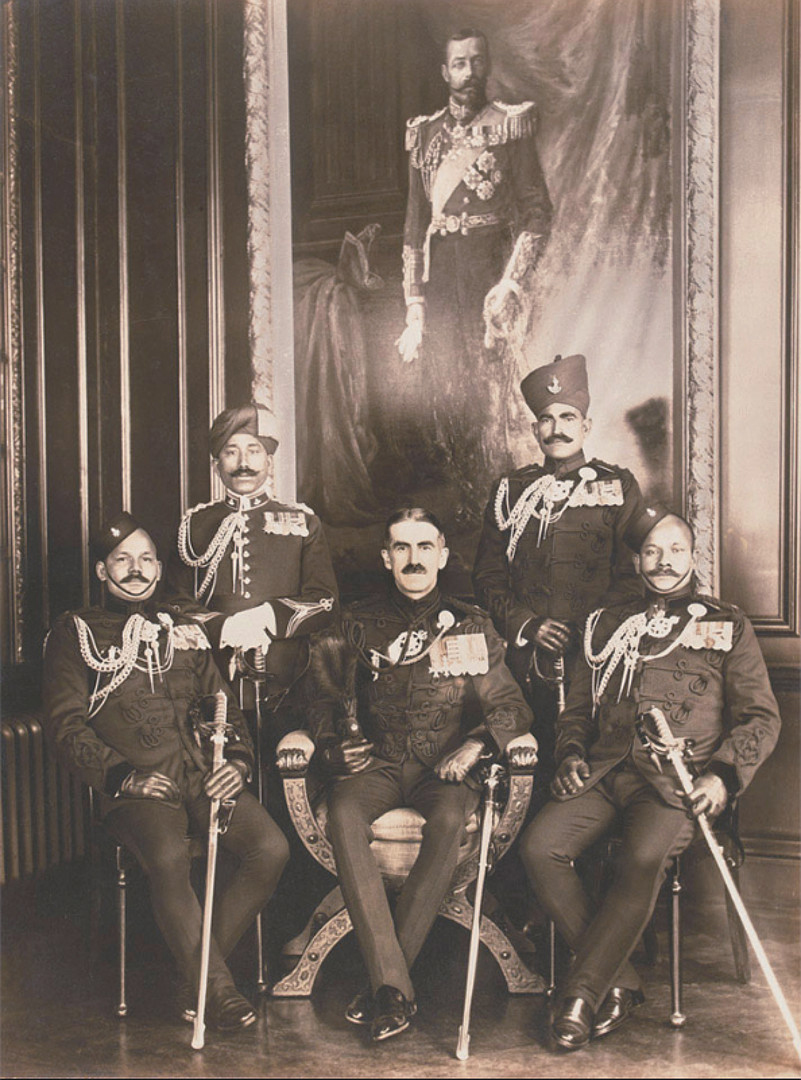
Seated left: Subadar-Major Dhum Sing Chauhan, Bahadur, 3rd Battalion 18th Royal Garhwal Rifles. The two Garhwali officers in this group belong to a regiment that remained intact, without any amalgamation as experienced by other regiments in 1922. Before WW1 they were a two-battalion regiment stationed at Lansdowne, raised in 1887 as a Kumaon Gurkha regiment. From 1890 to 1922 they were the 39th Garhwal Rifles, re-numbered 18th and honoured with ‘Royal’ for their service in WW1. The 3rd Battalion was raised in August 1917. Both officers wear rifle green uniforms with black facings and black cord and braid. Their green caps have a silver Maltese Cross badge.
Seated centre: Major Ronald Cardew Duncan OBE MVO, 2nd Battalion 5th Royal Gurkha Rifles (Frontier Force). The Gurkha regiments retained their numbering after WW1, and the 5th were awarded the title ‘Royal’ in 1921. Before and after WW1 the 5th and 6th Gurkha Rifles were stationed at Abbotabad. Major Duncan wears the Rifle green uniform with black velvet facings and black cord and braid. He holds a Rifle officer’s busby in his right hand which may have been worn while serving in England. The normal headwear for Gurkha officers was a green, spiked helmet as worn by Major Hugh Wake in 1910.
Seated right: Subadar-Major Autar Sing Negi, 1st Battalion 18th Royal Garhwal Rifles. He and the other Garhwali officer have a single embroidered crown on each black shoulder cord. The other two officers in the group are subadars with two stars (pips) on each shoulder. The 1st and 2nd Battalions, 39th Garhwal Rifles (as they were during WW1) were in 20th Brigade, Meerut Division and sent to Flanders in 1914 where they suffered heavy casualties. They were withdrawn from that theatre of war in 1915 and returned to Lansdowne where they recruited back to strength for service in Mesopotamia.
Standing left: Subadar Girdhari Chand, 1st Battalion 19th Hyderabad Regiment (Russell’s). Formerly the 94th Russell’s Infantry, and before 1903 the 1st Infantry Hyderabad Contingent. In 1914 the regiment was stationed at Bolarum and consisted of 3 companies of Rajputs, 3 of Dekhani Muslims and 2 of Jats. They served in India, Persia and Mesopotamia in WW1. The Subadar, a Rajput, wears a green turban and a scarlet tunic with green facings and gold lace.
Standing right: Subadar Tirkha Ram IDSM, 5th (Napier’s) Battalion 6th Rajputana Rifles. In 1921 five Bombay regiments became the first five battalions of the 6th Rajputana Rifles (the 6th Battalion was the Bengali 13th Rajputs). The 5th Battalion was the 125th Napier’s Rifles (25th Bombay Rifles before 1903). They were stationed in Mhow before WW1 and comprised 4 companies of Rajputana Jats, 2 of Rajputana Rajputs and 2 of Punjabi Muslims. In WW1 the 125th Napiers served in France, Egypt and Mesopotamia. Tirkha Ram was a Jemadar when he earned the Indian Distinguished Service Medal (IDSM) for his service in Mesopotamia. The uniform worn by the 6th Rajputana Rifles was a green turban worn in Jat style, a rifle green tunic with scarlet facings and black cords and braid (see Officer 1939).
