

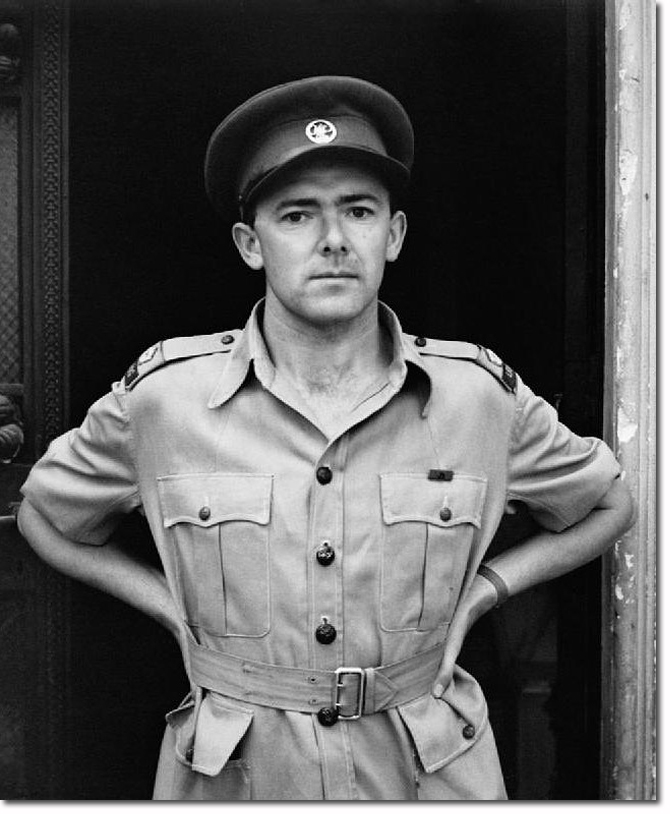
Eric Charles Twelves Wilson, born on 2 Oct 1912, was the son of the rector of Hunsdon, Rev. Cyril Charles Clissold Wilson. His mother was Evelyn Sophie Twelves. They lived at Sandown, Isle of Wight. He was educated at Marlborough and went on to Sandhurst. He was commissioned into the East Surreys on 2 Feb 1933 but spent his military career during WW2 in Africa seconded to local units. He was probably inspired by his paternal grandfather, Charles Thomas Wilson who was a missionary in Uganda.
Eric Wilson was seconded to the King’s African Rifles in 1936 and then the Somaliland Camel Corps in 1939. It was in British Somaliland that he carried out his act of heroism fighting against the Italians. The citation in the London Gazette of Oct 1940 assumed he had been killed and was therefore an announcement of a posthumous VC:
For most conspicuous gallantry on active service in Somaliland. Captain Wilson was in command of machine-gun posts manned by Somali soldiers in the key position of Observation Hill, a defended post in the defensive organisation of the Tug Argan Gap in British Somaliland. The enemy attacked Observation Hill on August 11th, 1940. Captain Wilson and Somali gunners under his command beat off the attack and opened fire on the enemy troops attacking Mill Hill, another post within his range. He inflicted such heavy casualties that the enemy, determined to put his gun out of action, brought up a pack battery to within 700 yards, and scored two direct hits through the loopholes of his defences, which, bursting within the post, wounded Captain Wilson severely in the right shoulder and in the left eye, several of his team also being wounded. His guns were blown off their stands but he repaired and replaced them and, regardless of his wounds, carried on, whilst his Somali sergeant was killed beside him. On August 12th and 14th the enemy again concentrated field artillery fire on Captain Wilson’s guns, but he continued, with his wounds untended, to man them, On August 15th two of his machine-gun posts were blown to pieces, yet Captain Wilson, now suffering from malaria in addition to his wounds, still kept his own post in action. The enemy finally over-ran the post at 5 p.m. on the 15th August when Captain Wilson, fighting to the last, was killed.
Wilson had in fact been captured by the Italians and imprisoned in Eritrea. He was released in 1941 when Italy surrendered in East Africa. He returned to the UK and was given his VC by the King at Buckingham Palace in July 1942. He returned to the fighting as adjutant of the Long Range Desert Group with the rank of major. He was then second in command of the 11th (Kenyan) King’s African Rifles in the Burma Campaign. It was here that he became ill with typhus and in hospital for 2 months. In 1946 he was seconded to the Northern Rhodesia Regiment and retired from the army in 1949 as a lieutenant-colonel.
Eric Wilson was a tall man and rather shy. He wore glasses as a young man and was a good athlete. He married Ann Pleydell-Bouverie in 1943 and they had two sons. But this marriage ended in divorce. He later married Angela Joy Gordon and had another son, Hamish Wilson. After the army he joined the Overseas Civil Service in Tanganyika and worked there until independence in 1961. He had mastered several languages during his time in Africa. In England he worked as Warden of London House where Commonwealth students resided. He retired in 1977 and lived in Stowell, Dorset. As a VC holder he had the distinction of being the last surviving British Army recipient of WW2. He was also the earliest recipient of the war. Despite his serious injuries and illnesses (including prostate cancer) he lived to the age of 96, dying of a stroke on 23 Dec 2008. The photo shows him in the rank of major, as adjutant of the Long Range Desert Group. The distinctive scorpion cap badge of this unit can be seen on his forage cap.

