

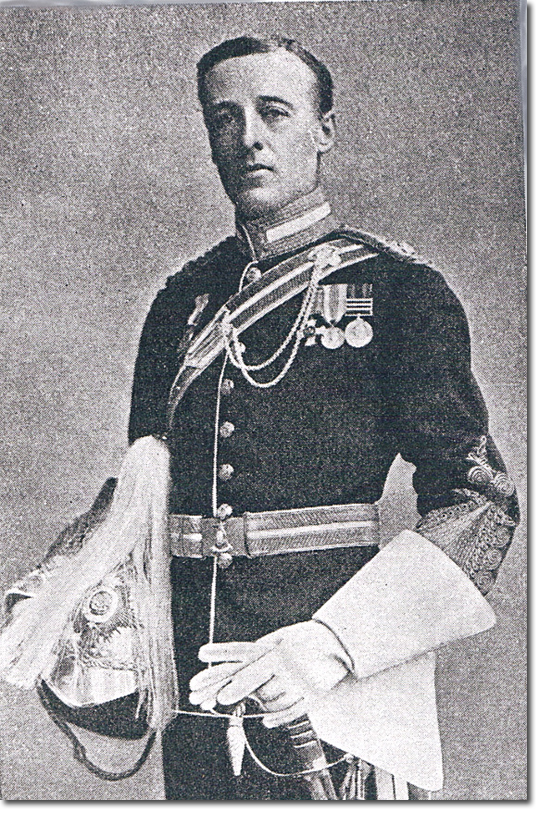
John Seely was born on 31 May 1868 at Brookhill Hall, Derbyshire. He was the seventh child of Sir Charles Seely Bt, from a family of landowners, industrialists and politicians. Young John spent his holidays in the Isle of Wight and developed a strong connection to it. He was educated at Harrow where he became friends with Winston Churchill, then studied at Trinity College, Cambridge in 1887 and became a lawyer, called to the bar in 1897.
While he was still a student he gained a commission as 2nd lieutenant in the Hampshire Carabiniers on 7 Dec 1889. He was promoted to lieutenant on 23 Dec 1891, and captain on 31 May 1892. The Carabiniers sent two squadrons to South Africa in 1900 and Captain Seely was placed in command of one of them on 7 Feb. He and his squadron sailed that month and took part in the capture of Prieska in the Cape Province. He gained fame in this war after an incident involving a 10 year old boy called Japie Greyling.
The boy’s father, Barend Christiaan Greyling took his son on commando in March 1901, and spent the night on a farm. But Captain Seely was on their trail and came to the farm after the Boers had left. Young Japie was still there and caught by Seely’s men. He was questioned about the direction that the Boers had gone but refused to tell them. Seely ordered Japie to be put against a wall and told his yeomen to form a firing squad. He was given a last chance to talk and only said, “Ich sall ne sag.” (I will not say). The order was given, “Ready,” but the boy still refused to betray his father. Seely was so impressed by the boy’s bravery that he told the men to stand down and let the boy go, shaking his hand and saying that he would like to see him again one day.
Whilst on active service in the Boer War John Seely was elected Conservative MP for the Isle of Wight. He was promoted to major in the Hampshire Carabiniers on 10 Aug 1901 and appointed Deputy Lieutenant of the Isle of Wight in 1902. He opposed the Balfour government’s support for Tariff Reform and also their support for Chinese slave labour in South Africa. On these issues he resigned from the Tories and set himself up as an independent in the 1904 election being returned to parliament unopposed. In 1906 he stood as a Liberal MP for Liverpool Abercromby and only just won. He was promoted to lieutenant-colonel commandant of the Hampshire Carabiniers on 20 June 1907.
In 1908 Asquith appointed Seely to the post of Under-Secretary of State for the Colonies. During his tenure the Union of South Africa came into being, in 1909. Two years later he was Under-Secretary of State for War and in 1912 he was Secretary of State for War, and as such was busy preparing the army for war with Germany. He was prominent in organising the BEF, and forming the Flying Corps. However, the Curragh Incident brought about an end to Seely’s political career. But this was in 1914 and the outbreak of war caused him to return to the military.
He served on the staff of Sir John French and was sent to liaise with the French Fifth Army. In the course of that he was nearly captured by a German cavalry patrol, but in the fog he spoke to them in German and escaped. At Antwerp, in October 1914, he assisted in the evacuation of the Royal Naval Division. On 28 Jan 1915 he was given the temporary rank of brigadier-general and command of the Canadian Cavalry Brigade. He was very hands on and involved in all the fighting. He was an unconventional leader, often getting into trouble with his superior generals. He captured Equancourt by commandeering infantry from XV Corps, thereby upsetting General du Cane.
He was sent home after suffering from a gas attack in 1918, and relieved of his command of the Canadian cavalry. But he was still an MP, and was appointed Parliamentary Secretary to the Ministry of Munitions on 19 July 1918. His boss was Winston Churchill, the only other member of the government to have first-hand experience of the war. In 1919 he was Under-Secretary for Air and President of the Air Council, still working for Churchill.
On 21 June 1933 John Seely was raised to the peerage as 1st Baron Mottistone in the County of Southampton. In 1933 he went to Berlin as a guest of Von Ribbentrop and in 1935 he sailed to Germany in his boat Mayflower. Later he made his infamous speech in the House of Lords in which he described Hitler as ‘a remarkable man’ who, he said, was absolutely truthful, sincere and unselfish. Even after the invasion of Czechoslovakia he still insisted that he believed in appeasement. Someone once said of Seely that if he had more brains he would have been half-witted. However, his bravery was never in question.
Seely was married to Emily Florence, daughter of his Colonel, Sir Henry Crichton. The wedding took place on 9 July 1895. They had three sons and four daughters before Emily died in August 1913. His eldest son, Frank was killed in action at Arras in April 1917. Colonel Seely married again, in July 1917, to a widow, Evelyn Izmé Nicholson. They had a son, David who became 4th Baron Mottistone, last Governor of the Isle of Wight. The MP for the Isle of Wight in modern times is a great-great nephew, Bob Seely.
John Seely died in Westminster on 7 Nov 1947, aged 79. The photo shows him in the uniform of the Hampshire Carabiniers wearing his DSO and medals for the South African War.

