

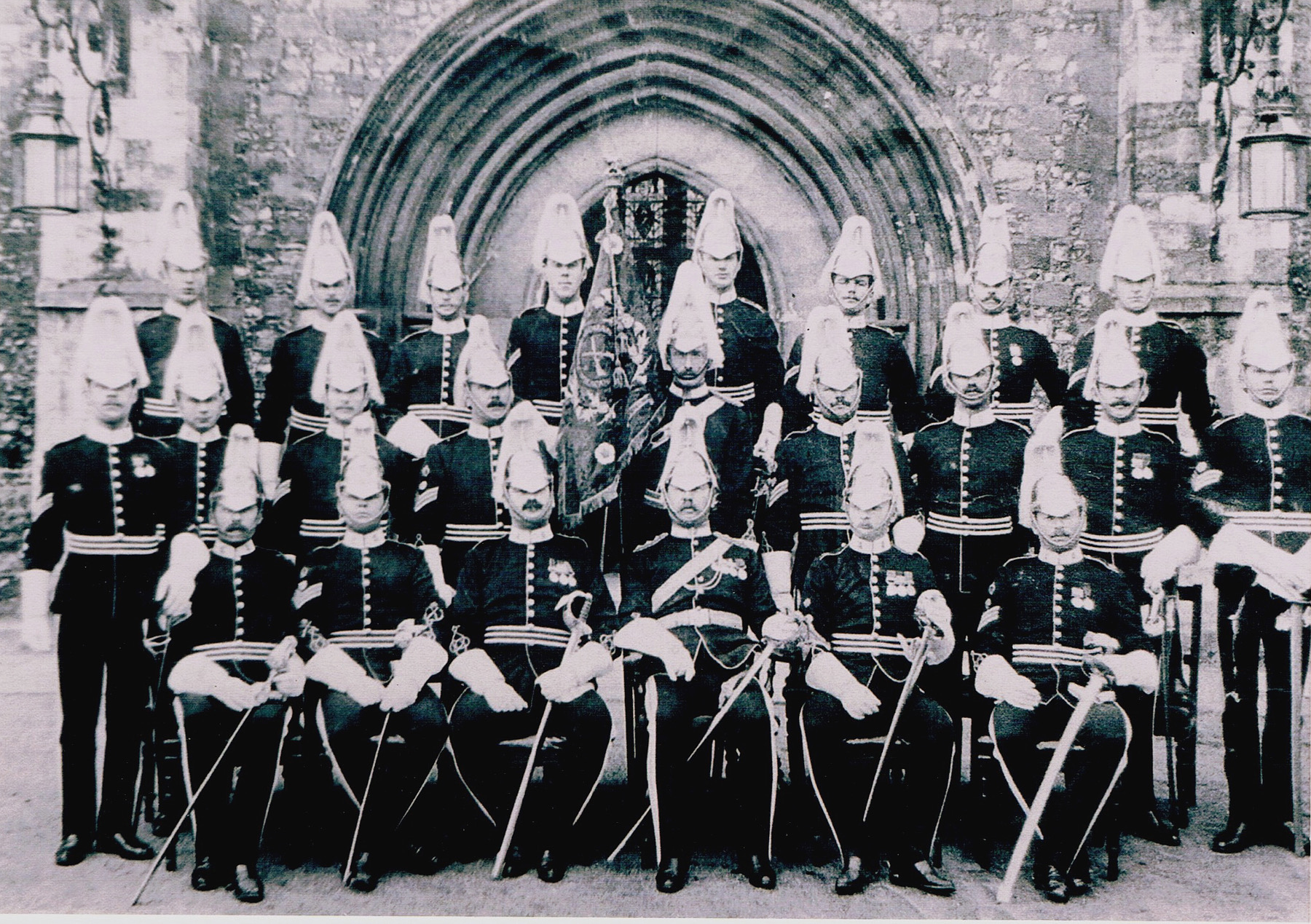
On 19 June 1909 there was a presentation of guidons and Colours to yeomanry and volunteer units at Windsor. King Edward VII made the presentation to 108 regiments. This photo shows the detachment of the Hampshire Carabiniers made up of two officers and 21 men, mostly non-commissioned officers. The new guidon is held by one of the officers in the middle of the group. The men all wear the new uniform issued in 1909 although the officers had worn theirs on special occasions since 1904. The tunics are blue with a white collar that has bimetal badges on each side. They have white gauntlets which partially conceal the yellow cord Austrian knots above the white cuffs. The photographic process at the time made yellow appear as black, but the more senior NCOs have gold cord which is visible. Staff sergeants and warrant officers are to be seen here. The RSM sits on the right hand of the seated captain, who, since 1902 has three rank stars on his shoulders. The RSM’s embroidered crown has disappeared in the folds of his sleeve.
On the other side of the officer is the RQMS with four inverted chevrons on his right forearm and a crown above, with a silver rose above that. Other NCOs with gold cord have a crown and rose above their stripes and are Squadron Sergeant Majors. The tunics of these senior NCOs do not have any other special features like gold lace on the collar as would be expected. The SSM sitting next to the RSM has shooting proficiency badges on each sleeve, the one on his right arm being a crown over crossed rifles meaning that he is the best shot in the regiment.
The tunic has the unusual feature of being worn with a blue and white striped lancer-type girdle instead of a white leather waist-belt. The swords are slung on white leather slings attached to a hidden webbing belt. The trousers, worn in dismounted order, are blue with a double white cloth stripe for both officers and men.

