

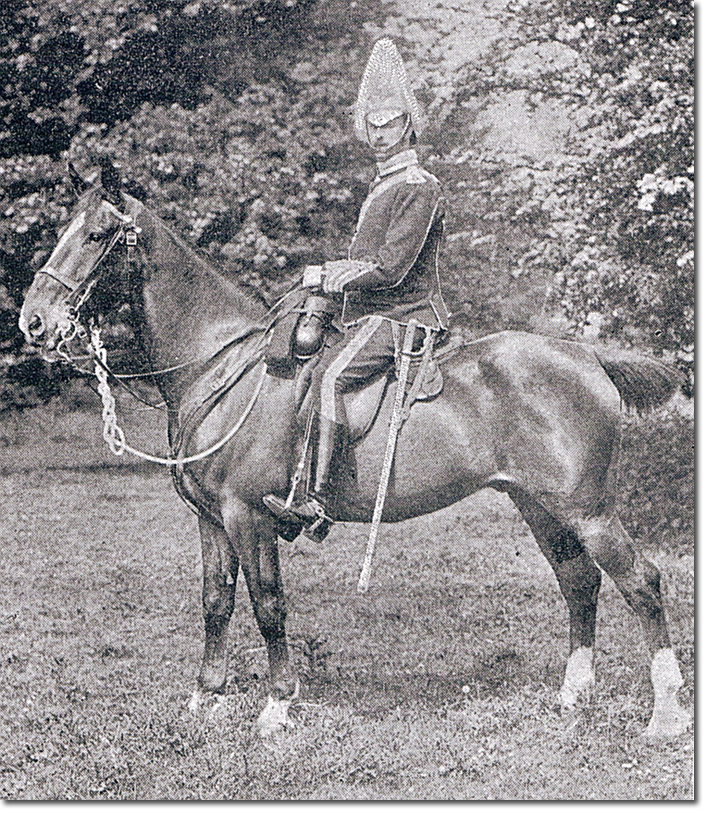
The uniform for normal wear and mounted duty is worn by Captain Henry Albert Barclay in this reproduction published in 1896. He was promoted to captain in March 1892 and to major in March 1897. The silver cuff ornamentation is indistinct but appears to show more braiding than in the photo of him as a 2nd lieutenant in 1889. It would be consistent with other light dragoon rank designations for a captain if the double row of silver lace was traced with small circlets of braid. The tunic is all blue, with silver lace on the collar and cuffs. Silver braid fills the small showing of blue between the lace on the top and bottom of the collar. White piping can be seen to follow the front edges of the tunic, along the hem, including the slits at the hips, and up the back seams of the tunic, and along the seams of the sleeves. The blue shoulder straps are edged with silver lace and would have two rank stars on each shoulder.
It is painfully clear from this photo that the uniform lacked the smartness expected of one of the top yeomanry regiments in Britain. The need for a waist-belt to be worn over the tunic rather than hidden beneath it, must have struck the officers on seeing this photo. There was a change of style within a few years of 1896, although the precise date is not clear. It is stated that the mess uniform changed to white facings in 1903 and it may be that that is the year that the uniform adopted the pattern very similar to the 6th Dragoon Guards. It is unlikely that any change took place between 1900 and 1902 when military tailors would have been busy preparing khaki uniforms. After 1902 those officers and men serving in South Africa would have returned to Hampshire.
Other aspects of the uniform and horse furniture are shown well in this photo. The helmet had acquired a falling white horsehair plume in 1894. The blue breeches have a double white cloth stripe and the black Hessian boots have steel spurs. His sword is slung from a hidden webbing waist-belt, the slings being gold laced with a white silk centre, like the pouch-belt. At the back of the saddle is a leather pouch for spare horseshoes. On the front of the saddle are leather holsters for a revolver or any peacetime necessaries. In front of them is a rolled greatcoat or cape for bad weather. The plaited white halter rope extends up the near side of the charger to a hidden fastening. It is astonishing to see that the charger’s tail is docked, as this practice was abolished in the army many years prior to 1896.

