

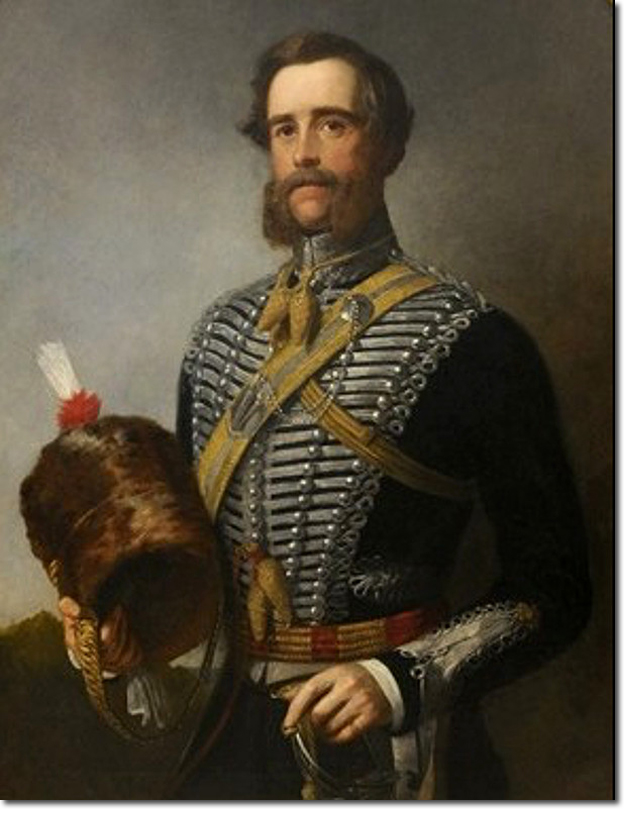
This officer is named as Sir Henry St John Mildmay 5th Bt. His family financed the raising of the Dogmersfield Troop in 1798, commanded by his father, the 4th Baronet. The portrait is a valuable source of information on the uniform of the Hampshire Yeomanry. In 1853 the ‘North’ had been dropped from the title so this is the first uniform of the Hampshire Yeomanry. The jacket is similar to the 1850 specimen and we can assume that the lace and braid on the back follow the seams in the same way. The pouchbelt with gold lace and central silver stripe is the same pattern as worn for the next 50 years or more. The interesting aspect of this portrait is the busby that he holds. This replaced the shako in 1854 and was very short lived, as the French style kepi was adopted along with a new pattern of uniform around 1860. The busby seen here is unusual in having no busby-bag. The plume is short, having white egret feathers over red vulture feathers. The cap-lines are gold and end with two large olivets at the neck.
A small reproduction of this portrait is also in P W Reynolds’ notebooks. Reynolds says that some coloured sketches by Orlando Norie show a similar uniform. They are dated c1850-60 and confirm that the busby had no bag. The jacket is blue and braided as the portrait, but the trousers are dark grey with a double silver stripe. All other details are in agreement with those visible in the portrait. There is no sabretache. The officer’s charger has a blue shabraque with a single broad silver edge. Plain front corners but the hind corners have a silver and crimson crown with silver HYC. There is a black sheepskin on the saddle. An NCO or private has simply a black sheepskin, no shabraque.

