

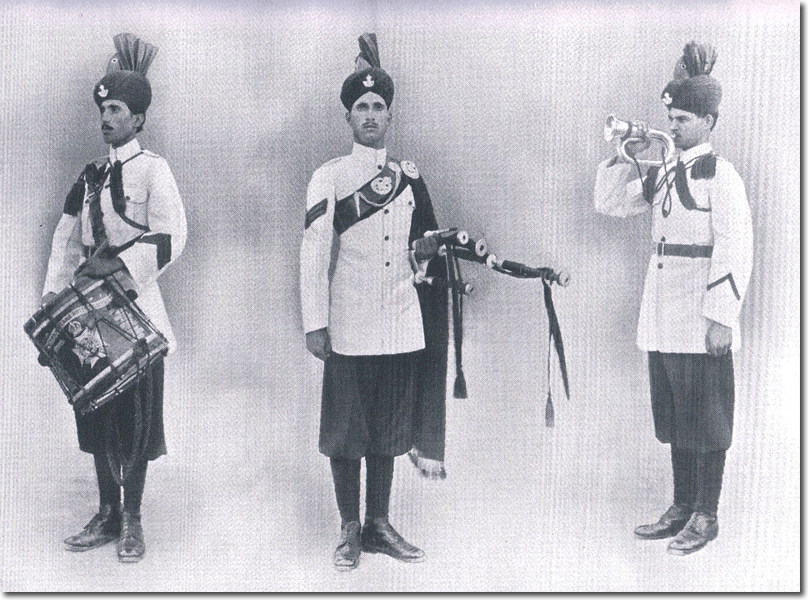
Up until 1927 the Battalion had a Brass Band, but in that year it was decided at a meeting at Razmak on 9 Feb 1927 to replace it with a Pipe Band. Before WW1, the 104th Wellesley’s Rifles had a good Brass Band composed entirely of Parwaris, descendants of the men who comprised the old Bombay army. Many of these men came from families that had served in the battalion for several generations. The earliest mention of musicians in the battalion is in 1788 when the strength of each company included a drummer and a fifer.
During the pre-war period the Bandmaster was Mr W S Walcott who had been band sergeant of the 2nd Battalion, The Suffolk Regiment. He brought the band up to a high state of efficiency and they were in demand for entertainments in Bombay. This generated an income which helped finance the band at a time when regimental bands were paid for by the officers. During WW1 the bandsmen, as was the custom, carried out the duty of stretcher-bearers. But few of them survived the Turkish prison camp after the fall of Kut.
Another effort was made, at the end of the war, to build up the band, but the expense to the officers was prohibitive and enthusiasm for brass music was not so forthcoming amongst the Indian ranks. Many Indian regiments had served alongside Scottish regiments and been inspired by their bagpipe music, especially the units comprised of hill men such as the 5th Gurkhas and 40th Pathans. Fortunately, within the 6th Rajputana Rifles, the 5th Battalion (125th Napier’s) already had a Pipe Band. They undertook the task of training pipers of the 1st Battalion and subsequently transferred to them their Pipe Major and senior drummer. They were also helped by the Seaforth Highlanders who ensured that the pipers and drummers were fully trained and efficient.
The Pipe Band uniform worn in this photo copied that worn in the band of the 5th Battalion. In Review Order the long-skirted white coat was worn with green pantaloons, pagris and puttees. The plaid worn by the pipers was of the Urquhart tartan. The piper is Pipe-Major Sarwar Khan. He has a black patent leather pouch-belt similar to that worn by the officers. His plaid brooch is of regimental pattern, bearing the crest and battle honours.
The Drummer is Ali Gaur, festooned with green plaited cords and tassels which denote him as a bugler as well. He has two black chevrons, with scarlet backing, on his left arm for long service and good conduct. His drum has dark green strings instead of the usual white. The Bugler is Sardar Ali who has one good conduct stripe on his left sleeve.
