

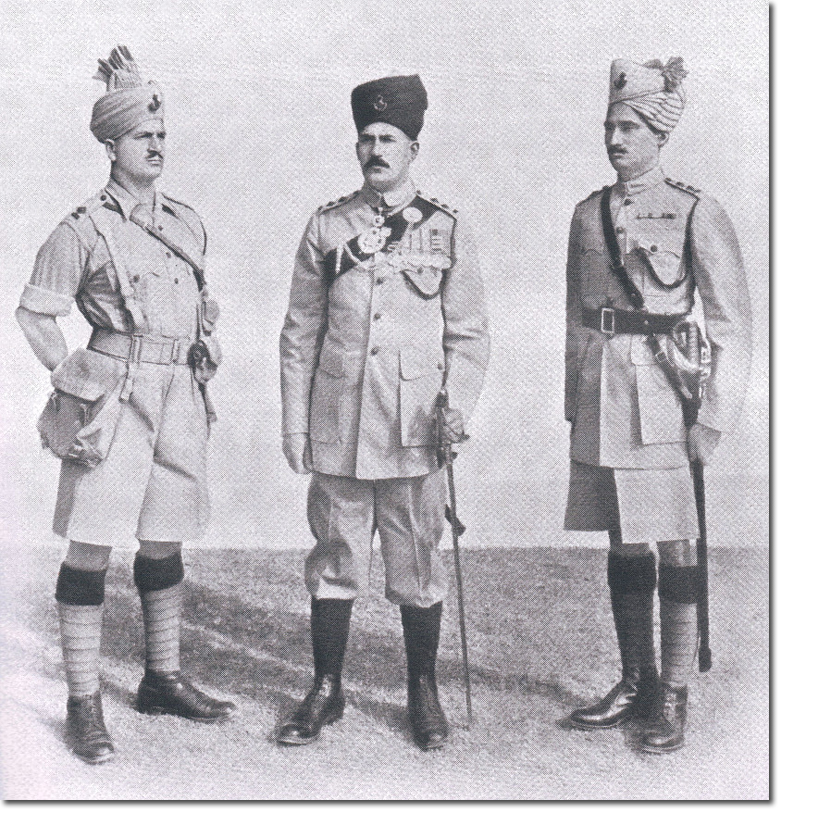
These three officers of 1st/6th Rajputana Rifles demonstrate orders of dress and differences in class in this photo from 1936. On the left is Jemadar Feroz Khan, a Punjabi Mussalman, in Field Service Order. In the centre is Subadar Ganesha Ram Bahadur, OBI IDSM, a Jat, in Review Order. On the right is Subadar Mul Singh, a Rajput, in Drill Order. The Jemadar has one rank star on each shoulder and the Subadars have two stars. Ganesha Ram was promoted to Subadar-Major on 1 Jan 1938. That rank was the most senior Indian rank and entitled him to have crowns on his shoulders.
Indian officers, also known as VCOs (Viceroy’s Commissioned Officers) after 1935, were senior soldiers, promoted NCOs (Non-Commissioned Officers) with a lifetime of military experience, commanding respect from Indian ranks below them and British ranks above them. They did not have authority over British soldiers who nevertheless addressed them as Jemadar-Sahib or Subadar-Sahib. In 1918 the first KCIOs (King’s Commissioned Indian Officers) passed out from the Indore Cadet School, and later were commissioned from RMA Sandhurst. In 1932 the Indian Military Academy was established at Dehradun which produced ICOs (Indian Commissioned Officers).
