

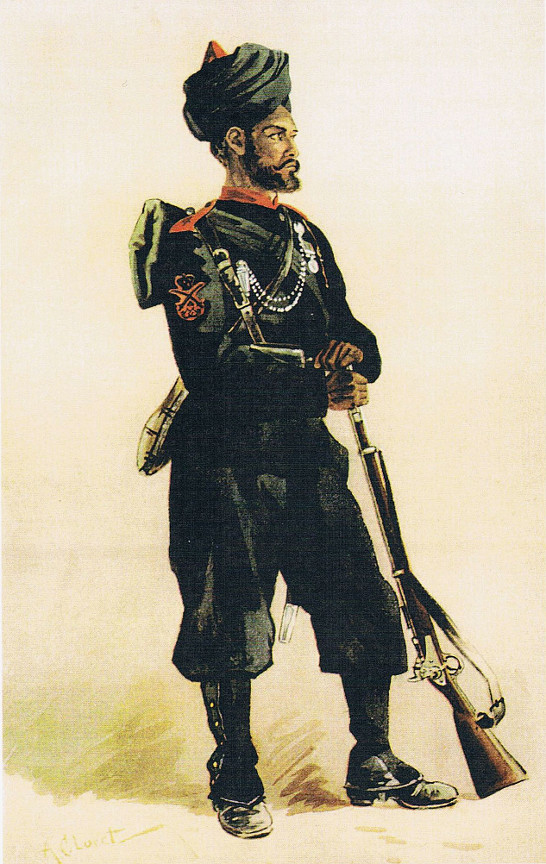
Lovett’s painting of a havildar of the 4th Regiment (Rifles) (1st Battalion the Bombay Rifle Regiment) shows him in an all-green uniform with scarlet facings. In 1884 orders were received for the colour of the facings to be changed from red to scarlet. He has black gaiters rather than puttees which replaced them later. He is in light marching order with black leather equipment and folded greatcoat on his back. He has a water-bottle for his own needs as an independent soldier, not relying on a bhisti who accompanied Indian infantrymen to supply water when required.
His rank is indicated by a Colour-Sergeant’s badge on his right arm. Rifle regiments did not carry Colours but the rank of Colour-Havildar continued. Lovett has painted the badge very carefully. It is based on the badge worn by Colour-Sergeants of the King’s Royal Rifle Corps. Instead of three stripes, Queen Victoria’s crown was placed above crossed swords with two stringed bugles beneath.
His green turban, or pagri, has a scarlet pointed kullah. and his tunic has scarlet shoulder straps as well as a scarlet collar. As a havildar he was entitled to a black leather pouch-belt similar to those worn by officers. It had a silver whistle on a chain. He is armed with a Snider Rifle which was issued in late 1887.
Another Lovett painting of the same period shows a Jemadar of the 4th Regiment wearing a braided tunic of the British Army Rifle pattern, with scarlet collar and cuffs. It shows the uniform similar to the one worn by an officer in Norie’s painting of the KRRC in 1889, except that the Jemadar wears a green turban with scarlet Kullah instead of the British officer’s helmet. British officers of the 4th Regiment would have dressed almost identically to the KRRC officers.
