

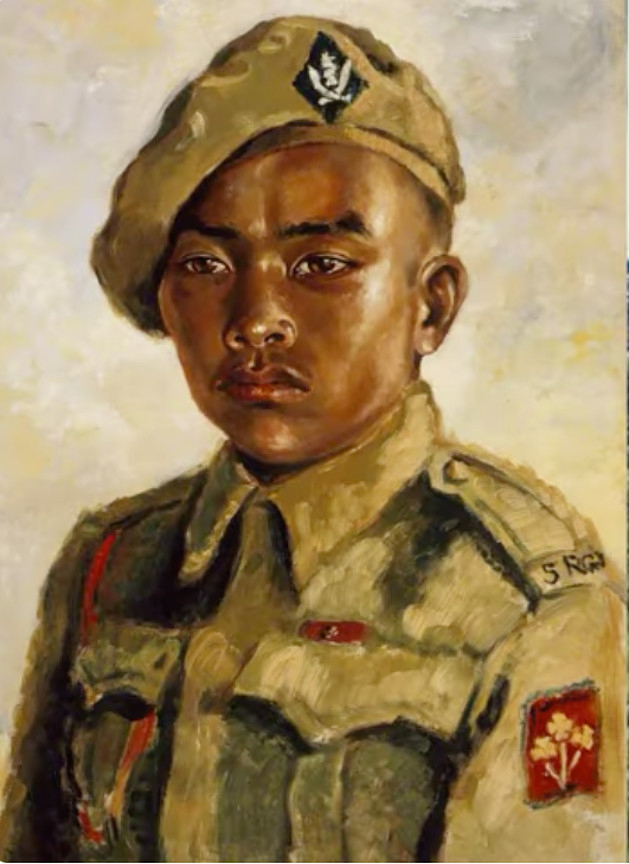
Rifleman Thaman Gurung was only 20 years old when he showed great bravery at least three times to save the lives of his fellow Gurkhas. The riflemen of the 1st Battalion, 5th Gurkha Rifles were fighting the Germans in Italy as part of the 17th Brigade, 8th Indian Division. On 10 November 1944, ‘A’ Company sent out a reconnaissance patrol in preparation for an attack on Monte San Bartolo. Gurung and another rifleman were sent ahead as scouts, but the other man was less stealthy, and Gurung saw that the defenders had spotted him and were about to open fire. He charged at the group and took them by surprise, enabling him to neutralise the post.
His platoon was poised for the assault on the summit of San Bartolo, but Gurung could see that the Germans were preparing a devastating grenade and machine-gun barrage to repel the Gurkhas. He charged forward in full view, firing on the enemy, giving cover for the platoon to launch the attack. However, it was not enough to prevent the attack from coming under heavy fire. The platoon was forced to retire, with the help of Gurung’s grenades and rifle fire, but the leading section became pinned down.
Having run out of ammunition, he ran back and armed himself with a Bren gun. He used two magazines of .303 ammunition, allowing the section to escape certain destruction. Sadly, the young Rifleman Thaman Gurung was fatally shot as he carried out this final act of courage.
Rifleman Thaman Gurung was born on 2 October 1924 in Singla village, No. 2 Thehsil, West Nepal. He was gazetted for the Victoria Cross on 22 February 1945, and his mother received the medal from Field Marshal Lord Wavell in Delhi on 19 December 1945. The 20‑year‑old is buried in Rimini Gurkha War Cemetery.
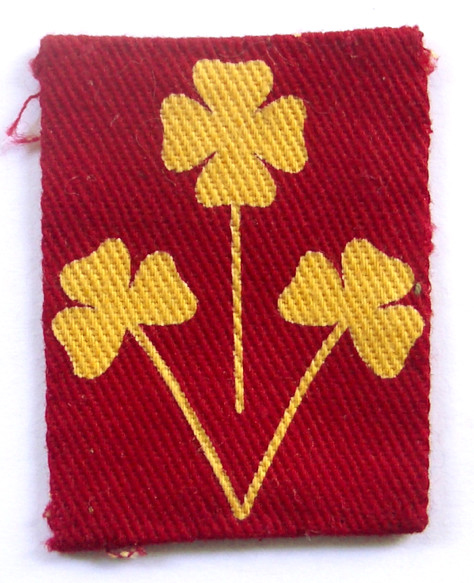
The red patch on Thaman Gurung’s upper left arm was the sign of the 8th Indian Division, formed in October 1940. The three yellow clover leaves on stems were chosen as symbolic of Nepal, where the plant known as ‘Tinpaate’ or ‘Seto Beuli’ grows wild with a white flower and is used as fodder for animals.

