

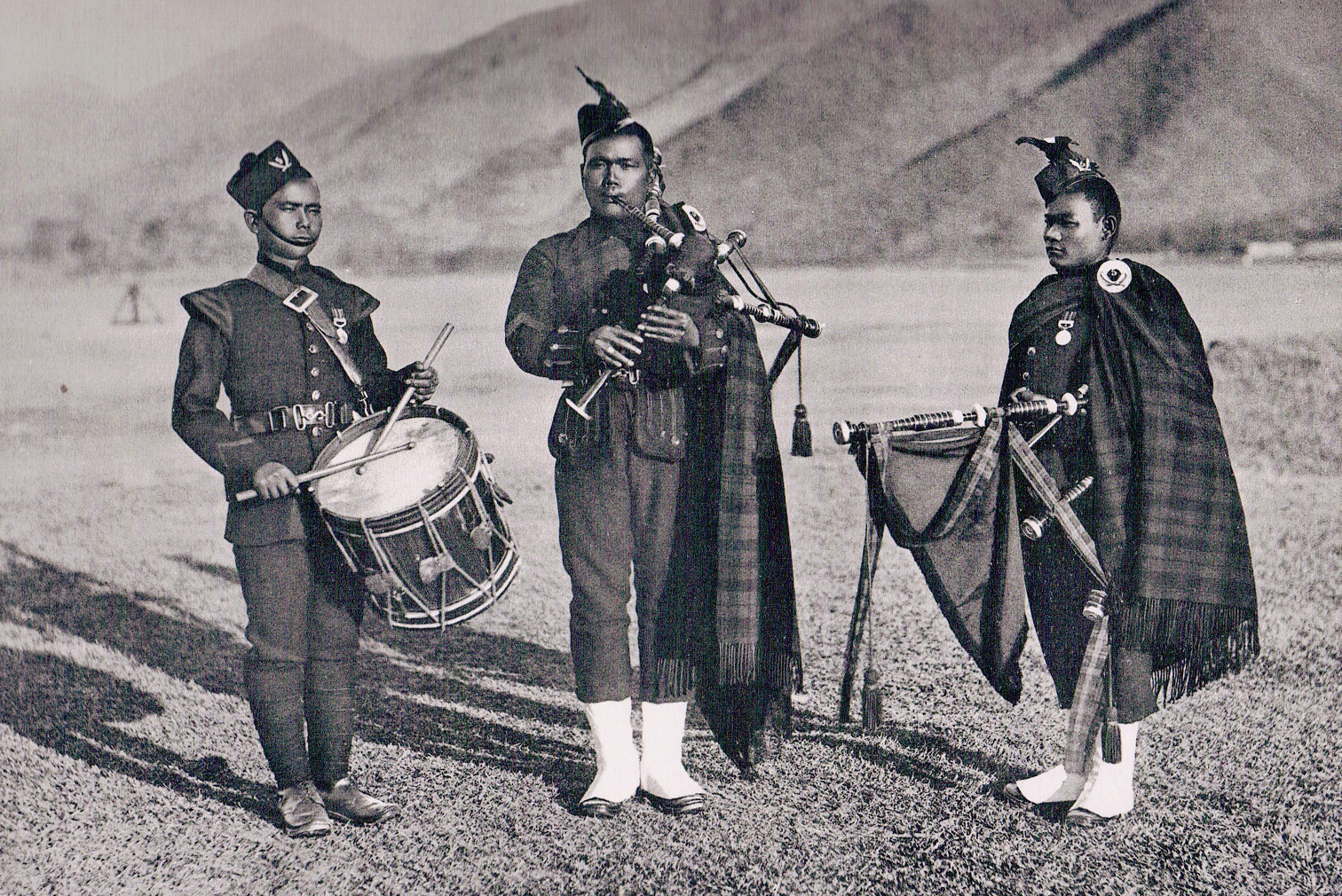
The Scottish influence in the Gurkha regiments came from the number of British officers with Scottish family connections. The Gurkhas came from mountainous regions and the sound of bagpipes had strong associations with both the Scottish Highlands and the Himalayas. The pipers in this photograph by Frederick Bremner are dressed in a special uniform: rifle green, but styled as doublets instead of tunics.
The round Kilmarnock caps have been replaced by Glengarries, adorned with Blackcock-tail feathers imported from Scotland. The 5th Gurkhas regimental badge is fastened to the left side. A plaid or scarf has been added, using the Government tartan as worn by the Black Watch. A special plaid brooch of regimental pattern is worn on the left shoulder; close inspection reveals the number 5 in the centre of the brooch on a dark background. Pipe banners are present, though the devices emblazoned on them are unclear.
The central figure is a lance-naik, indicated by an inverted chevron on his right sleeve. Instead of kilts, the pipers wear green trousers tucked into white gaiters, which also act as spats over black boots. He is from the Magar clan. The figure on the right is a havildar, a Gurung.
The drummer wears a more conventional rifle green uniform similar to the rank and file, apart from the shoulder wings. Normally, in the British Army, a drummer would also serve as a bugler, but here there is no sign of a bugle or bugle cord. This suggests he is a bandsman rather than a regimental bugler required to follow officers and relay orders from a distance. This drummer is a Magar.

