

John Purcell was born at Macroom, County Cork in 1821. After civilian employment as a labourer he enlisted in the 4th (Royal Irish) Dragoon Guards at Cork on 27 May 1839. He transferred to the 9th Lancers on 1 April 1842 and sailed out to India with the regiment. He fought at the battle of Punniar for which he received the Gwalior Star medal. His other medals included the Sutlej and Punjab medals for the two Sikh Wars and for the Indian Mutiny. He was posthumously awarded the Victoria Cross as he was killed two months after his act of bravery. He was buried in the Old Delhi Military Cemetery.
In June 1857 Delhi was occupied by mutinous sepoys but besieged by British and Indian troops loyal to the East India Company. Several small battles occurred outside the city and Private John Purcell was caught up in the fighting on 19 June. The CO of the 9th Lancers, Colonel James Hope Grant had been given command of the Cavalry Brigade and, after the charge of the Guides and 9th Lancers on the Subzi-Mundi Road in which Lt-Col Yule was killed, the rebels, at first driven back, crept round to the British flank under cover of darkness. Two guns were in danger of being captured so Hope Grant collected a few men and attacked the enemy. Grant and Purcell both lost their horses which were shot under them. Grant was stunned but protected by Purcell, Hancock and Rupur Khan of the 4th Irregular Cavalry. Hancock and Khan offered the Colonel the use of their horses but in the end he grasped the tail of Khan’s horse and was dragged clear. Hancock was severely wounded in the arm during this action. Colonel Grant wrote to the Assistant Adjutant-General of the Division on 22 June 1857:
‘The guns, I am happy to say, were saved, but a waggon of Major Scott’s battery was blown up. I must not fail to mention the excellent conduct of a Sowar of the 4th Irregular Cavalry, and two men of the 9th Lancers, Privates Thomas Hancock and John Purcell, who, when my horse was shot down, remained with me throughout.One of these men and the Sowar offered me their horses, and I was dragged out by the Sowar’s horse. Private Hancock was severely wounded, and Private Purcell’s horse was killed under him. The Sowar’s name is Roopur Khan.’
The letter brought a recommendation for the Order of Merit for Rupur Khan, and the Victoria Cross for Hancock and Purcell. In February 1858 the War Office confirmed John Purcell’s posthumous award of the VC. But he did not live long enough to receive his reward as, at the age of 36, he died of wounds on 19 September 1857 during the assault on Delhi, two months after his brave act. The assault took place on 14 Sep, when the 9th suffered 40 casualties. Sir James Hope Grant later wrote in his memoirs:
‘I took the cavalry back to camp and then visited all the wounded men in hospital. Among them was poor Purcell, who as my orderly had behaved so gallantly on the 19 June when in the darkness of the night I was almost alone and riderless in the midst of the rebels. He had been shot through the chest and could scarcely speak, but was full of hope. He died a few days later,’
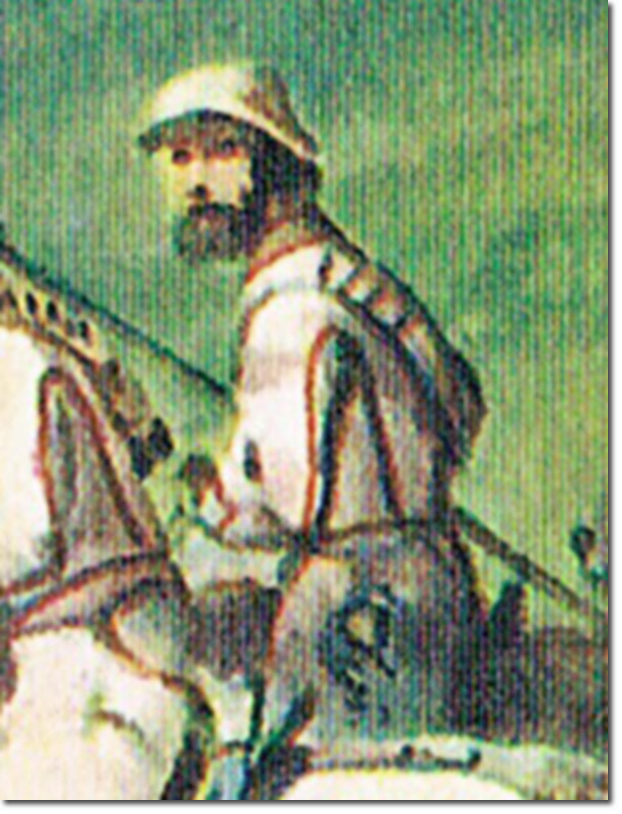
The medal was presented by Lord Clyde to John’s brother, James, also a private in the 9th Lancers. Its present location is unknown. Purcell’s Gwalior Star medal remained in private ownership for 40 years before being sold at Spink on 8 Dec 2020 for the price of 2,900 pounds. The picture accompanying this text is a detail from a painting by Orlando Norie, of the 9th Lancers in action at Budli-ke-Serai on 8 June 1857, a battle that Private Purcell would have take part in as one of the ‘Delhi Spearmen’, but this does not purport to be a likeness of the man.

