

In June 1857 Delhi was occupied by mutinous sepoys but besieged by British and Indian troops loyal to the East India Company. Several small battles occurred outside the city and Private Tom Hancock was caught up in the fighting on 19 June. The CO of the 9th Lancers, Colonel James Hope Grant had been given command of the Cavalry Brigade and, after the charge of the Guides and 9th Lancers on the Subzi-Mundi Road in which Lt-Col Yule was killed, the rebels, at first driven back, crept round to the British flank under cover of darkness. Two guns were in danger of being captured so Hope Grant collected a few men and attacked the enemy. Grant and Private Purcell both lost their horses which were shot under them. Grant was stunned but protected by Purcell, Hancock and Rupur Khan of the 4th Irregular Cavalry. Hancock and Khan offered the Colonel the use of their horses but in the end he grasped the tail of Khan’s horse and was dragged clear. Hancock was severely wounded in the arm during this action. Colonel Grant wrote to the Assistant Adjutant-General of the Division on 22 June 1857:
‘The guns, I am happy to say, were saved, but a waggon of Major Scott’s battery was blown up. I must not fail to mention the excellent conduct of a Sowar of the 4th Irregular Cavalry, and two men of the 9th Lancers, Privates Thomas Hancock and John Purcell, who, when my horse was shot down, remained with me throughout. One of these men and the Sowar offered me their horses, and I was dragged out by the Sowar’s horse. Private Hancock was severely wounded, and Private Purcell’s horse was killed under him. The Sowar’s name is Roopur Khan.’
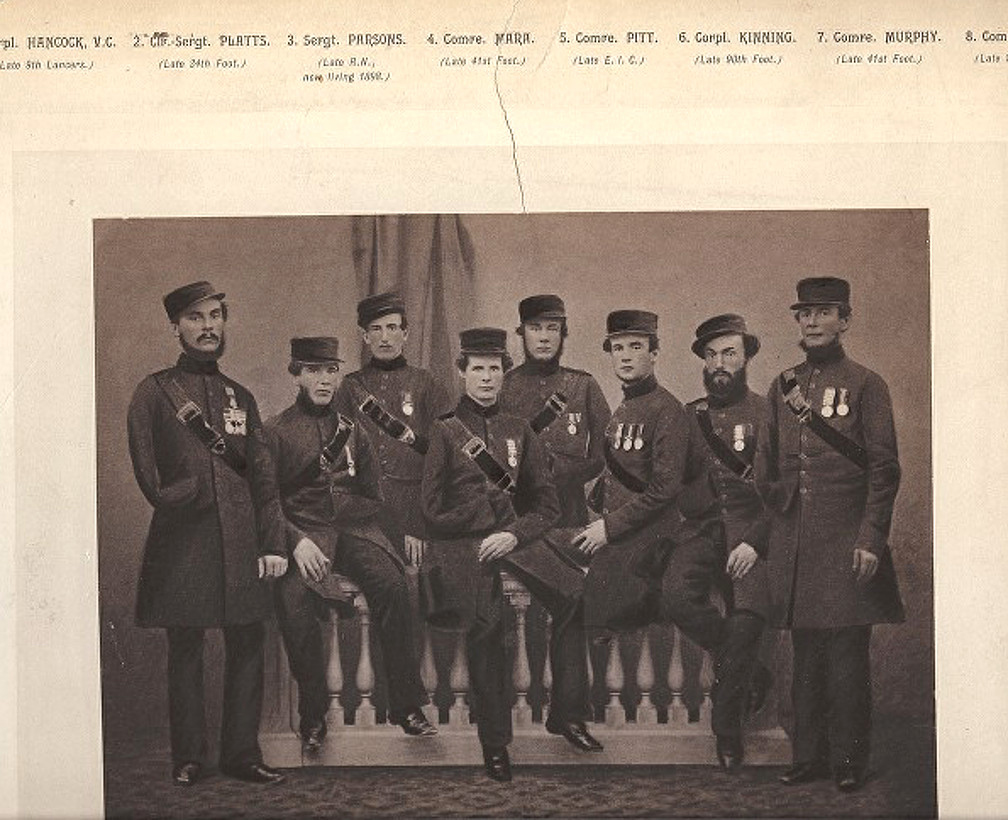
The letter brought a recommendation for the Order of Merit for Rupur Khan, and the Victoria Cross for Hancock and Purcell. Their citation was published in the London Gazette 15 Jan 1858 and Hancock was presented with his medal by the Queen at Buckingham Palace on 8 June 1859. But it was the end of his career as a soldier as his injury was so bad that his right arm had to be amputated. He found himself unemployed in London so wrote to Captain Sir Edward Walter who had recently set up the Corps of Commissionaires as a way to provide employment for ex-servicemen. The photo shows the original eight men of the Corps, all amputees. They all have campaign medals, and Hancock (far left), who had been promoted to corporal, has the VC medal above his medals for the Indian Mutiny, the Gwalior Star and the medals for the Sikh Wars.
Thomas Hancock was born in London in July 1822. He had joined the army as a trooper in the 3rd Light Dragoons in 1840, transferred to the 9th Lancers a year later, in time for the Battle of Punniar on 29 Dec 1843. He was also at the battles of Sobraon, Chillianwalah and Gujerat. His final years were sadly spent in the workhouse where he died on 12 march 1871. His grave in Brompton cemetery was unmarked but Brian Horton found it in a corner of the cemetery and organised a memorial stone in 2011.

