

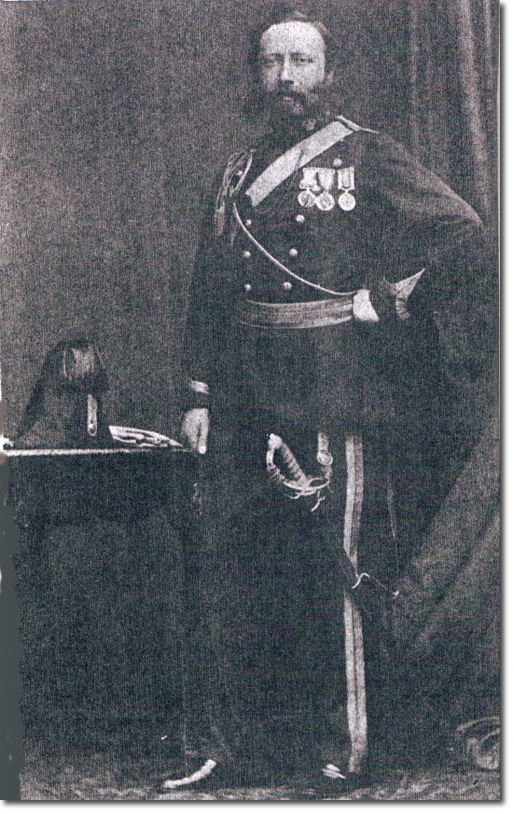
The 1864 Dress Regulations for officers states that The Paymaster, Quarter-Master, Surgeon, Assistant Surgeon, and Veterinary Surgeon, to wear the same uniform as the other officers, except that they wear instead of a lance-cap, a cocked hat, with bullion tassels, and a gold loop, one and three eighths inches wide, formed of four rows of gold gimp chain, with regimental button.
The Quarter-Master wears a white feather drooping 5 inches. The Surgeon and Assistant Surgeon, wear a feather of black cock’s tail of same pattern. The Veterinary Surgeon, red feather. The Paymaster no feather.
The Surgeon and Assistant Surgeon to wear also a black morocco shoulder-belt, with a small case for instruments according to pattern, instead of the regimental pouch and belt. The Veterinary Surgeon a white shoulder belt and black instrument case.
The Assistant Surgeon in this photo is George Carleton Clery who after his medical training joined the army on 13 Oct 1854. He served in the Crimea with the 17th Lancers, from 11 Nov 1854 to 11 Feb 1855. He was with the 17th Lancers in the Indian Mutiny campaign including the pursuit of Tantia Topi and actions at Raghur, Mongrowlie, Sindwaho, Koorwye and Zeerapore. He has three medals; a Crimea medal with a clasp for SEBASTOPOL, a Turkish medal, and a medal for the Indian Mutiny.
He wears the uniform of the 9th Lancers which he joined in 1860. He has a rank badge on his collar of an embroidered crown which denoted the rank of lieutenant. He wears the regimental gold pouch-belt which contravenes the Regulations. Although he has a cocked hat with black feathers he still has gold cord cap-lines. His gloves are on the table; they look like white gauntlets. He has a sword slung from a waist-belt worn under the blue tunic.

