

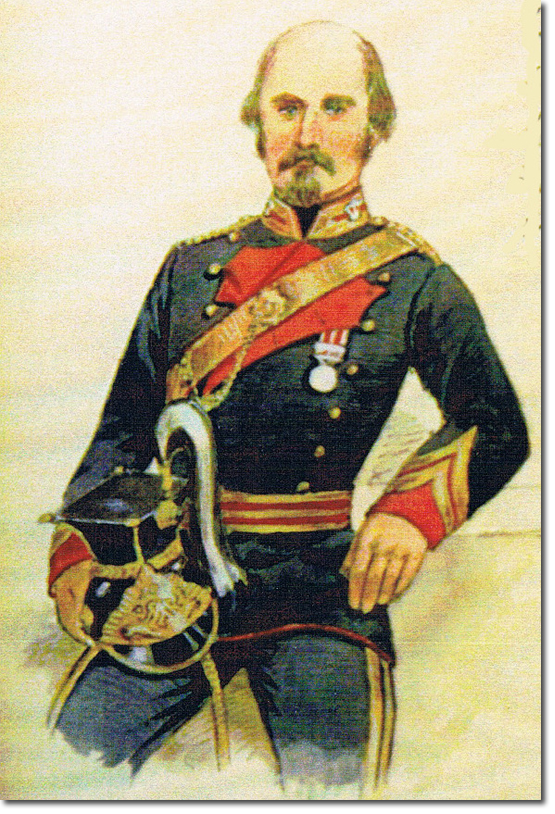
The radical change of uniform that took place in the army in 1855 did not affect the 9th Lancers until after they returned from India in 1859. The skirted tunic replaced the coatee so that the expensive gold epaulettes were redundant. The tunic was double-breasted with scarlet on the inside of the lapels so that in dress uniform these were turned back to form a plastron, last worn in dress uniform in 1827. The initial shape of the plastron was asymmetrical, as seen here; the tunic buttoned up with the lower three buttons, the top four left open. The lapels don’t appear to be buttoned back in this illustration but a tunic owned by Captain Robert Buckley who was an officer of the 9th Lancers from 1859 to 1862, has similar lapels but secured to the second button on each side.
This illustration is by P W Reynolds copied from a photograph of Brevet Lieutenant-Colonel William Drysdale. That, and other photos of him, show the lapels unattached to buttons. The photo shows him as a field officer i.e. above the rank of captain; he has two rows of gold lace on his pointed cuff, and the collar has gold lace on the top and lower edge leaving only a thin showing of scarlet facing. He has an embroidered crown rank badge on each side which according to the 1861 Dress Regulations signified the rank of lieutenant-colonel. Drysdale was appointed brevet lieutenant-colonel on 20 July 1858 and full lieutenant-colonel on 24 May 1861. The photo on which this is based was taken soon after the return from India, and after he received his new uniform, in 1860, when he wore only one medal for his service in the Indian Mutiny. He was entitled to many other medals for his service since 1835, which appear on a later photo.
The blue tunic has an edging of red piping down the front which would be more apparent when the lapel was buttoned over in marching order. The edging followed the hem and was on the back seams and the back of the sleeves. The shoulders have twisted gold cords with small buttons near the neck. There were also two small buttons near the cuff, just above the gold lace. A gold and crimson girdle was retained from the former uniform, and the sword was slung from a hidden belt under the tunic. There was no sabretache at this stage. The all-gold pouch-belt remained the same as before. The lance-cap was smaller but retained the distinctive pattern for the 9th Lancers, with gilt metal ornaments. However, the plume was now black and white. And initially, of horsehair. The cock feather plume was restored unofficially a few years later. There are no cap-lines in this illustration.

